DATA DELUGE PRESAGES REVOLUTION, SAYS SCIENCE SECTOR
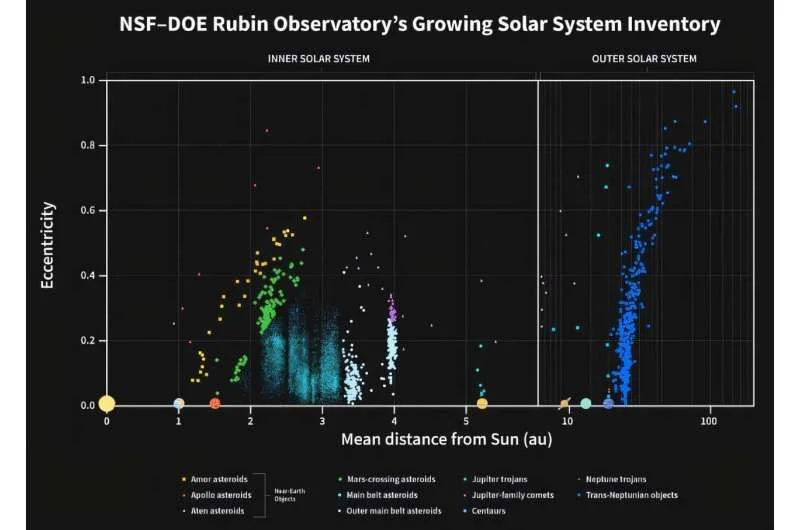
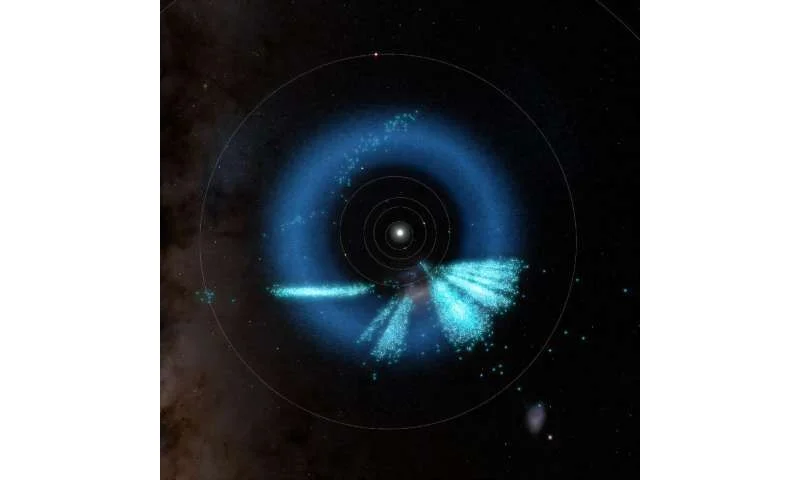
The 'NSF–DOE Vera C. Rubin Observatory' has churned out an initial preliminary output of over 11,000 newly identified asteroids. This prodigious number, drawn from what are described as "early optimization surveys," marks the observatory's most substantial asteroid discovery cache to date, predating its official, decade-long 'Legacy Survey of Space and Time' (LSST). The raw data processing was reportedly handled by sophisticated software developed at the 'University of Washington’s Data-Intensive Research in Astrophysics and Cosmology (DiRAC) Institute'.
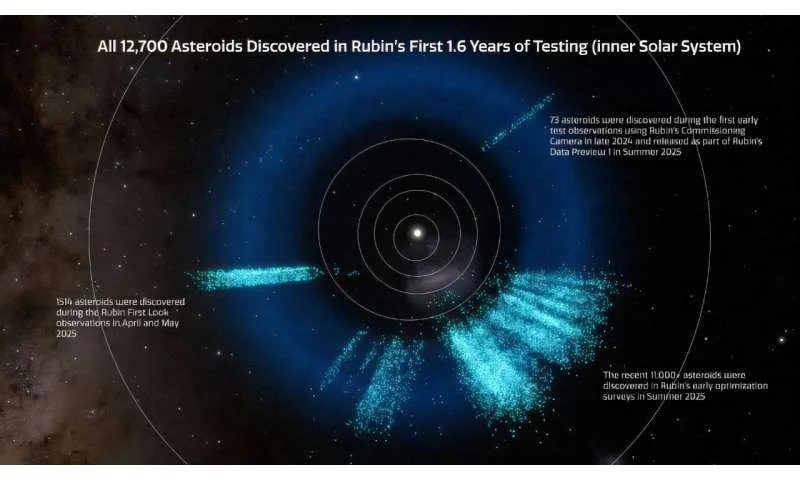
The observatory's early performance is framed by its proponents as a harbinger of a profound shift in our understanding of the solar system. Scientists involved assert that these discoveries, even in their nascent stage, provide crucial data points for refining orbital mechanics and potentially illuminating the distribution of celestial bodies in the solar system's farther reaches.
Read More: JWST Finds Oldest Barred Spiral Galaxy M1149-BSG-z5
PROBING THE PERIPHERY AND THE PLANET NINE SPECULATION
The identified objects are said to offer insights into the early dynamics of planetary formation. More speculatively, the data's capacity to detect distant solar system objects has fueled discussions about the possible existence of a ninth large planet, a hypothetical body often referred to as 'Planet Nine' or 'Planet X'. Algorithms developed by researchers like Kevin Napier of the 'Harvard-Smithsonian Center for Astrophysics', in conjunction with Mario Juric, the 'Rubin Solar System Lead Scientist' at the 'University of Washington', are credited with enabling these deep-sky probes.
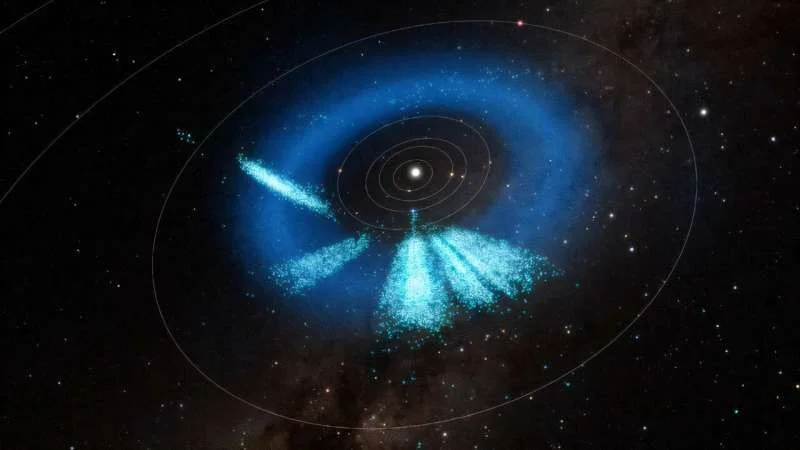
The full catalog of these nascent discoveries is purportedly accessible via a 'Rubin Asteroid Discoveries Dashboard' and a 'Rubin Orbitviewer', allowing for further examination by interested parties.
INSTITUTIONAL AND TECHNOLOGICAL ROOTS
This burgeoning asteroid census is deeply intertwined with the technological architecture underpinning the Rubin Observatory. Ari Heinze, a researcher at the 'University of Washington', alongside graduate student Jacob Kurlander, is cited for designing a novel software framework specifically tailored to the observatory's unique observation schedule, a crucial element for its advanced asteroid detection capabilities.
Read More: Indigenous Data Rights Now Key in Conservation Genomics
Beyond the primary discoveries, the observatory's early data has also yielded more precise orbital measurements for tens of thousands of previously cataloged asteroids. While the exact nature and implications of these findings are still being parsed, the sheer volume of incoming information suggests a significant expansion of the known celestial inventory.
INSTITUTIONAL PROMINENCE
The project involves a consortium of research entities. Key figures and institutions associated with this initial asteroid haul include researchers from the 'University of Washington' (such as Pedro Bernardinelli, now at the 'Institute for Astronomy, Geophysics and Atmospheric Sciences of the University of São Paulo'; Joachim Moeyens, a 'UW research software engineer' and 'B612 Asteroid Institute' team member; and Siegfried Eggl, formerly of the 'University of Illinois Urbana-Champagne'), as well as 'Princeton University' ('Erfan Nourbakhsh'). Public inquiries are directed towards [email protected] for the scientific lead and [email protected] for public information from 'NSF NOIRLab'.
Read More: Astronomers' discoveries about comets and cosmic background radiation explained