A peculiar imbalance in the cosmos – the overwhelming abundance of matter over antimatter – is prompting renewed consideration of a radical idea: that the universe's very existence, in its current form, might be due to primordial black holes preferentially consuming antimatter shortly after the Big Bang. This theoretical framework, championed by physicist Nikodem Poplawski, posits that these early cosmic entities, born from extreme density fluctuations, acted as cosmic vacuum cleaners, mopping up the universe's antimatter and thereby paving the way for a matter-dominated existence.
The core of this proposition hinges on the idea that some subtle, early-universe mechanism favored the annihilation or sequestration of antimatter. If antimatter particles were indeed heavier or slower than their matter counterparts during pair production in the nascent universe, this could create an asymmetry. Poplawski's research suggests that such an initial imbalance, amplified by the consumption of antimatter by hypothetical primordial black holes, could explain the stark absence of antimatter today. This offers a potentially elegant solution to a long-standing cosmological puzzle.
Read More: Indigenous Data Rights Now Key in Conservation Genomics
The Enigma of Antimatter's Absence
Scientists grapple with a fundamental question: why is the observable universe so overwhelmingly composed of matter, with antimatter being exceedingly rare? Current understanding offers a few scenarios, each with its own difficulties. One posits that the universe simply began with more matter than antimatter, with most antimatter subsequently annihilating into energy. Another suggests an equal initial distribution, with an unknown process subsequently skewing the balance. A less considered possibility is that antimatter was initially more abundant, with the ratio somehow reversing.
The observable evidence offers little support for significant quantities of antimatter existing independently. The theoretical presence of antimatter galaxies would, upon interaction with matter galaxies, produce colossal energy signatures and observable annihilation byproducts – phenomena that have not been detected. Therefore, the assumption remains that the vast majority of cosmic mass is indeed matter.
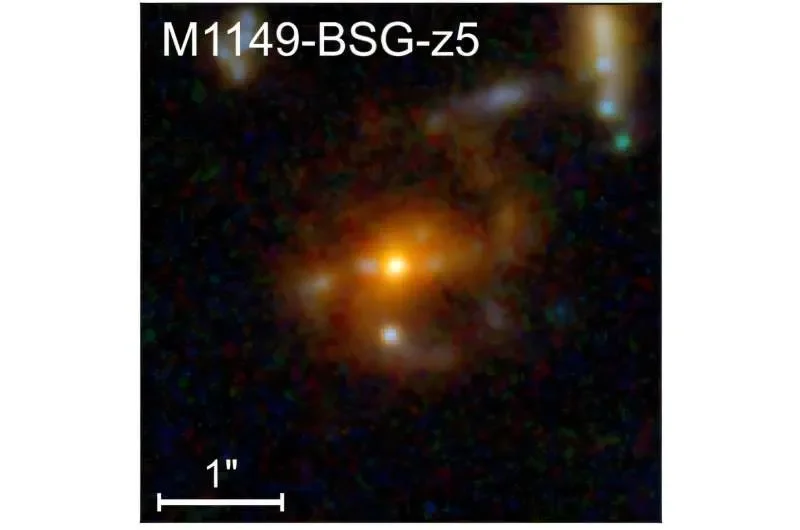
Read More: JWST Finds Oldest Barred Spiral Galaxy M1149-BSG-z5
Primordial Black Holes as Cosmic Regulators
The concept of primordial black holes is central to Poplawski's theory. These are not the stellar black holes formed from collapsed stars, but hypothetical entities that could have formed in the extremely dense conditions of the very early universe.
The James Webb Space Telescope's observations have noted surprisingly massive black holes appearing relatively early in cosmic history, lending some observational context to the idea of early black hole formation.
However, a significant hurdle remains: proving the actual existence of these primordial black holes, as they are currently purely theoretical constructs.
Poplawski theorizes that if these early black holes were indeed present, they might have preferentially consumed heavier antimatter particles. This differential consumption could have accelerated their growth beyond what might be expected from matter alone.
What Constitutes an Antimatter Black Hole?
Extrapolating from our understanding of matter, theoretical discussions consider what an "antimatter black hole" might entail. At a fundamental level, such entities are predicted to share many properties with their matter counterparts.
An antimatter black hole would likely possess the same mass, size, and gravitational influence as a matter black hole of equivalent characteristics.
Differences, if any, are expected to be subtle, potentially manifesting at the quantum level.
The speculative scenario of a matter black hole merging with an antimatter black hole raises questions about annihilation. However, current physics suggests they would behave gravitationally the same, with their internal composition not leading to mutual destruction upon merger in the same way as particle-level annihilation.
Background and Context
The universe's matter-antimatter asymmetry remains one of cosmology's most profound mysteries. Since the discovery of antimatter, physicists have sought to reconcile its theoretical existence and equal production with its apparent near-total absence in the observable universe. While many theories explore particle physics at the quantum level, Poplawski's work revisits the role of macroscopic structures – specifically, early black holes – as potential agents in resolving this cosmic puzzle. The implications of such a theory are vast, touching upon the very conditions that allowed for the formation of stars, galaxies, and ultimately, life.
Read More: New Room Temperature Photon Source for Quantum Tech in Korea