An exceptionally rare star, identified with remarkably low levels of elements heavier than hydrogen and helium, offers astronomers an unprecedented glimpse into the universe's nascent stages. This celestial object, designated GDR3_526285, exhibits an extreme deficiency not only in iron but also, crucially, in carbon, setting it apart from previously identified "pristine" stars. Its discovery, detailed in Nature Astronomy and other reports, has significant implications for understanding the formation of the first stars and galaxies.

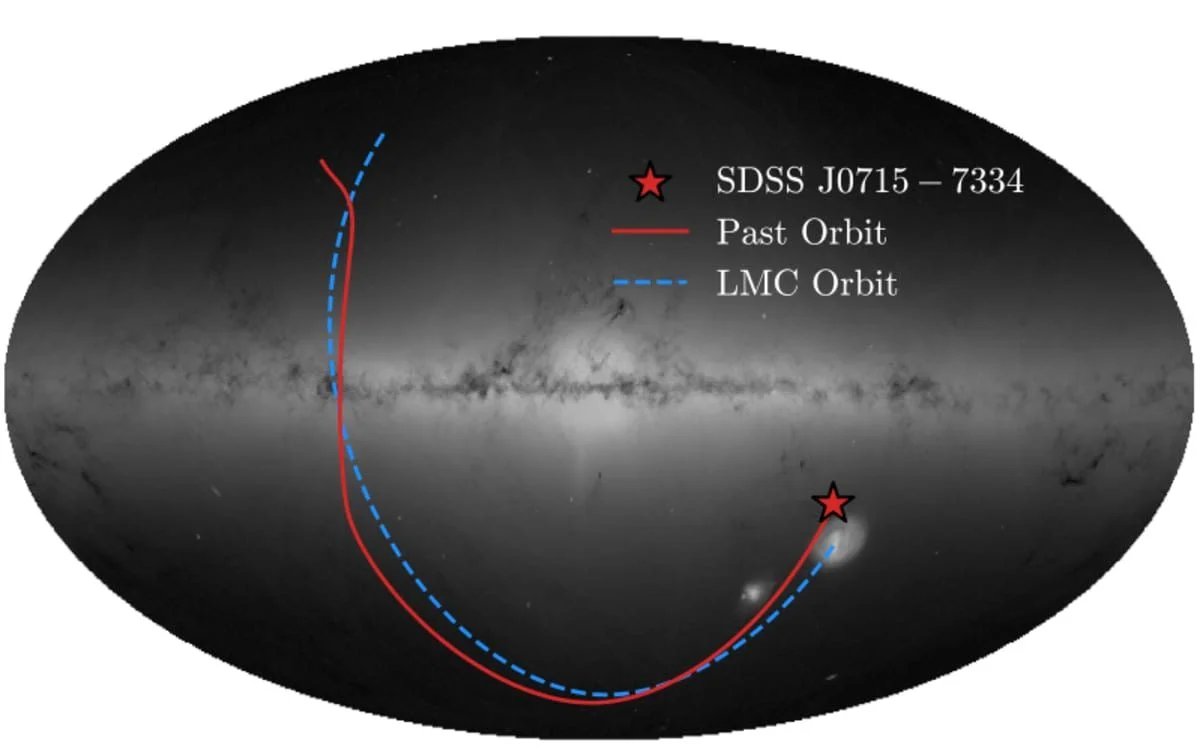
The star's origin has been traced to the Large Magellanic Cloud (LMC) using Gaia data and orbital modeling. This location, outside the Milky Way, is noteworthy. Unlike other ultra-metal-poor stars that still retained a discernible amount of carbon, GDR3_526285 presents a near-absence of this element. This characteristic is significant because carbon plays a vital role in cooling processes that are believed to be essential for the formation of stars with such low metallicity. The du Pont telescope at Carnegie Science's Las Campanas Observatory, employing the MIKE spectrograph, was instrumental in this discovery.
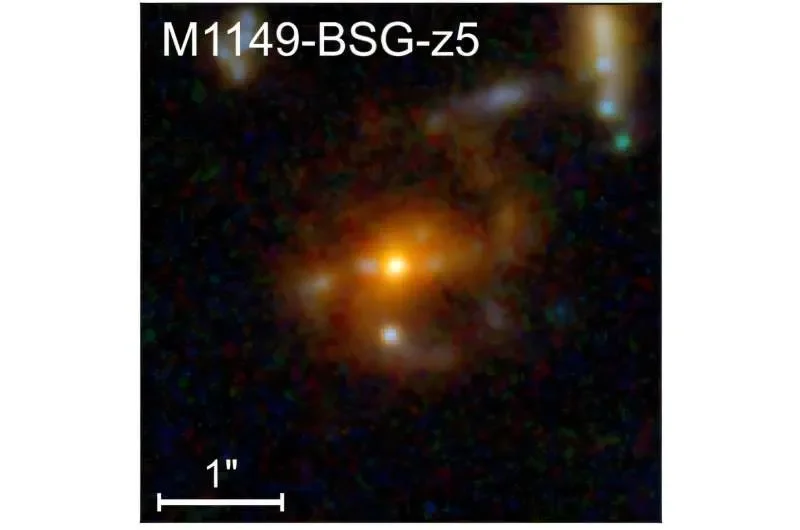
Read More: JWST Finds Oldest Barred Spiral Galaxy M1149-BSG-z5
EARLY UNIVERSE FORMATION UNDER SCRUTINY
The implications of this discovery extend to models of cosmic evolution. The extreme low metallicity, particularly the scarcity of carbon, suggests that 'dust cooling' mechanisms, aided by cosmic dust, may be a prerequisite for the formation of stars at this metal-poor threshold. This process appears to occur not only in the early universe but also within galaxies beyond our own Milky Way. The finding provides new constraints on theories about how the very first stars, known as Population III stars, came into being. These early stars, theorized to be massive, hot, and short-lived, were composed primarily of hydrogen and helium, with only trace amounts of lithium, as heavier elements were synthesized only later.
Read More: US Space Force Victus Haze Mission Successfully Tests Orbital Intercepts

A COSMIC RELIC
The newly identified star is a relic from a time when the universe was considerably less chemically enriched. After the Big Bang, the cosmos was predominantly filled with hydrogen and helium. Heavier elements, such as carbon and iron, were forged within the cores of stars and dispersed through supernova explosions. Each subsequent generation of stars inherited and further processed these elements, leading to an increasing metallicity over cosmic time. Stars like GDR3_526285, with their elemental compositions mirroring the early universe, allow researchers to probe conditions before this 'cosmic alchemy' became widespread. Its metallicity is far lower than that of previously cataloged metal-poor stars, including those found within the Milky Way's halo.
INSTRUMENTATION AND OBSERVATION
The identification relied on detailed chemical abundance analyses of a sample of metal-poor stars, including the examination of 190 metal-poor stars and providing detailed abundances for 313 metal-poor stars. Observations were conducted using advanced spectrographs on powerful telescopes. The Magellan telescopes at Carnegie Science's Las Campanas Observatory in Chile played a key role in these astronomical investigations.
Read More: Astronomers' discoveries about comets and cosmic background radiation explained
METALLICITY AND ITS SIGNIFICANCE
Metallicity, in astronomical terms, refers to the abundance of elements heavier than hydrogen and helium in a celestial object. Iron, for instance, is often used as a proxy for overall metallicity due to its relative ease of detection. However, the absence of carbon is proving to be a critical differentiator for stars like GDR3_526285. While other extremely metal-poor stars still possess a notable carbon content, this star's near-complete lack of it poses new questions for formation models. Its metallicity is contrasted with the next lowest known star, which has a total metallicity of approximately 1.4 × 10^-6.
Read More: Magnetic Fields Help Binary Stars Form Faster, New Study Shows