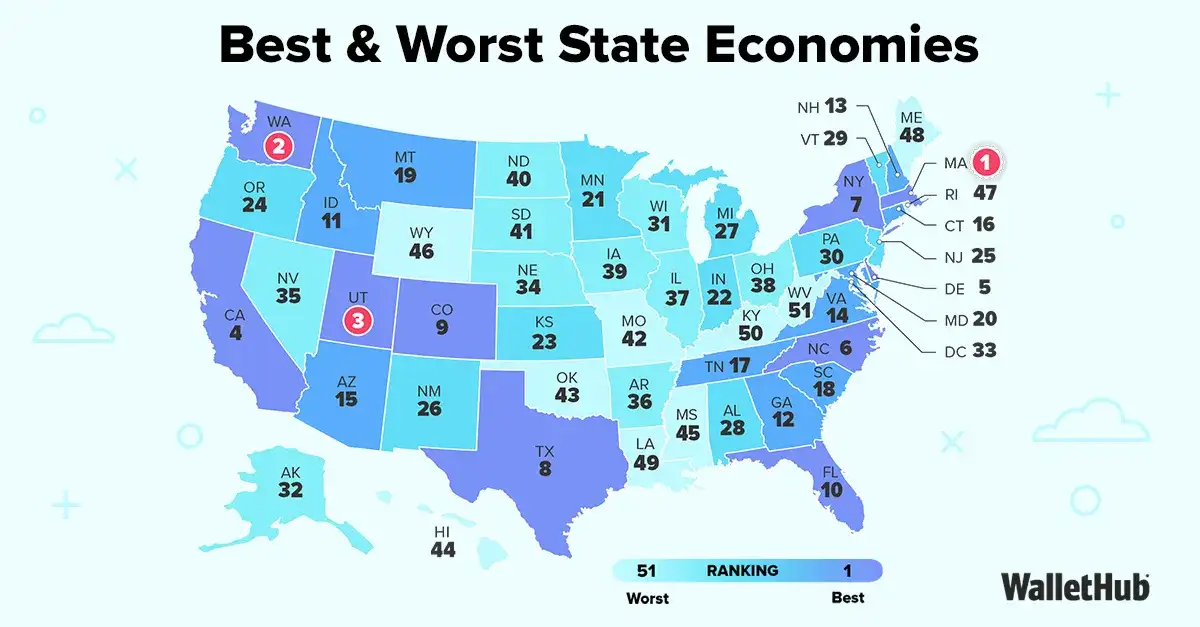
Recent analyses of state economic landscapes reveal Massachusetts at the forefront, securing the top position in overall economic standing. This assessment, derived from studies examining metrics across economic activity, health, and innovation potential, highlights a complex national picture where states exhibit markedly different strengths and weaknesses.

The core of these rankings hinges on WalletHub's comprehensive evaluation, which scrutinizes various economic indicators. These include factors like the rate of new business establishments, shares of jobs in high-tech and STEM fields, patent generation by independent inventors, and industry research and development investment. Other critical components influencing these rankings involve state gross public debt relative to GDP, export volumes per capita, and building permit activity, a measure of new residential construction.

While Massachusetts claims the overall lead, other states show considerable strength in specific categories. For instance, Utah is noted for its robust economic activity, having previously been recognized in other economic competitiveness indexes. New Hampshire also features prominently, particularly in discussions of economic health and innovation.
Read More: Goldman Sachs predicts 15 million US jobs lost to AI by 2036

Conversely, states like West Virginia and Mississippi consistently appear at the lower end of these economic assessments. Their positions are often influenced by weaker performance across multiple evaluated dimensions, including fiscal stability, healthcare infrastructure, and educational outcomes.

The methodology employed by WalletHub, as detailed in their report, assigns significant weight to various sub-metrics. For example, "Startup Activity" and "Exports per Capita" are given full weighting, as are metrics within the "Innovation Potential" dimension, such as "Share of Jobs in High-Tech Industries" and "Independent Inventor Patents per 1,000 Working-Age Population."
Other reports, like one from AOL, offer granular rankings for individual states across economic activity, economic health, and innovation potential. These provide a more detailed view, showing how a state like North Carolina ranks 9th in economic activity, 8th in economic health, and 9th in innovation potential, demonstrating a generally strong but varied profile. Meanwhile, states like North Dakota exhibit a different pattern, appearing further down the overall list but with specific strengths, such as high rankings in infrastructure and fiscal stability in some analyses.
Read More: US 250th Anniversary on July 7, 2026, sees 20% not celebrating
These assessments, published recently and drawing data from studies conducted across 2025 and 2026, paint a picture of a dynamic and uneven economic terrain across the United States. The rankings underscore the multifaceted nature of economic success, where a state's position can be influenced by a combination of innovative industries, fiscal prudence, and infrastructure development.