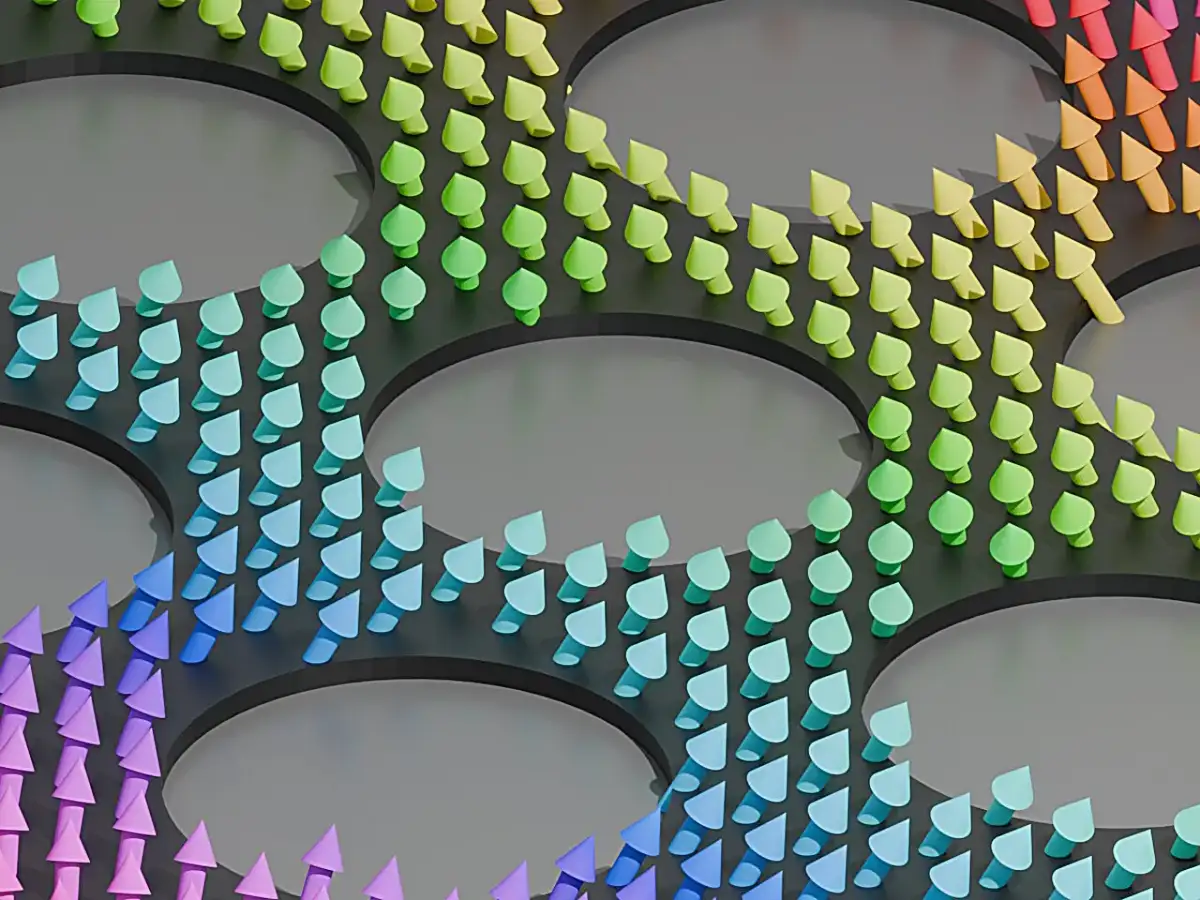
Researchers at the University of Illinois Urbana-Champaign have engineered magnetic films that exhibit behaviors described by the same mathematical equations governing massless electron waves in 'graphene'. This discovery collapses what was previously thought to be a distinct divide between electronic and magnetic phenomena in two-dimensional materials.
The core finding is that specific magnetic systems, when structured in two dimensions, can be made to follow the 'Dirac equation', the same equation that describes how electrons move in graphene without mass. This allows for the simultaneous existence of various wave behaviors, including massless spin waves (analogous to graphene's electron waves), localized states with little energy dispersion, and even topological effects.
A Shared Mathematical Language
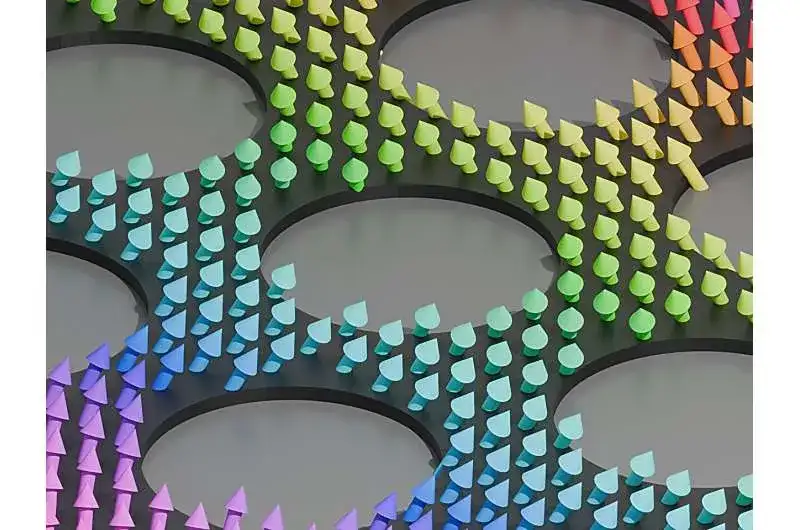
Traditionally, the properties of electrons and magnetic spins were considered separate realms. However, this new work, published in 'Physical Review X', demonstrates a shared 'mathematical language' between these two domains. The engineered magnetic films, a form of 'magnonic crystals' or 'metamaterials', were designed to emulate the electronic band structure of graphene.
Read More: HKUST Scientists Discover How DICER Enzyme Cuts RNA With High Precision in 2024
This unification holds significant implications for 'spintronics' and 'microwave technology'. The ability to engineer magnetic spin waves ('magnons') to behave like electrons in graphene opens doors for advancements in 'wireless communication devices' and other electronic applications.

Uncovering Complex Behaviors
The researchers identified nine distinct energy bands within these engineered magnetic systems. This multiplicity of bands allows for a richer array of physical phenomena to occur concurrently. The identified behaviors range from the propagation of massless spin waves, reminiscent of the charge carriers in graphene, to bands that suggest localized states and the presence of 'topological effects'. These effects could offer new ways to control and manipulate magnonic devices.
The study's foundation lies in emulating 'two-dimensional electronic properties' using engineered magnetic spin systems. This breakthrough extends the concept beyond electron behavior to magnetic 'spin waves', showcasing how these excitations can precisely mimic graphene's electronic band structure.
Read More: Linux users struggle to get older AMD GPUs working with new drivers



.jpg)