Recent analyses, particularly those surfacing on platforms like Aeon, suggest a critical re-evaluation of how we frame ecological breakdowns. The dominant narrative of impending catastrophe, while not entirely without basis, risks oversimplifying a deeply intricate web of environmental degradation. Instead of a singular, monolithic "eco-failure," the discourse is shifting towards understanding a more fragmented and multifaceted unraveling of natural systems.
The prevailing model of climate catastrophe, predicated on immense complexity, proves inherently difficult to accurately forecast. This intricate dance of the climate system means that simplistic, doom-laden pronouncements may obscure more than they reveal. This perspective challenges the notion of a single, predictable "eco-failure," pushing instead for an understanding that acknowledges the "immense complexity of the climate [making] it impossible to model accurately." This complexity is not merely an academic quibble; it underpins the very notion of "radical uncertainty" now pervading global economies due to uninsurable regions.
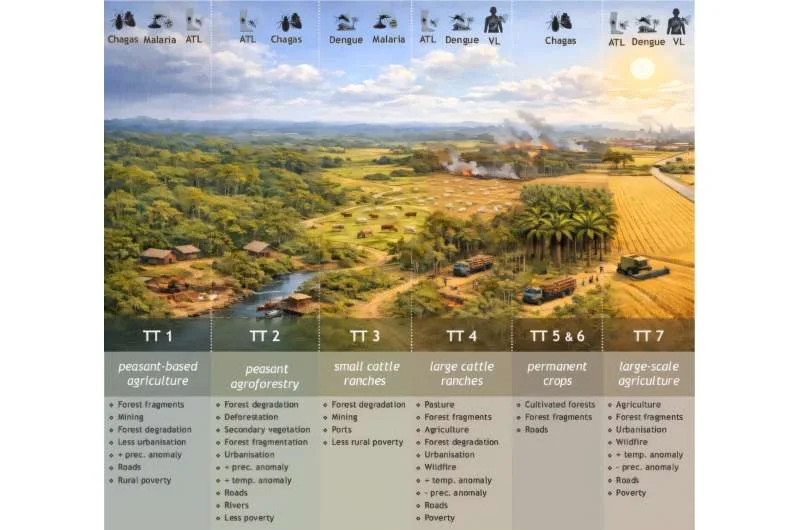
Read More: Amazon Land Use Changes Cause Disease Clusters in Brazil
Environmental Degradation: A Patchwork of Crises
While the specter of widespread ecosystem collapse looms, the evidence points to a more granular, yet equally concerning, reality. Human actions have demonstrably fractured ancient cycles, such as the vital circulation of phosphorus, a life-giving element "stored in rock and organic material." This disruption leads to the documented demise of "countless species from human-induced environmental change."

The essays explore specific instances and implications:
Phosphorus Cycle Disruption: The breakdown of ancient Earth cycles, particularly the phosphorus cycle, is highlighted as a critical factor.
Species Extinction: The loss of "countless species" is directly linked to "human-induced environmental change."
Geological Instability: The awakening of "sleeping volcanoes" serves as a potent, albeit metaphorical, reminder of Earth's inherent, and potentially volatile, dynamism.
Shifting the Paradigm: Uncertainty as a Tool
Instead of succumbing to predictive models that forecast inevitable doom, a counter-argument emerges: embracing uncertainty as a strategic advantage. This reframing suggests that "we must use uncertainty to our advantage" rather than viewing it solely as a harbinger of failure.
This intellectual pivot has broader implications:
Challenging "Zombie Ideas": The persistence of certain environmental "prejudices" necessitates a more rigorous ethical examination, particularly when neat ethical principles falter against the "brutal, bloody compromises of hospital life," as an analogy might suggest.
Redefining Life and Death: Emerging "technologies of preserving and reviving organisms" are already blurring the lines, prompting a reconsideration of the very definitions of "life, death, and extinction itself."
The Human Element in Ecology: The focus extends to how various life forms, from birds to insects, navigate their environments and reproductive cycles, underscoring the interconnectedness and inherent struggles within ecosystems. Examples include the artistry of taxidermy, the leafcutter ant's architecture, and the long journey of migrating seabirds.
A Deeper Cultural and Philosophical Context
The discourse surrounding environmental issues is also being interrogated through a wider philosophical and cultural lens. This includes questioning anthropocentric views and exploring deeper connections between humanity and the natural world.
Read More: Indigenous Data Rights Now Key in Conservation Genomics
"We Are Nature": The idea that even the "Anthropocene is nature at work transforming itself" suggests a less oppositional stance and a more integrated understanding of human impact.
The Role of Culture in Emotion: Drawing on figures like Franz Boas, the essays probe whether our emotional responses to environmental issues are innate or culturally constructed.
Ethical Stance: The question of how individuals find "moral courage to defy convention" when ethical beliefs are rooted in social environments is explored, suggesting that solutions may lie not in eliminating distractions but in addressing a fundamental "design problem."
This expansive approach, encompassing scientific, philosophical, and ethical dimensions, calls for a more nuanced and adaptable response to the complex challenges facing our planet.