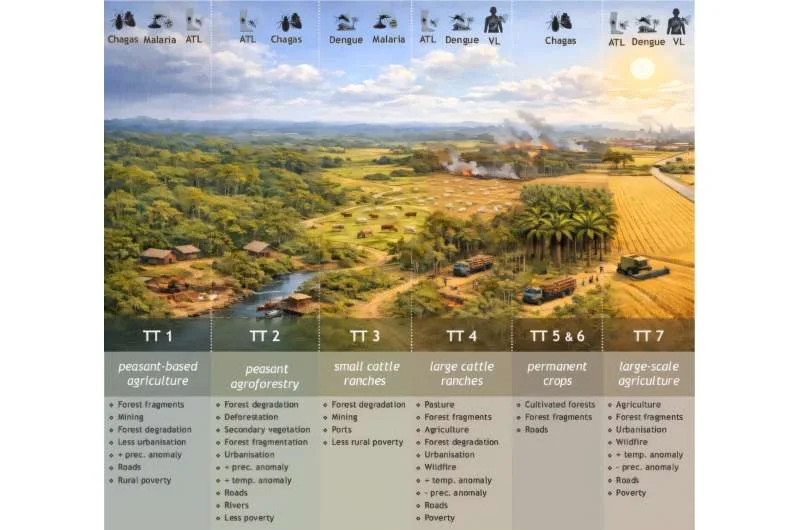
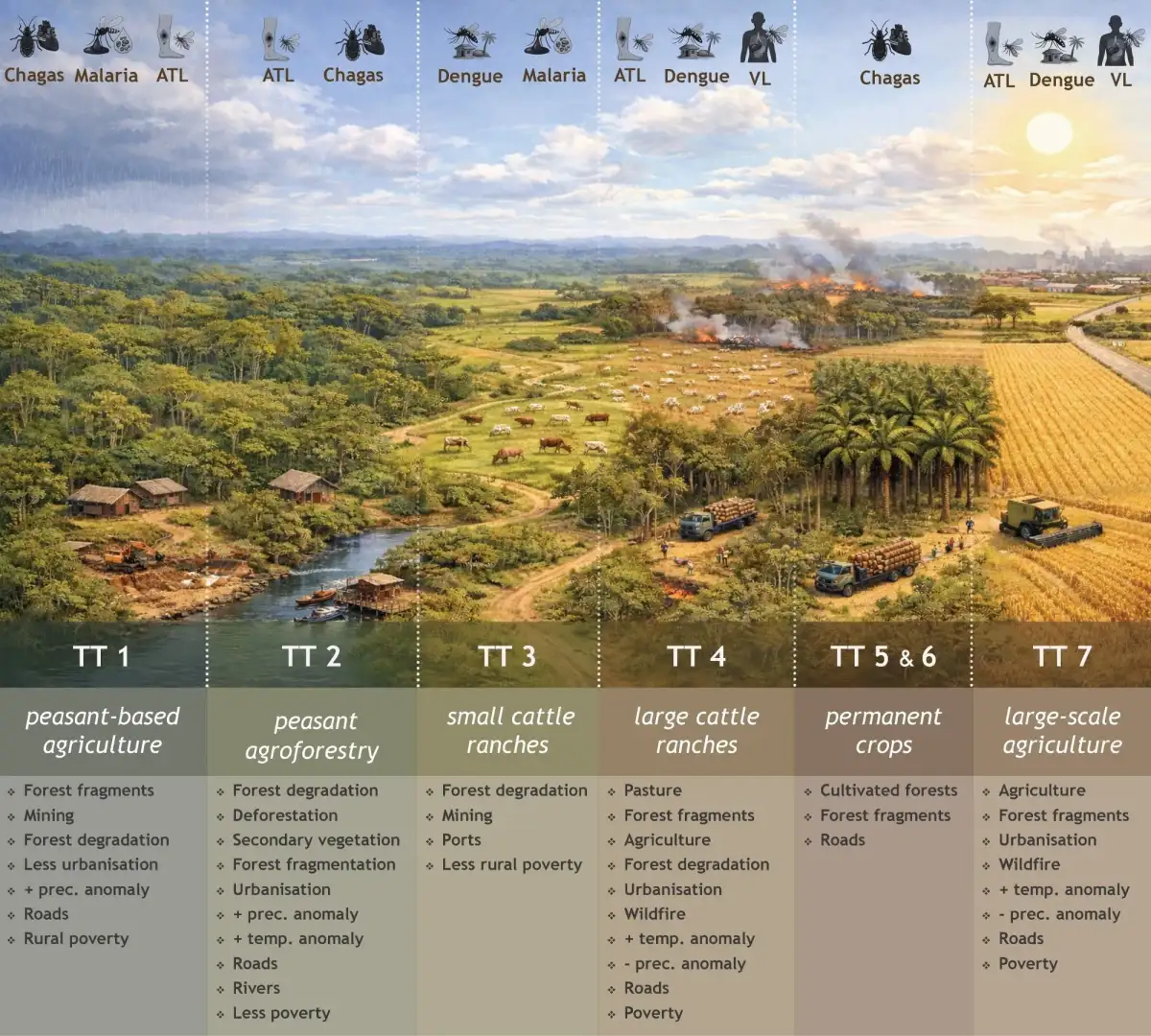
Current data from the Brazilian Amazon indicates that the distribution of insect-borne illnesses is not random but follows distinct patterns dictated by =human economic activity and land alteration=. Research published across multiple platforms in June and July 2026 demonstrates that =vector-borne disease (VBD) clustering aligns directly with how landscapes are manipulated—from mining and cattle ranching to urban expansion.==
Visceral leishmaniasis remains distinct from other diseases, tethering itself to zones of urban poverty, climate instability, and intensive cattle-linked economies.
Chagas disease exhibits a bifurcated profile: rural instances correlate with river networks and secondary forest regrowth, while urban instances map to mining sites, fragmented forest zones, and agricultural encroachment.
"The Amazon should be seen as a mosaic of different socio-environmental systems," says Claudia Codeço, highlighting that medical intervention alone cannot solve the contagion landscape.
| Disease Cluster | Primary Drivers | Economic Context |
|---|---|---|
| Visceral Leishmaniasis | Environmental disruption, fires | Urban poverty / Cattle ranching |
| Rural Chagas | Secondary vegetation, river flow | Subsistence / Rural expansion |
| Urban Chagas | Forest fragmentation, mining | Large-scale agriculture / Mining |
Socio-Economic Architecture as a Vector
Lead author Dr. Milton Barbosa of the Federal University of Minas Gerais (UFMG) argues that the health of the population is a secondary product of regional Land Use and development policies. The findings suggest that when Agrarian Expansion moves forward without regard for the surrounding Socioenvironmental context, the risk of multiple diseases occupying the same space increases.
Investigating the Epidemiological Mosaic
For decades, the Amazon was viewed through a purely biological lens, yet these recent reports frame the jungle as an active socio-economic construct. The correlation between high deforestation and the simultaneous emergence of urban and rural Chagas cases within single municipalities suggests that the barrier between 'wild' disease cycles and 'city' disease cycles is thinning.
Read More: India IVF Costs And Social Barriers Limit Access In April 2026
Policy frameworks that fail to address the underlying economic drivers—specifically the link between industrial mining and forest degradation—may be overlooking the root causes of current Epidemiological trends. By prioritizing "eco-health" integrated policies, observers note a potential shift away from reactive medicine toward systemic environmental management. The evidence suggests that as the forest fragmentizes, the pathogens that thrive on that instability move closer to the populations least equipped to mitigate the fallout.