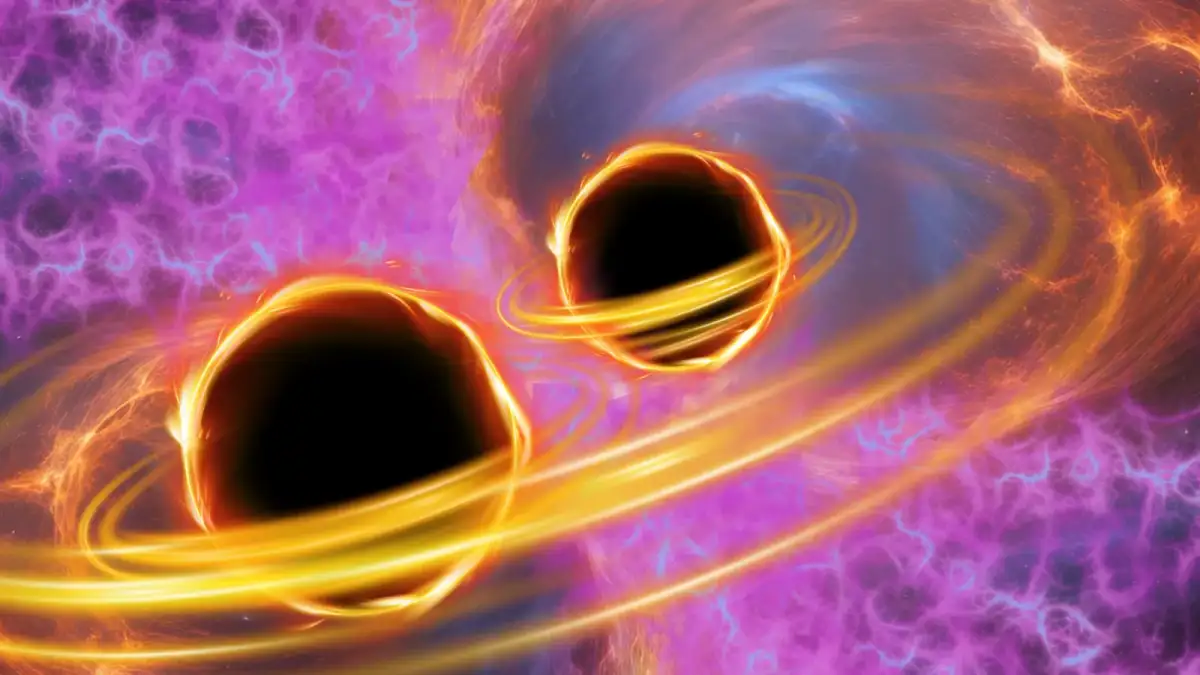
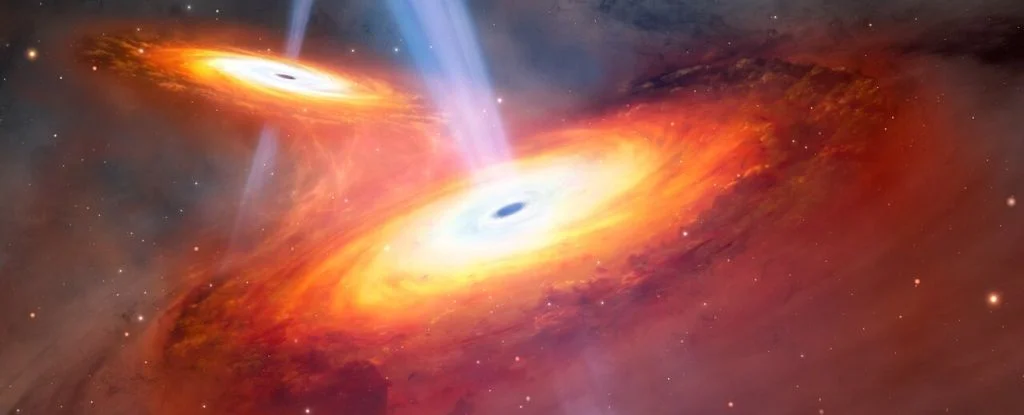
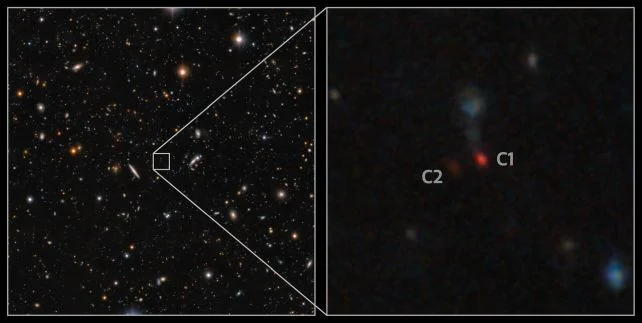
Astronomers have directly observed a rare spectacle: two intensely bright quasars, situated in merging galaxies, locked in a cosmic dance from the universe's nascent stages. Using the Atacama Large Millimeter/submillimeter Array (ALMA), researchers have confirmed a close pair of quasars, designated J2037–4537, observed at a redshift of 5.7, placing them within the universe's first billion years. This system represents one of only two confirmed quasar pairs found at such a high redshift, a period known as the 'Cosmic Dawn'. The host galaxies themselves are identified as massive, rapid star-forming engines.
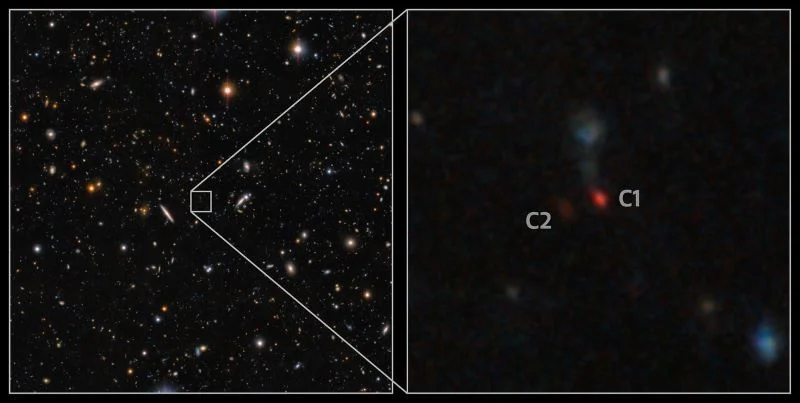
The visual evidence strongly suggests a tidal bridge of material connecting the two galaxies. This structure is believed to have formed as the galaxies’ mutual gravitational pull tore streams of gas and dust from each other during their prolonged merger. Such cosmic collisions are thought to funnel vast amounts of material towards the central supermassive black holes, igniting them into the luminous quasars observed. Critically, this tidal bridge structure effectively rules out alternative explanations, such as a single, gravitationally lensed quasar mimicking a dual image.
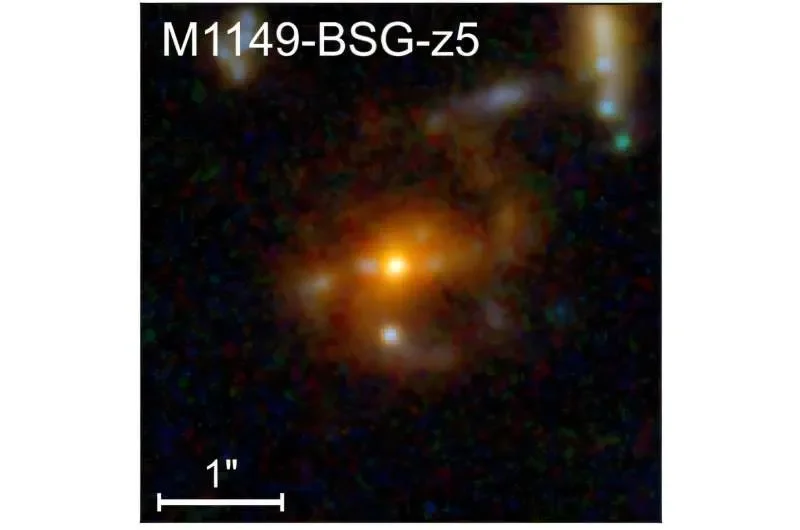
Read More: JWST Finds Oldest Barred Spiral Galaxy M1149-BSG-z5
Echoes from the Early Cosmos
The discovery of these dual quasars at such an early epoch (redshift 5.7) is significant. It provides concrete evidence that galaxies, and the supermassive black holes within them, were actively merging and growing even when the universe was less than a billion years old. While theories predicted the abundance of such dual black hole systems in the early universe, direct observational confirmation has been scarce.
The observed galaxies exhibit high star formation rates, exceeding 500 solar masses per year, indicating intense periods of stellar birth.
The phenomenon provides a potential source for the cosmic gravitational wave background.
These systems, though smaller and more compact than the Milky Way, are remarkably developed for their early cosmic era.
The Challenge of Detection
Detecting dual quasars is an exceptionally challenging endeavor. It requires both supermassive black holes within merging galaxies to be actively accreting matter and shining as quasars simultaneously. The statistical probability of this occurring is low; it's estimated that for every hundred supermassive black holes, only one is actively accreting at any given moment.
Previous observations have hinted at such phenomena. In 2023, using instruments including Gemini North and the Hubble Space Telescope, astronomers identified a pair of gravitationally bound quasars within merging galaxies from a slightly later epoch, when the universe was about three billion years old. The James Webb Space Telescope (JWST) has also been instrumental, with studies analyzing its data to explore the similarities between quasar pairs, even posing the question of whether some observed instances are indeed two distinct quasars or a single lensed object.
Read More: US Space Force Victus Haze Mission Successfully Tests Orbital Intercepts
The allure of these dual quasars lies in their potential to shed light on the formation and evolution of galaxies and supermassive black holes in the universe's formative years. As galaxies merge, so too do their central black holes, embarking on a slow, spiraling collision course over millions of years. The intense gravitational interactions funnel interstellar material, fueling the bright accretion disks that make quasars visible across vast cosmic distances. The identification of more such systems, potentially aided by future instruments like the Nancy Grace Roman Space Telescope, promises to further unravel the violent and dynamic processes that shaped the early cosmos.
Read More: Astronomers' discoveries about comets and cosmic background radiation explained