Recent findings derived from X-ray observations of the Perseus Cluster are forcing a significant re-evaluation of established theories concerning the chemical composition forged within supernovae. Specifically, data collected by the Hitomi telescope has unveiled discrepancies between predicted elemental abundances and those observed, particularly for silicon-group (Si, S, Ar, Ca) and iron-group (Cr, Mn, Ni) elements.
The core of the issue lies in how these stellar explosions are thought to create and distribute elements throughout the cosmos. Existing models, based on nucleosynthesis yields from massive stars, appear to fall short when directly compared to the precise chemical makeup of the Perseus Cluster. Researchers are now working to adjust these models, searching for specific supernova configurations that can better replicate the observed ratios. This suggests a fundamental need to rethink the metallicity-dependence of massive stars and their overall role in the universe's chemical enrichment history.
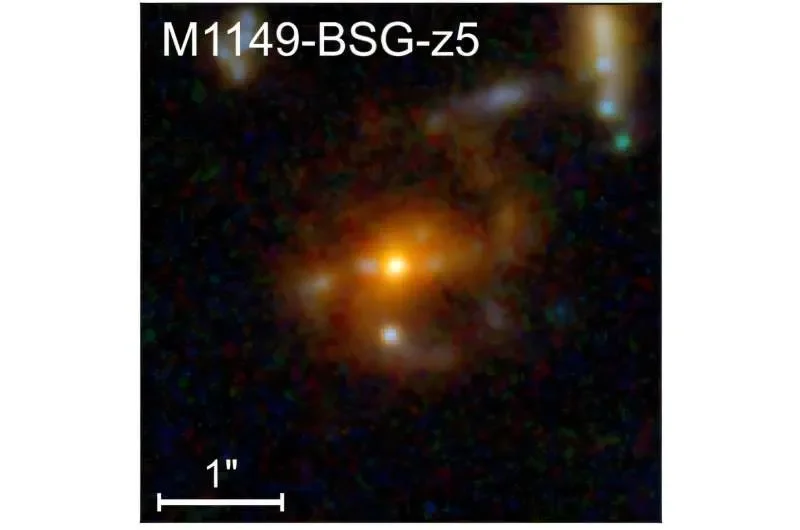
Read More: JWST Finds Oldest Barred Spiral Galaxy M1149-BSG-z5
Shifting the Narrative on Stellar Factories
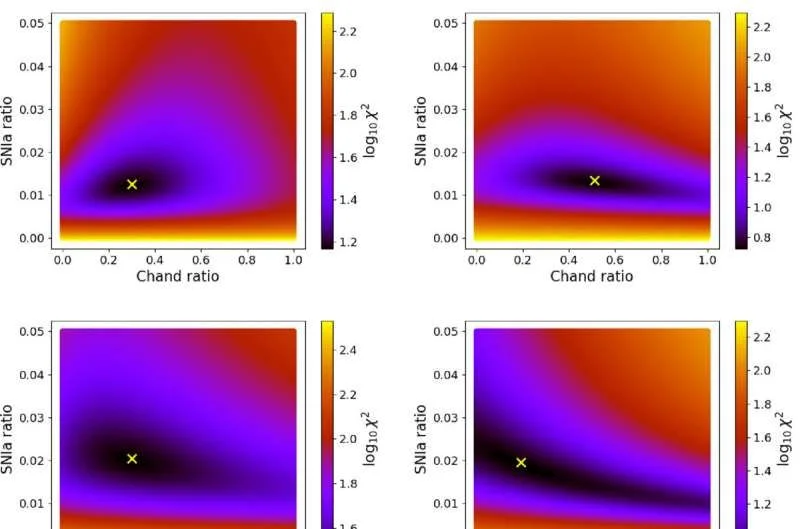
The analysis, detailed in a preprint submitted on February 26, 2026, and revised on April 7, 2026, uses the Perseus Cluster as a crucial reference point. By conducting parameter surveys for each supernova yield, scientists aim to pinpoint the theoretical setups that provide the closest match to the cluster's observed elemental signatures. The implications extend to our understanding of Core-Collapse Supernovae (CCSNe) and their specific contributions to the creation of these elements.
While newer research is actively pushing these boundaries, earlier work has also highlighted aspects of this cosmic puzzle. A 2018 report from NASA Technical Reports Server, drawing on high-resolution X-ray spectroscopy, also sought to constrain the chemical enrichment history of the Perseus Cluster. Further work, published in Nature in November 2017, explored solar abundance ratios of iron-peak elements within the same cluster, linking observed diversity in Type Ia supernovae to chemical abundance patterns. This earlier research had already hinted at discrepancies in supernova models, particularly concerning the "Diversity of Type Ia supernovae imprinted in chemical abundances" and "Constraints on type Ia supernova models from X-ray spectra of galaxy clusters."
Read More: US Space Force Victus Haze Mission Successfully Tests Orbital Intercepts
The complexity is further underscored by findings published in Astronomy & Astrophysics in June 2024, which emphasize that Type Ia supernova explosion models are inherently multidimensional, suggesting that simpler, one-dimensional approaches may be insufficient to capture the full picture. This current wave of research appears to be building upon these earlier observations, using more advanced data to force a more radical overhaul of existing theoretical frameworks.