Information Theory Unlocks Star Formation Secrets
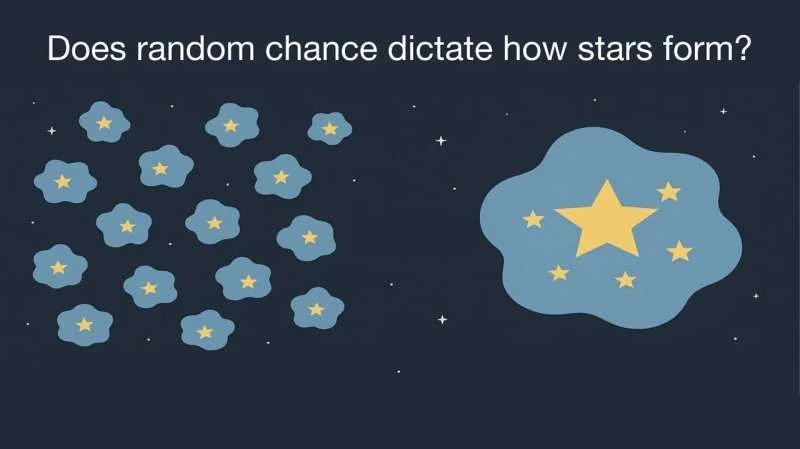
A self-regulating process, quantified by Shannon entropy, appears to govern the distribution of stellar masses within cosmic star clusters. This recent insight, spearheaded by Dr. Eda Gjergo of Nanjing University, challenges prior assumptions about the randomness of star formation, suggesting an underlying order previously unrecognized. The study posits that the initial mass of a gas cloud dictates the resulting population of stars with remarkable predictability.
This principle, termed 'optimal sampling' by Pavel Kroupa, allows for more efficient calculations regarding galactic evolution. Instead of intricate simulations for individual clusters, a single figure – the total mass of the stellar population – suffices to determine the array of star types and their quantities. This development promises to reduce the computational burden, saving significant 'supercomputing time' and associated energy consumption.
The implications extend to fundamental cosmological theories. Kroupa notes that previous models, which assumed dwarf galaxies did form massive stars, now require re-evaluation. The new framework indicates small dwarf galaxies do not produce massive stars, a finding with "fundamental impact on the theory of the matter cycle in the Universe."
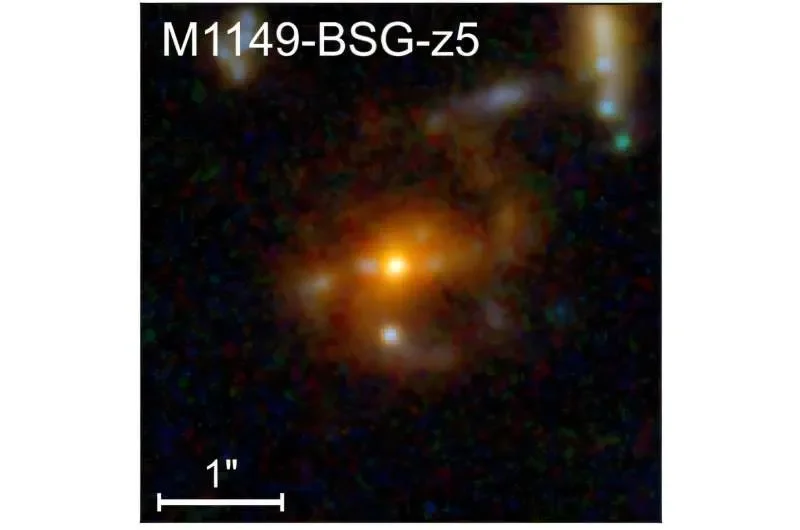
Read More: JWST Finds Oldest Barred Spiral Galaxy M1149-BSG-z5
Order, Not Chance, in Stellar Births
Star clusters, the nurseries for new stars within galaxies, were long thought to harbor a somewhat random assortment of stellar masses. While some stars are small, cool, and dim, others can be ten times the mass of our Sun and a hundred thousand times brighter, albeit with shorter lives. The research presented suggests this variation is not a matter of chance.
"When stars are formed from a gas cloud, their masses aren’t decided at random but follow a precise order that leaves no room for statistical fluctuations," Kroupa stated. This order is, in essence, the universe's efficient method for organizing its stellar material.
Read More: Indigenous Data Rights Now Key in Conservation Genomics
The methodology, leveraging Shannon entropy—a measure of information or uncertainty—provides a quantifiable framework for this cosmic order. It translates a complex astronomical phenomenon into a calculable principle, simplifying predictive models.
Background: Galaxies and Stellar Evolution
Galaxies form new stars primarily within these stellar clusters, embedded in vast reservoirs of gas. The characteristics of these newborn stars – their mass, brightness, and lifespan – profoundly influence a galaxy's overall luminosity and its ongoing evolution. Understanding the processes that govern their formation is therefore crucial for comprehending galactic dynamics and the broader cosmic matter cycle. This latest work offers a new lens through which to view these fundamental processes, potentially rewriting established narratives about the universe's star-making machinery.