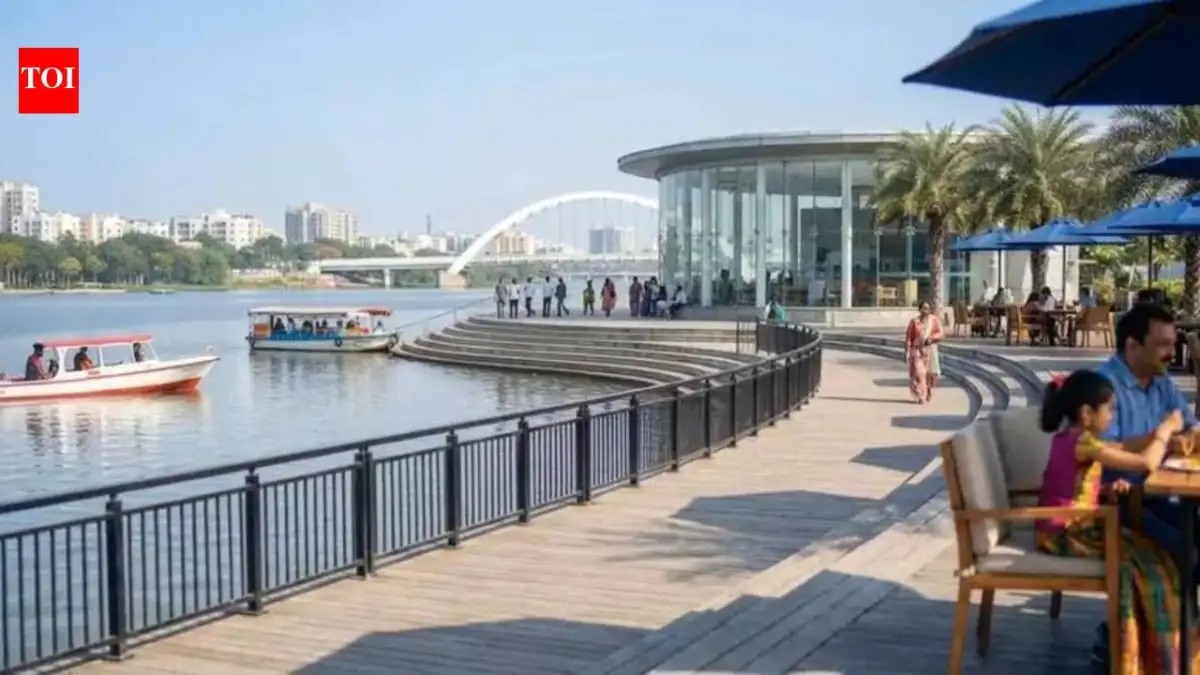
The Telangana government will begin moving dirt in the first week of April to reshape the Musi River. The initial phase focuses on ₹5,812.4 crore of heavy spending across two specific stretches: 11 km from Osman Sagar to Bapu Ghat and 9 km from Himayat Sagar to the same confluence. This effort hinges on the creation of the Gandhi Sarovar, a 200-acre basin designed to hold water still for a 123-foot statue of Mahatma Gandhi.
While the rhetoric speaks of ' rejuvenation ', the physical reality involves building a check dam at Bapu Ghat to arrest the flow. To ensure this new lake does not become a pool of waste, the state plans to install 70 sewage treatment plants (STPs) and lay massive trunk mains along the buffer zones to intercept the grey sludge that currently defines the river’s character.
Read More: Amazon Land Use Changes Cause Disease Clusters in Brazil

"The primary goal is to ensure clean air and water… the Musi River Rejuvenation project playing a crucial role." — Duddilla Sridhar Babu, Minister for IT and Industries.
The Ledger: Budgeting the Iconography
The administration recently pushed back against claims that the statue alone would cost billions. Instead, they have partitioned the ' financials ' into specific, mechanical buckets to quell political friction from the BRS opposition.
| Project Component | Estimated Cost (INR) | Functional Purpose |
|---|---|---|
| Total Phase 1 | ₹5,812.4 Crore | Cleaning, roads, and profiling. |
| Gandhi Statue | ₹73.8 Crore | National height record (123 ft). |
| Statue Platform | ₹22.6 Crore | Structural foundation in the riverbed. |
| Museum & Building | ₹220 Crore | Philosophy and experiential center. |
| Electro-Mechanical | ₹79 Crore | Lighting and technical guts. |
| Osman Sagar Stretch | ₹1,992 Crore | 11 km of riverbed reshaping. |
| Himayat Sagar Stretch | ₹1,684 Crore | 9 km of flood walls and stabilization. |
Engineering a "Natural" Flow
The project is not merely a cleanup but a wholesale re-engineering of the landscape. To keep the Gandhi Sarovar filled during dry months, the government intends to pump 2.5 tmcft of water from the Mallanna Sagar reservoir into the twin lakes, which will then bleed into the Musi. This creates a perpetual, artificial water level to support the "night-time economy" and tourism planned for the banks.
Infrastructure Alterations: The plan includes ' road construction ' consisting of a four-lane road on one bank and a two-lane road on the other.
Flood Mitigation: Concrete walls and slope stabilization will be used to profile the riverbed, potentially altering the natural spill-over patterns of the old waterway.
Land Acquisition: The state requires roughly 300 acres, a patchwork of defense land, private holdings (patta), and government-owned soil.
Investigative Context: The Debt and the Blueprint
The ' Asian Development Bank (ADB) ' has greenlit a ₹4,100 crore loan, signaling that the project's survival depends on international credit rather than local surplus. A consortium of global firms, including Meinhardt, Cushman & Wakefield, and ZHA, is currently drafting the Detailed Project Reports (DPRs) to be submitted within weeks.
Read More: Two building collapses in India kill 6 people
The Musi has long functioned as a drainage gut for Hyderabad, carrying untreated industrial runoff and city waste. The current administration, led by Revanth Reddy, is attempting to pivot this from an environmental liability into a "cultural grid." However, the success of this transformation relies on the unproven efficiency of 70 new treatment plants and the controversial logic of pumping distant water into a local basin to maintain the appearance of a living river.