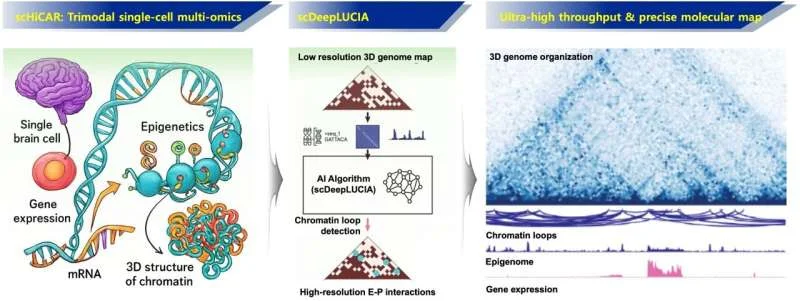
Researchers have developed a new method, dubbed scHiCAR, that allows for the simultaneous examination of a cell's gene expression, its epigenetic marks, and its three-dimensional genome structure. This "trimodal" profiling within individual cells marks a significant advance, offering a more granular look at the complex machinery driving cellular function and disease.
The development promises to illuminate how these different molecular layers interact in real-time, especially during critical biological processes. Early applications have focused on brain tissue and the regeneration of muscle stem cells, revealing distinct operational principles across 22 major cell types. This integrated approach tackles a persistent challenge: the difficulty in accurately observing these molecular changes at the single-cell level with prior technologies.

scHiCAR integrates transcriptome, epigenome, and 3D genome data from the same cell. This contrasts with older methods that often relied on bulk-cell data, averaging out individual cellular states and losing critical resolution. The technique has demonstrated robustness, even in challenging tissues like skeletal muscle, during processes such as muscle stem cell regeneration.
The method is presented as a scalable, efficient, and cost-effective platform for studying gene regulatory landscapes. Code for processing scHiCAR data and related tools has been made available in a GitHub repository.

Mapping Molecular Interactions
The scHiCAR technology builds upon previous efforts in single-cell genomics. While some methods can profile transcriptional activity and chromatin accessibility together, they lack data on chromatin interactions. scHiCAR aims to fill this gap by more efficiently capturing long-range interactions anchored at specific regulatory elements.
Read More: HKUST Scientists Discover How DICER Enzyme Cuts RNA With High Precision in 2024

"The origin of many diseases begins at the cellular level and involves multiple molecular interactions."
This integrated view is crucial for understanding the genesis of diseases, which often involve intricate cellular-level disruptions. The researchers have likened the technology's capability to "zooming in on Earth using Google Earth," implying a layered and detailed exploration of the cellular genome.
Collaboration and Availability
The development of scHiCAR is attributed to a collaboration between researchers at KAIST, led by Professor Inkyung Jung, and Duke University, under Professor Yarui Diao. The research has been published, with a DOI of 10.1038/s41585-026-03013-7. Data related to the technology, including for cell lines, is available via the GEO database under accession number GSE267117.
Background
Understanding the 3D organization of cis-regulatory elements (CREs) is considered central to controlling gene transcription. Previous single-cell 3D genome methods have faced limitations in efficiently enriching long-range cis-interactions, particularly those anchored at candidate CREs (cCREs). The development of scHiCAR seeks to overcome these limitations, providing a more comprehensive view of gene regulation dynamics.
Read More: Rob James Claims Hair Loss Reversed With Daily Routine, Others Use Minoxidil
Other related single-cell multi-omic approaches, such as ChAIR, have also been developed, capable of simultaneously capturing chromatin accessibility (ChAIR-ATAC), 3D chromatin structure (ChAIR-PET), and gene expression (ChAIR-RNA) in individual cells. These systems have generated large datasets, processing over 100,000 single cells per experiment.




.jpg)