Nokia and Nvidia have committed to a hardware shift that installs Blackwell GPUs and Grace CPUs directly into cellular base stations. By late 2025, the standard radio tower is being re-tooled to function as a distributed AI-RAN node. This architecture forces the hardware to juggle raw signal processing alongside generative AI inference. While proponents claim this turns idle network assets into profitable "AI factories," the physical reality involves cramming high-wattage processors into outdoor cabinets originally designed for simple radio-wave modulation.

The push toward 6G defines the network not as a carrier of data, but as a "native" host for it. Every cell site becomes a micro-datacenter, attempting to solve the latency problem by bringing the brain to the edge of the antenna.
The Mechanics of Signal Capture
The primary objective is the "Aerial RAN Computer-1," a platform intended to host AI workloads and network functions on a shared substrate. Current deployments move away from fixed-function chips toward software-defined radio-rigging.
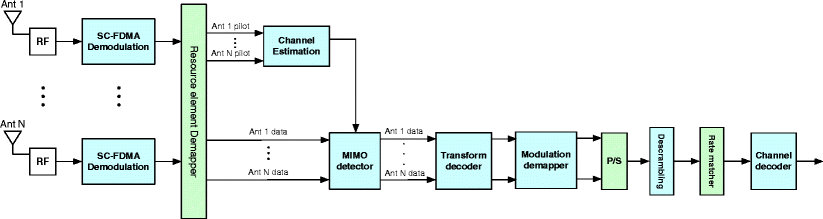
Nokia's ARC Integration: Combines Nvidia’s specialized silicon with traditional mobile network stacks to prepare for an "AI-native" 6G.
Samsung’s Megafactory: Utilizing 50,000 GPUs to link manufacturing robotics with local 5G/6G neural networks.
Resource Harvest: Proponents argue that RAN hardware often sits underused; the GPU allows the tower to sell "inference" cycles to nearby devices during low-traffic hours.
| Component | Role in Base Station | Current Status |
|---|---|---|
| GPU (Blackwell) | Heavy math, AI inference, 6G algorithms | Integration Phase |
| CPU (Grace) | System logic, control plane | Active Deployment |
| RIC (Controller) | Software-defined intelligence | Near-real-time trials |
The Thermal Threshold
The transition to GPU-heavy towers faces a blunt physical wall: Heat. Recent research into 3D-stacked memory (HBM) on GPUs shows internal temperatures can spike to 140°C, far exceeding the standard 80°C safety limit. While companies like Imec are testing blank silicon buffers and micro-cooling to drop these numbers to 88°C, the outdoor environment of a base station provides little of the climate-controlled luxury found in a traditional server farm. The "scorching" potential of these chips threatens the longevity of the radio gear they are supposed to enhance.
Read More: Render Network Shifts to AI Compute, Adds 60,000 GPUs Today, April 7, 2026
Skeptical Refinement: Why Now?
The narrative of "AI-RAN" suggests a seamless software upgrade to 6G, but it functions more like an industry-wide hardware mandate. By moving radio frameworks onto GPUs, vendors ensure that telecommunications companies remain tethered to specific high-end silicon cycles. This move replaces specialized, energy-lean chips (ASICs) with hungry, general-purpose processors.
Power Consumption: Base stations must now provide enough electricity to feed high-performance GPUs, potentially ballooning operational costs.
Software Drift: The "Open-RAN" movement is being absorbed by large-scale AI-RAN Alliance members, narrowing the field of hardware providers.
Background: The Decade-Long Pivot
The concept of using graphics processors for radio tasks is not a recent breakthrough. Researchers were publishing papers on GPU-accelerated LTE as early as 2014. What has changed is not the technical feasibility—which remains strained by thermal and power constraints—but the market necessity. As traditional 5G revenue plateaus, the industry is betting on the physical integration of AI as the only viable path to justify the massive infrastructure spend required for the 6G transition.
Read More: Nations Championship rugby starts 7 April 2026 with new point system