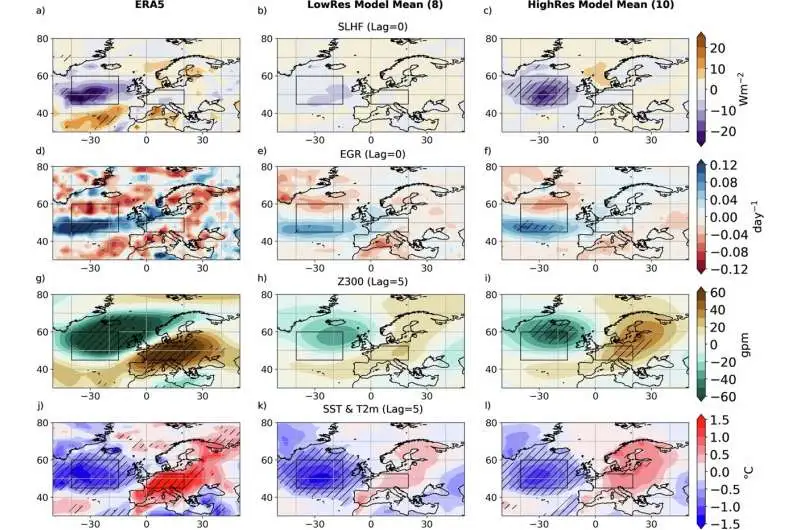
High-resolution ocean models, specifically those that can resolve small-scale swirling currents called mesoscale eddies, are showing a markedly better capacity to simulate the intense heat waves that periodically grip Europe. These advanced models, with spatial resolutions often below 25 kilometers, can more accurately depict how oceanic processes in the North Atlantic influence atmospheric conditions over the continent. Researchers at the GEOMAR Helmholtz Centre for Ocean Research Kiel, working with the Max Planck Institute for Meteorology, have highlighted this breakthrough, suggesting it's a significant step forward in predicting these extreme weather events.

North Atlantic's Curious Role in Continental Heat
The North Atlantic, often described as a thermostat for European weather, plays a crucial, if sometimes counterintuitive, role in generating heat waves. Observations indicate that exceptionally cold sea surface temperatures in the subpolar North Atlantic can paradoxically precede and intensify European heat events. This phenomenon is linked to the persistence and strengthening of low-pressure systems over the Atlantic. These strengthened low-pressure systems, in turn, contribute to the formation of stable high-pressure systems downstream over Europe.
Read More: HKUST Scientists Discover How DICER Enzyme Cuts RNA With High Precision in 2024
Eddies and Their Heat Transport
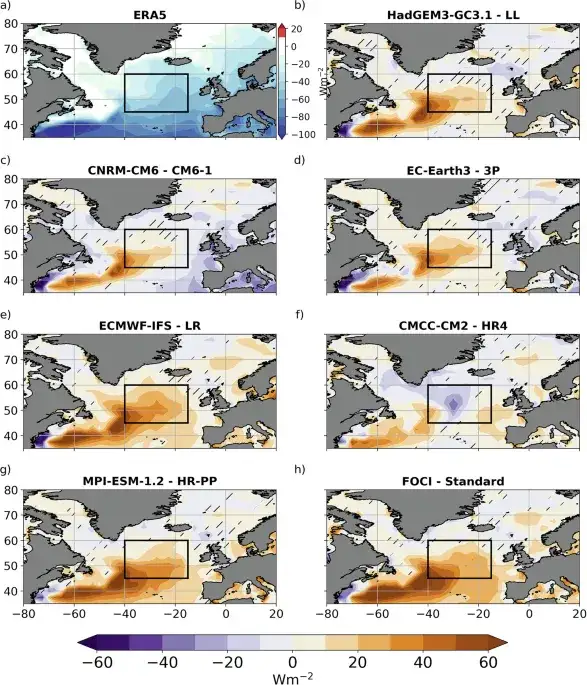
The key advancement lies in the models' ability to explicitly simulate 'mesoscale eddies.' These are turbulent ocean features, typically 10 to 100 kilometers wide, that are adept at transporting heat, momentum, and nutrients across vast oceanic distances. By resolving these eddies, the models gain a more nuanced understanding of how heat is distributed in the ocean, which directly impacts the overlying atmosphere and, subsequently, European climate patterns during summer.

Lingering Discrepancies
Despite the progress, the studies acknowledge that challenges remain. Even with these high-resolution models, there's a tendency to underestimate the intensity of European heat waves and to shift their predicted location eastward. Further refinement of these models and their underlying processes is deemed necessary.
Academic Foundation
This improved simulation capability stems from research published in journals like 'Communications Earth & Environment,' with key contributions from researchers including Julian Krüger, Joakim Kjellsson, Katja Lohmann, Daniela Matei, and Robin Pilch Kedzierski. Their work focuses on enhancing the representation of 'extratropical North Atlantic atmosphere-ocean variability' and the impact of 'Atlantic Ocean Forcing' on North American and European summer climates. The investigation into the "latent heat flux over the North Atlantic Ocean" is also a critical component.
Read More: EU Investigates Broadcom's VMware Partner Changes After Cloud Provider Complaint

.jpg)