Recent academic papers highlight a burgeoning trend: the fusion of Large Language Models (LLMs) with Knowledge Graphs (KGs) as a strategy to curb their tendency towards producing factually incorrect information, a phenomenon termed "hallucination." This integration seeks to imbue LLMs with a more structured understanding of facts, drawing on the relational data KGs provide.
The core idea revolves around leveraging the interconnected facts within KGs to offer context and grounding for LLM outputs, thereby enhancing reliability and accuracy. This approach is seen as a promising avenue to mitigate a significant challenge facing current LLM applications, ranging from text generation to question answering.
Frameworks for Fusion
Several research efforts are exploring different architectures and methods for this integration.
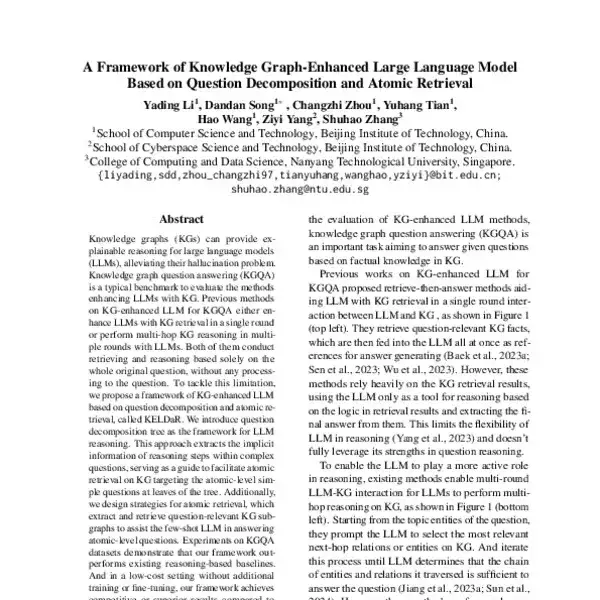
KELDaR Framework: Introduced in a paper published two days ago, this framework tackles LLM hallucinations by decomposing complex questions into smaller, manageable parts and then retrieving atomic pieces of information from KGs. Notably, this method achieves competitive or even superior results to existing training-based approaches without requiring additional training or fine-tuning, suggesting a more accessible path to enhanced LLM performance.
Path Selection for Enhancement: A paper from six days ago delves into 'Knowledge Graph-Enhanced Large Language Models via Path Selection.' This suggests a focus on how the model navigates and utilizes the relationships within the KG to improve its responses.
Healthcare Predictions: Further demonstrating the practical application of this convergence, a January 22, 2025, submission explores 'Reasoning-Enhanced Healthcare Predictions with Knowledge Graph…'. This points towards specialized domains where factual accuracy is paramount and the structured nature of KGs can offer distinct advantages.
The Hallucination Problem
LLMs, despite their impressive capabilities in natural language processing, are prone to generating plausible-sounding but ultimately false statements. This "hallucination" issue has been a persistent barrier to their widespread adoption in critical applications.
Read More: AI Study Tools Help Students Prepare For Exams
Knowledge Graphs, in contrast, represent data as a network of entities and their defined relationships. By connecting these structured facts with the generative power of LLMs, researchers aim to create more robust and trustworthy AI systems. The availability of structured data within KGs is presented as a key factor in filling gaps in an LLM's understanding and thereby bolstering the accuracy of their output.