Orbital Close Call | Asteroid 2026 JH2 Approaches
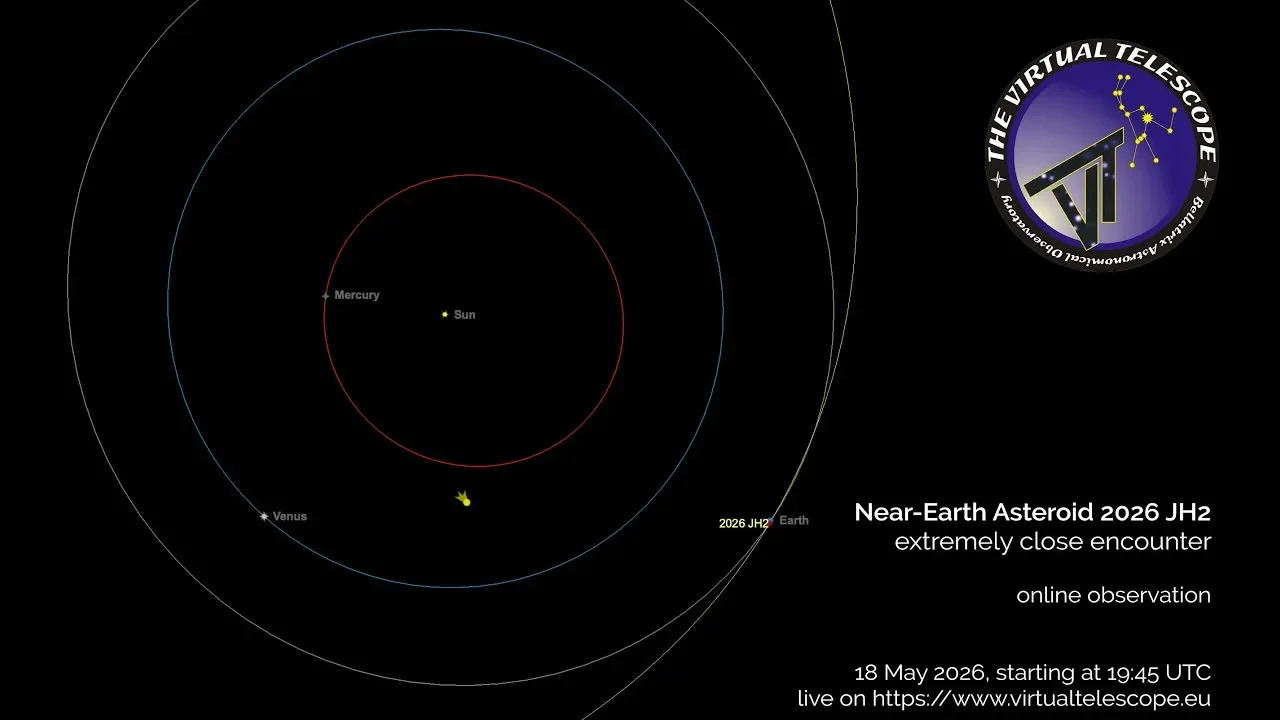
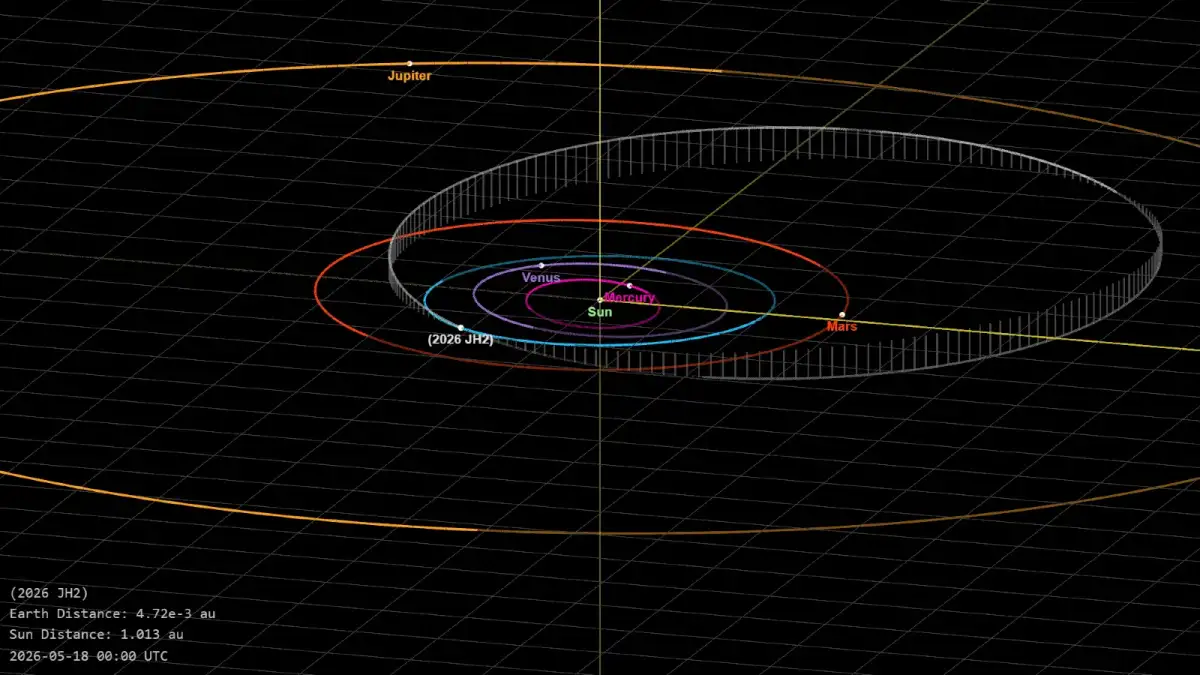
An asteroid, newly cataloged and measured to be about the size of an adult blue whale, is slated to make a relatively close pass by Earth on May 18. The celestial body, identified as 2026 JH2, will navigate a trajectory that brings it within approximately 56,628 miles (91,135 kilometers) of our planet's surface. This distance, representing about 24% of the average separation between Earth and the Moon, places the asteroid closer than some artificial satellites currently orbiting.

The Virtual Telescope Project will host a free YouTube livestream, offering near real-time views of the asteroid as it hurtles past. The broadcast is scheduled to commence at 3:45 p.m. EDT (19:45 GMT), contingent on favorable weather conditions. Observers can anticipate seeing 2026 JH2 as a "sharp dot of light" moving against a backdrop of stars, with the telescopes designed to track its rapid motion. The asteroid is traveling at a velocity of roughly 19,417 mph (31,248 km/h) relative to Earth.
Read More: US Space Force Victus Haze Mission Successfully Tests Orbital Intercepts

A Public Glimpse | Live Stream Details
The livestream aims to democratize observation of this astronomical event, allowing individuals without specialized equipment to witness the encounter. Viewers are advised to ensure their public display names are confirmed before engaging in the live chat feature. The event's peak brightness is expected around magnitude 11.5.
Context and Concerns | Asteroid Research
This flyby highlights the ongoing efforts in asteroid detection and tracking. Scientists note that due to limited initial observations, there remains some degree of uncertainty regarding the precise closest approach distance. The event underscores the importance of continued scientific endeavors in understanding asteroid composition, refining trajectory predictions, and exploring deflection strategies for potential future threats. Resources like TheSkyLive.com are expected to provide detailed tracking information for amateur astronomers.

Background | The Virtual Telescope Project
The Virtual Telescope Project, an initiative with a track record of successfully broadcasting asteroid flybys, utilizes robotic telescopes situated in Italy for its observations. Their webTV platform has been a key tool in sharing these "spectacular, close encounters with the world," according to their published information. The organization designates asteroid research as a significant area of focus.
Read More: Indigenous Data Rights Now Key in Conservation Genomics