The Senate Leadership Fund, a group aligned with Republican leadership, has publicly outlined its strategic targets for the 2026 U.S. Senate elections. This announcement signifies a proactive offensive stance by the Republican party, aiming not just to defend existing seats but to actively pursue a broader majority. Democrats are reportedly facing significant pressure, with some reports suggesting internal "panic" as they anticipate the GOP's campaign strategy.
The Republican strategy appears to focus on flipping at least four Democratic-held seats while simultaneously defending a limited number of their own competitive districts. Key states identified for potential GOP gains include New Hampshire, where a familiar name is reportedly gaining traction, and Georgia, which is expected to host a highly contested race with a crowded Republican primary. Minnesota and Michigan are also mentioned as areas where Republicans see "strong opportunity" due to local political dynamics and competitive Democratic primaries.
Read More: Modakkurichi MLA Saraswathi Challenged by Vaiko on Jal Jeevan Mission Failures

Defense and Offense
While the primary focus is on offensive maneuvers, Republicans are also tasked with defending seats in Maine and North Carolina, both described as "perennial battlegrounds." Crucially, the GOP contends that the number of truly vulnerable Republican seats remains "limited," suggesting confidence in their defensive posture. This dual approach of expanding their reach while shoring up existing territory underpins their stated objective.
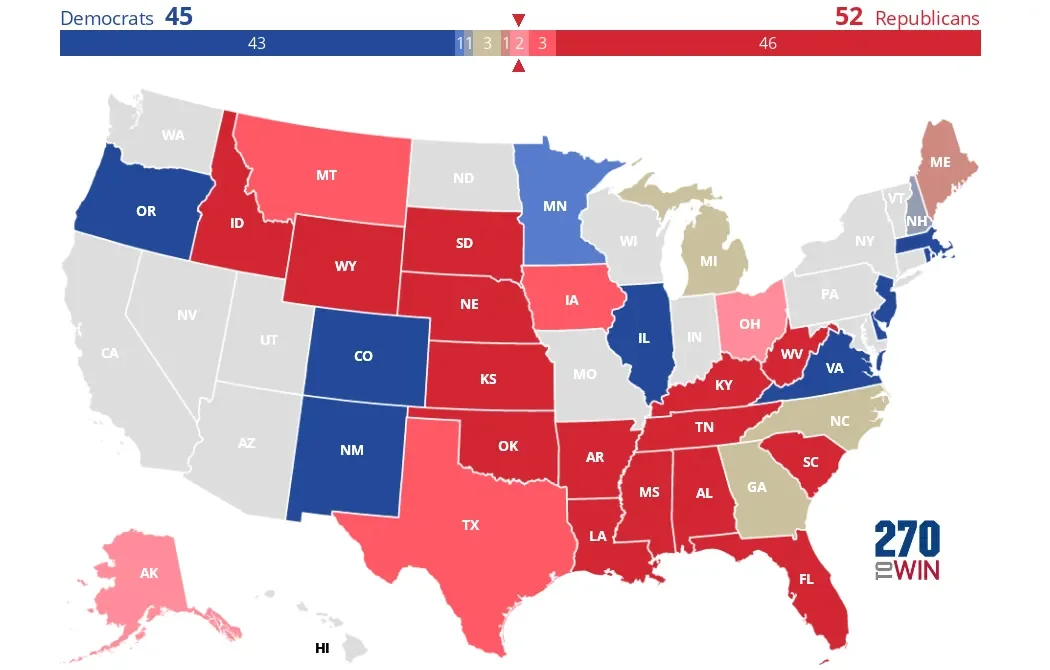
The current Senate composition is noted as 53 Republicans and 47 Democrats, including independents. This sets the stage for a tight contest where any shift in a few seats could dramatically alter the balance of power. The strategic planning by the Senate GOP's campaign arm suggests a calculated approach, aiming to capitalize on perceived political trends and potentially a "wave election."
Contextual Currents
Some reports frame the Republican push within the broader context of President Trump's second term and his "America First agenda," suggesting that electoral success for Republicans in 2026 would be a continuation of these policies. Conversely, Democratic strategists are portrayed as being aware of the impending challenge and preparing for what they perceive as an aggressive Republican campaign. The effectiveness of this Republican strategy hinges on their ability to secure wins in targeted states while maintaining their current hold on other seats.
Read More: Assam Forest Guards Not Used for Elections After NGT Order on April 2