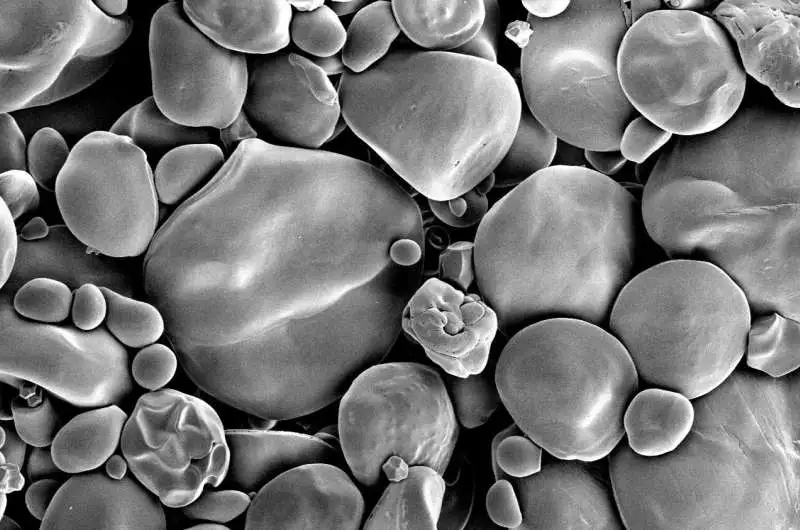
Scientists have successfully cultivated wheat varieties that yield exceptionally large starch granules, a development that could reshape food digestion and unlock new industrial processes. This biological engineering feat, detailed in Science Advances, targets the fundamental mechanisms governing starch formation within wheat.
The core innovation involves manipulating the initiation of starch granules and the structure of amyloplasts, the cellular compartments where starch is synthesized. By doing so, researchers have overcome previous limitations on granule size, resulting in significantly enlarged starch structures. This breakthrough addresses a long-standing gap in understanding the genetic controls that dictate starch granule dimensions.
The starch found in staple foods like bread and pasta is typically a composite of different granule types: larger, flatter A-type granules and smaller, spherical B-type granules. The size and structure of these granules are known to influence how our bodies process the starch. Larger granules, for instance, are believed to enhance food texture, potentially leading to improved palatability and mouthfeel in processed foods.
Read More: Karnataka requests higher Totapuri mango limit for farmers in April 2026
Beyond dietary implications, the altered starch properties are expected to offer advantages across a spectrum of manufacturing applications. The precise nature of these industrial benefits remains under development, but the capacity to engineer starch on such a scale suggests potential for new materials and enhanced processing efficiencies.
The research involved two of the study's authors, Lara Esch and David Seung, who are also listed as co-inventors on a patent application related to this method of increasing granule size. This patent, filed under PCT/EP2024/059060, covers their novel approach.