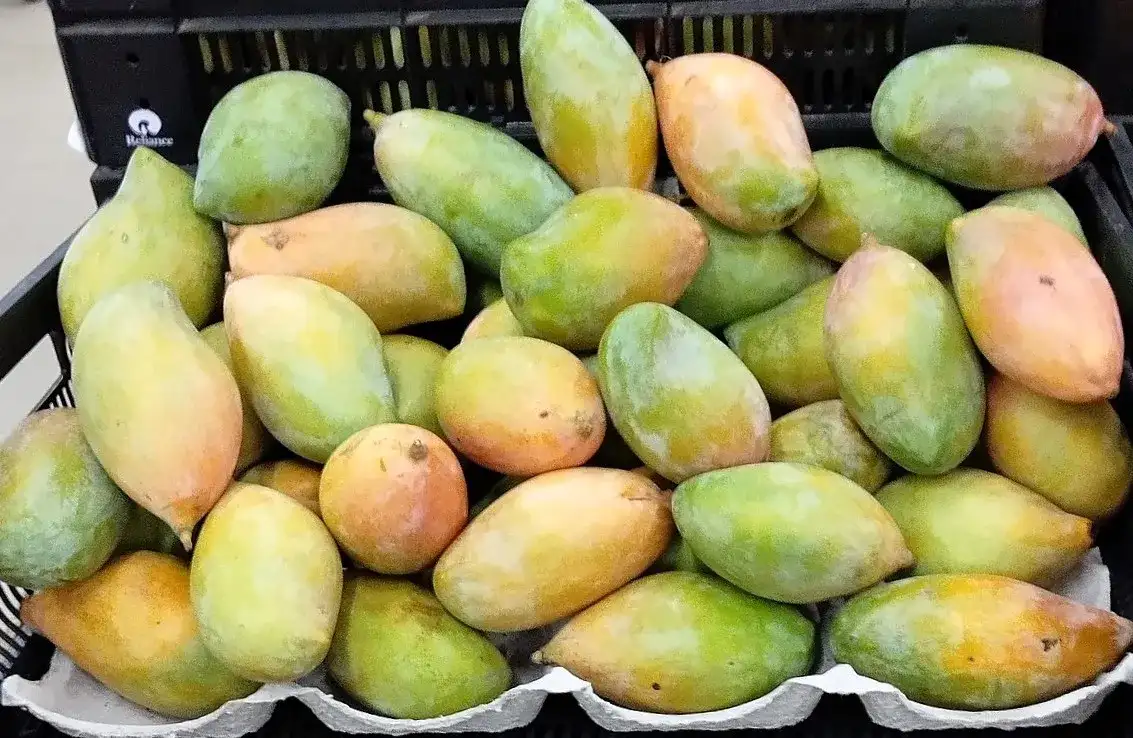
The government of Karnataka has formally requested the Union government to increase the approved procurement limit for Totapuri mangoes from 1.30 lakh metric tonnes (MT) to 5.20 lakh MT. This urgent plea follows the exhaustion of the initial quota, which has effectively halted registrations for the Price Deficiency Payment Scheme (PDPS).
Current exhaustion of the support quota has left approximately 12,700 registered farmers in a state of financial precarity, threatening to escalate into widespread public unrest within the Kolar and Chikkaballapur belts.
Market Dynamics and Intervention
The necessity for state intervention emerged as market prices for the Totapuri variety plummeted to approximately ₹5 per kilogram—a figure significantly below the calculated production cost of ₹8.6 per kilogram.
Price Support: The Union government currently mandates a Market Intervention Price (MIP) of ₹1,750 per quintal.
Coverage: The scheme currently supports 1.30 lakh MT of produce.
Farmer Sentiment: Agricultural stakeholders have expressed dissatisfaction, noting that previous years saw higher compensation levels, with some groups demanding support closer to ₹10 per kg to mitigate losses.
Institutional Backdrop
The intervention, championed by Union Minister HD Kumaraswamy following consultations with Agriculture Minister Shivraj Singh Chouhan, was initially designed as a Market Intervention Scheme (MIS) measure to stabilize the sector.
Read More: New Wheat Makes Bigger Starch for Food and Industry
| Metric | Detail |
|---|---|
| Current Procurement Limit | 1.30 Lakh MT |
| Requested Limit | 5.20 Lakh MT |
| Current Support Price | ₹1,750 / Quintal |
| Estimated Production Cost | ₹860 / Quintal |
Reflective Context: The Fragility of Commodity-Specific Economies
The situation highlights the inherent risks of regional over-reliance on a single processing variety. When global or national demand for specific industrial mango derivatives—such as pulp—wanes, the Totapuri market loses its elasticity.
As the harvest season progresses, the disconnect between state-sanctioned support prices and the realities of the open market continues to deepen. The failure to expand the procurement ceiling may not only trigger law-and-order challenges in major producing districts like Dharwad, Belagavi, and Tumakuru but also expose the limits of current Price Deficiency Payment mechanisms when faced with systemic gluts.