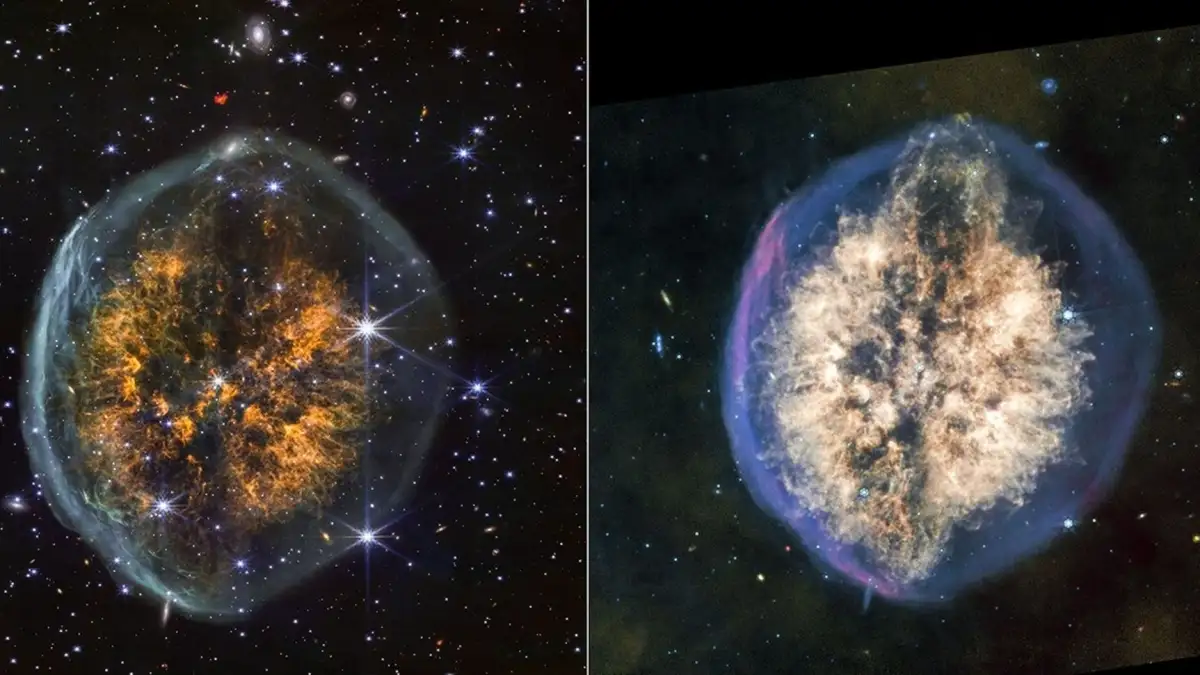
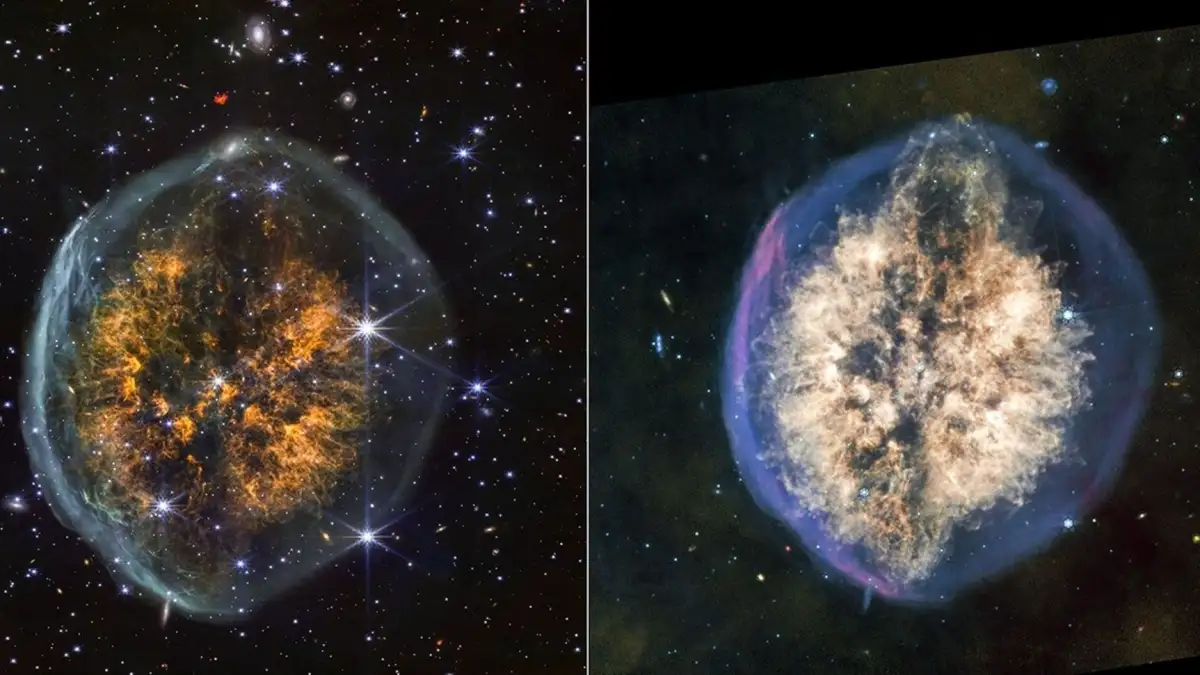
The James Webb Space Telescope (JWST) has captured striking new images of a nebula that bears a resemblance to a human brain. This celestial object, located approximately 5,000 light-years away in the constellation Vela, is the result of a massive star nearing the end of its life. As this star expends its fuel, it is shedding its outer layers, creating vast clouds of gas and dust. The visual similarity to a brain has captured public attention, highlighting the complex and often unexpected forms that cosmic phenomena can take.
Cosmic Events Leading to Nebula Formation
The nebula, known by various descriptions such as the 'Exposed Cranium Nebula', is a testament to the life cycle of stars. When a massive star exhausts its nuclear fuel, it undergoes significant changes.

The star begins to shed its outer material, forming expanding shells of gas and dust.
These expelled layers are illuminated by the star's remaining heat and radiation, creating the visible structure of a nebula.
The specific shape and appearance of the nebula are influenced by factors like the star's mass, its rotation, and the surrounding interstellar medium.
The Fate of the Dying Star
The ultimate fate of the star at the center of this nebula is a subject of ongoing astronomical inquiry. For massive stars, there are typically two main pathways after they exhaust their fuel:
Read More: JWST Finds Oldest Barred Spiral Galaxy M1149-BSG-z5

White Dwarf Formation: If the star is not massive enough to trigger a catastrophic explosion, it will likely collapse into a white dwarf. This is a very dense remnant that is predicted to gradually cool over an immense period, eventually becoming a theoretical black dwarf. The universe's current age may be insufficient for any black dwarfs to have formed yet.
Supernova Explosion: Alternatively, if the star possesses sufficient mass, its death throes could culminate in a supernova. This is a violent explosion that briefly outshines entire galaxies and disperses heavy elements into space, which can contribute to the formation of new stars and planets.
JWST's Role in Astronomical Observation
The James Webb Space Telescope, with its advanced infrared capabilities, plays a crucial role in observing and understanding these distant cosmic events.

JWST can penetrate the dust and gas that often obscure the view of stellar nurseries and dying stars, revealing intricate details.
Its sensitive instruments allow astronomers to analyze the chemical composition and physical conditions within nebulae.
These observations contribute to a deeper understanding of stellar evolution, the formation of elements, and the processes that shape the universe.
Public Perception and Scientific Engagement
The striking visual resemblance of the nebula to a brain has resonated with the public, sparking curiosity about the universe.
Images from JWST often evoke strong visual connections to familiar objects, making complex astronomical phenomena more accessible.
This public engagement is vital for supporting scientific endeavors, as highlighted by calls for subscriptions to science publications to maintain in-depth reporting on research and discovery.
Expert Analysis
While specific expert quotes were not available in the provided summaries, the scientific understanding presented in the articles points to established astrophysical principles. The formation of nebulae from dying stars and the potential outcomes of stellar evolution (white dwarfs or supernovae) are well-documented phenomena in astronomy. The JWST's contribution is in providing unprecedented clarity and detail of these processes.
Conclusion
The recent JWST images offer a compelling view of a massive star's final stages, manifesting as a brain-like nebula. This discovery not only showcases the aesthetic beauty of the cosmos but also provides valuable data for understanding stellar evolution. The visual allure of the nebula serves as a bridge, drawing public interest to the intricate and ongoing work of astronomical research. Future observations will continue to refine our understanding of this star's ultimate fate and the broader implications for galactic chemistry and evolution.
Read More: US Space Force Victus Haze Mission Successfully Tests Orbital Intercepts
Sources
Scientific American: Eerie brain-like nebula captured in stunning new JWST images
Published: [Date of publication not precisely available, described as "il y a 41 minutes"]
Summary: Confirms location, distance, cause (dying star), and potential outcomes (white dwarf/supernova).
Space.com: James Webb Space Telescope performs brain surgery on mysterious 'Exposed Cranium Nebula'
Published: [Date of publication not precisely available, described as "Il y a 1 jour"]
Summary: Mentions JWST's involvement and the nebula being a late stage of a star's life.
ivugangingo.com: Spooky brain-like nebula captured in gorgeous new JWST picture
Published: 2026/02/27 [Note: The date format suggests a future publication, which is likely an error in the provided data.]
Link: https://ivugangingo.com/2026/02/27/spooky-brain-like-nebula-captured-in-stunning-new-jwst-image/
Summary: Focuses on the visual aspect and calls for scientific support.