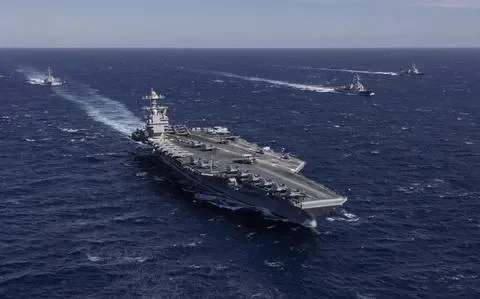
The United States Navy has unveiled plans, spanning the Future Years Defense Program (FYDP), to significantly bolster its fleet with a total of 122 ships and 63 uncrewed platforms. This initiative, dubbed the 'Golden Fleet', outlines substantial investments across numerous vessel categories and signals a strategic push to maintain maritime dominance amidst evolving global challenges.
The FY2027 shipbuilding request alone seeks 34 new vessels, with a total program cost estimated at $65.8 billion. This multi-year strategy aims to enhance naval capabilities by incorporating advanced technologies and expanding shipbuilding capacity. The current operational fleet stands at 291 battle force ships, a figure notably below the established target of 355 vessels.
Key Ship Acquisitions Detailed
The comprehensive FYDP outlines the acquisition of:
Five Columbia-class ballistic missile submarines
Ten Virginia-class attack submarines
Seven Arleigh Burke-class destroyers
Four frigates
Two amphibious assault ships (LHA)
Five amphibious transport docks (LPD)
Twenty-three Medium Landing Ships
Seven fleet oilers
Five ocean surveillance ships
The plan also continues incremental funding for the third and fourth Ford-class aircraft carriers, CVN 80 and CVN 81, and supports the design and development of a new large surface combatant, designated the BB(X) battleship. Unmanned systems feature prominently, with specific plans for 47 Medium Unmanned Surface Vehicles (MUSVs) and 16 Extra Large Unmanned Underwater Vehicles (XLUUVs) within the next five years.
Read More: Air Force Major Detained for Calling for President's Impeachment
Strategic Underpinnings and Industrial Revitalization
Central to this 'Golden Fleet Initiative' is a dual focus on modernizing the fleet and overhauling the shipbuilding process itself. The strategy aligns with a 'High-Low Mix Strategy' and the operational demands of the Navy Warfighting Concept. Efforts are also directed at revitalizing the naval industrial sector and holding it accountable for delivery.
This endeavor encompasses changes in how the Navy procures ships, enhances maritime power through a balanced fleet, and addresses maintenance, manning, training, modernization, and sustainment across the naval force. The initiative explicitly validates the Ford-class aircraft carriers as a battle-proven design, citing operational achievements that showcase their combat power and tempo.
Read More: US 250th Anniversary on July 7, 2026, sees 20% not celebrating
A Look Back at the 'Golden Fleet' Concept
The term 'Golden Fleet' appears to have roots in prior pronouncements, with specific mentions of a new class of battleships first revealed in December of last year. The ongoing strategy aims to translate these visions into tangible fleet expansion, a significant undertaking that underscores the Navy's long-term strategic objectives.