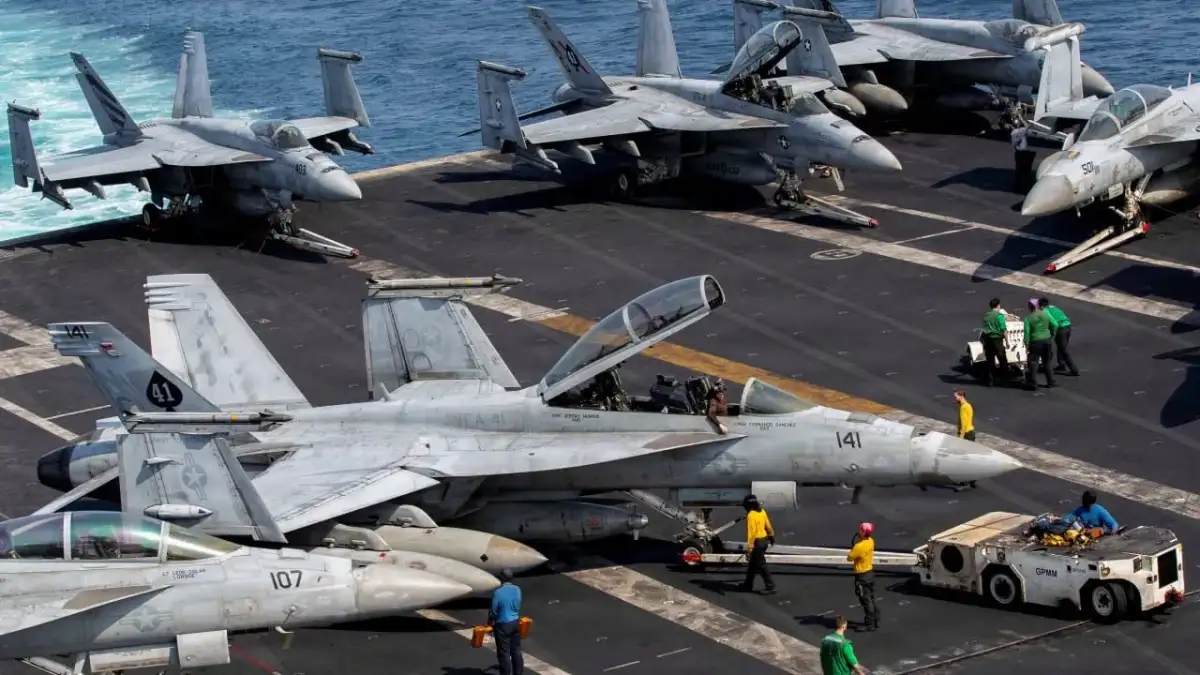
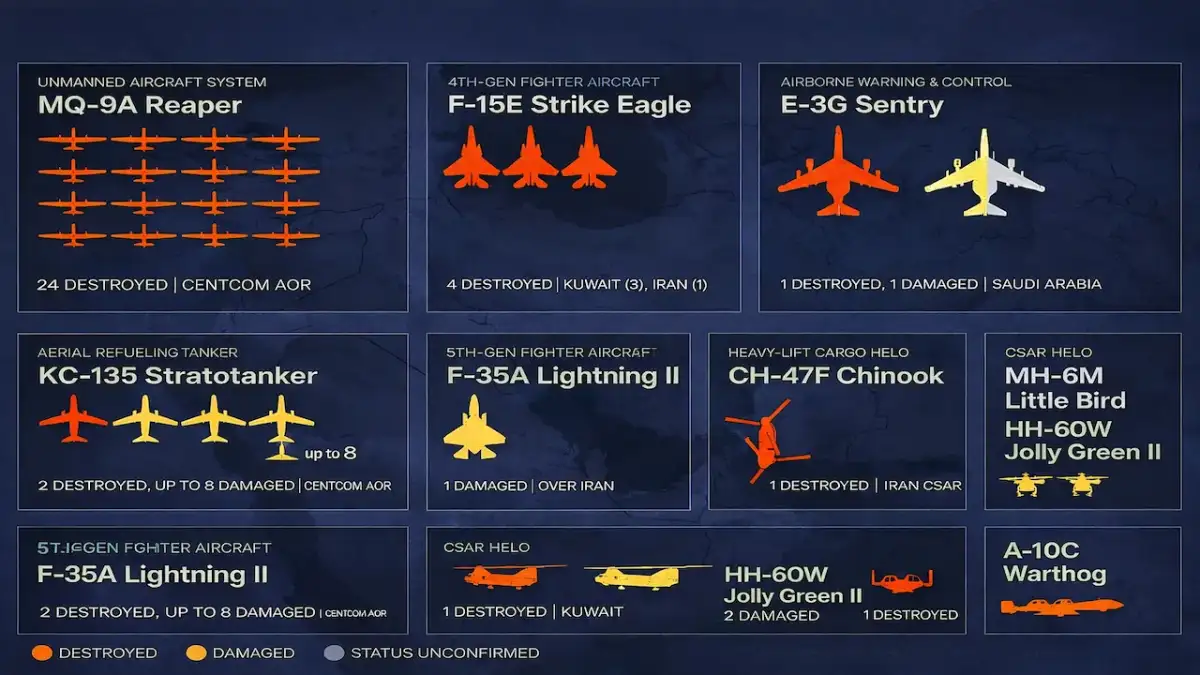
Congress has verified a list of 42 types of US military aircraft reported lost, damaged, or destroyed since the conflict began on February 28, 2026. The Department of Defense currently estimates the fiscal impact of these hardware losses at approximately $2.6 billion.
The loss of these assets, spanning from advanced stealth fighters to reconnaissance drones, represents a significant shift in regional power dynamics. Key hardware impacted includes:
Fixed-Wing: F-35A Lightning II stealth fighters, F-15E Strike Eagles, and A-10C Warthogs.
Support & Logistics: Multiple KC-135 Stratotankers, E-3G Sentry airborne warning systems, and MC-130J Commando II transports.
Rotary-Wing: CH-47F Chinooks, MH-6M Little Birds, and HH-60W Jolly Green II helicopters.
Uncrewed Systems: At least 24 MQ-9A Reaper drones, which comprise the bulk of the attrition.
Incident Reports and Tactical Reality
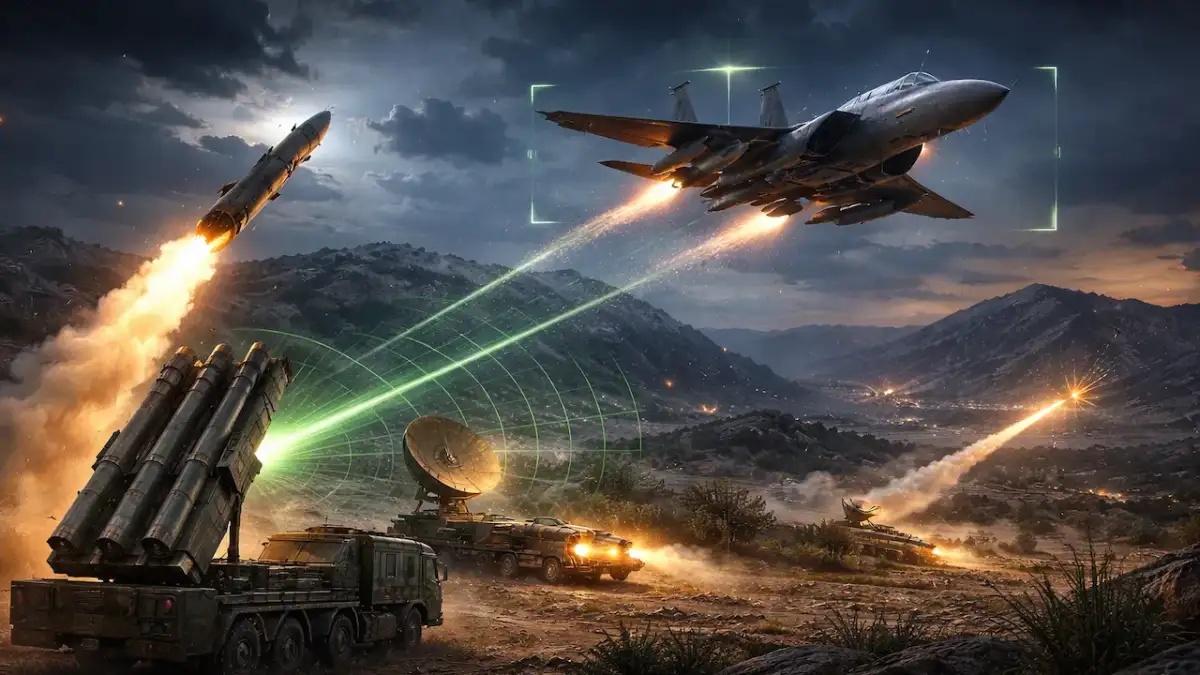
The degradation of US air capability has occurred across multiple fronts, including bases in Saudi Arabia, Iraq, and Kuwait. Reports confirm that low-cost Iranian targeting systems have successfully struck high-value platforms, challenging the assumption of absolute air superiority.
| Aircraft Category | Reported Status (Examples) |
|---|---|
| Stealth / Fighter | F-35A (Damaged), F-15E (Destroyed) |
| Drone (UAV) | MQ-9A (24 Destroyed) |
| Tanker / AWACS | KC-135 (Destroyed/Damaged), E-3G (Damaged) |
| Utility / Special Ops | CH-47F (Destroyed), MH-6M (Destroyed) |
The loss of the KC-135 refuelling tanker on March 12, which resulted in six fatalities, marked one of the most severe personnel outcomes linked to aircraft destruction during the campaign. While US and Israeli forces continue to operate, the accumulation of these losses—exacerbated by missile strikes on regional air bases—has introduced a visible vulnerability into the American logistical tail.
Read More: Air Force Major Detained for Calling for President's Impeachment
Contextualizing the Attrition
The conflict, which entered its seventh week recently, has prompted a move toward diplomatic mediation in Islamabad following a fragile two-week ceasefire. Historical analysis of the campaign suggests that the intensity of the anti-access and area-denial (A2/AD) capabilities deployed by Iran has outperformed earlier assessments.
The divergence between high-cost American hardware and relatively inexpensive Iranian missile and drone systems defines the current phase of the war. While the Pentagon continues to account for damaged inventory, the operational rhythm of the conflict remains tied to the capacity of both sides to sustain or replace their specialized military equipment. Investigations into the precise effectiveness of US air defense systems versus incoming fire continue to be a primary point of friction for military planners.