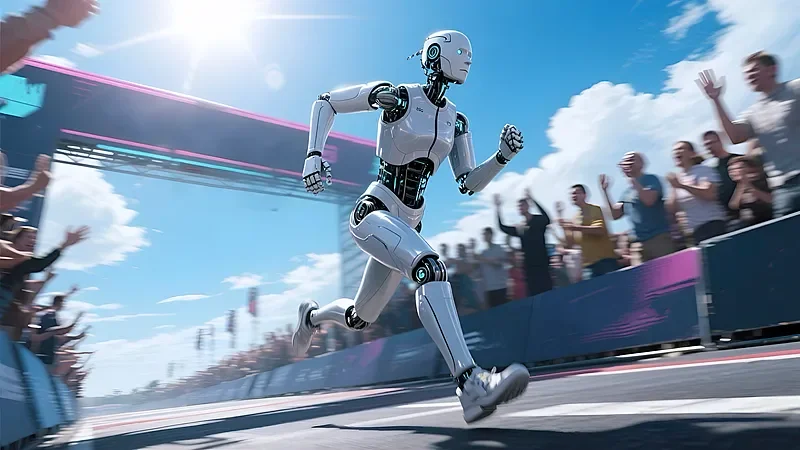
Beijing, China – The inaugural "2025 Beijing Yizhuang Half Marathon" saw twenty teams of humanoid robots, ranging in size from 75 centimeters to 1.8 meters tall, compete on a parallel track alongside human runners on April 19, 2025. The event, billed as the world's first half-marathon featuring both humans and humanoid robots, served as a significant testbed for the capabilities and limitations of current robotic technology in a real-world, endurance setting.
The race underscored the rapid, albeit nascent, development within China's humanoid robotics sector, showcasing leaps in integrated joint design, endurance engineering, and heat dissipation for prolonged operation. While "Tiangong" (天工) was reported to be the winner, finishing the 21-kilometer course, the event was not without its technical stumbles. Reports indicate various challenges, including robots requiring battery swaps and even instances of robots sustaining damage, such as a "head falling off," yet continuing the race.
Read More: Chrome mimeHandler API lets extensions handle file types
Competition Highlights and Technical Hurdles
The half-marathon, officially titled the "2025 Beijing Yizhuang Half Marathon," aimed to push humanoid robots beyond laboratory conditions. Robots competed under a distinct set of guidelines compared to their human counterparts. Despite the celebratory atmosphere, with spectators capturing the unusual sight of mechanical athletes, the event served as a stark reminder of the current limitations in robotic autonomy and endurance.
The reliance on human operators or external guidance for navigation and control in most participating robots highlights that fully autonomous decision-making in unpredictable environments remains a future aspiration.
Ambiguities persist regarding robot performance and endurance, with conflicting reports on whether robots required battery swaps or full unit replacements. Official results noted two robot-swap penalties, impacting perceived individual performance.
The event featured a diverse range of participants, from imposing 1.8-meter figures to smaller 75-centimeter machines, representing twenty-six different robot brands and a mix of corporate and university teams.
Future Trajectory and Industry Implications
The marathon is positioned not just as a competition but as a launchpad for China's burgeoning humanoid robotics industry. The organizers emphasized the event's role in testing the application performance of humanoid robots.
The participation of over 300 humanoid robots and more than 80 corporate teams, alongside over 20 university teams, in subsequent events (as reported for a later, unspecified race) indicates a substantial increase in scale and industry engagement compared to the inaugural event.
University involvement has seen a significant uptick, with twenty institutions participating, a tenfold increase from the first event, signaling a strengthening collaboration between academia and industry.
The development of high-density integrated joints and bodies engineered for endurance and heat dissipation are critical components for robots to complete such long-distance challenges.
Background: A Push for Robotic Advancement
The focus on humanoid robots aligns with broader national strategies. China's "14th Five-Year Plan for the Robotics Industry Development" (2021-2025), released in late 2021, outlined ambitious goals for increasing robot density and fostering innovation across the sector. The establishment of entities like the Beijing Humanoid Robot Innovation Center, a provincial-level hub established in late 2023, underscores a concentrated effort to drive research and development in this field. Events like the half-marathon serve as public demonstrations of progress and as platforms for investors and industry leaders to identify opportunities and potential for market application, from laboratories to factories.
Read More: Humanoid Robot Beats Human Marathon Record in Beijing