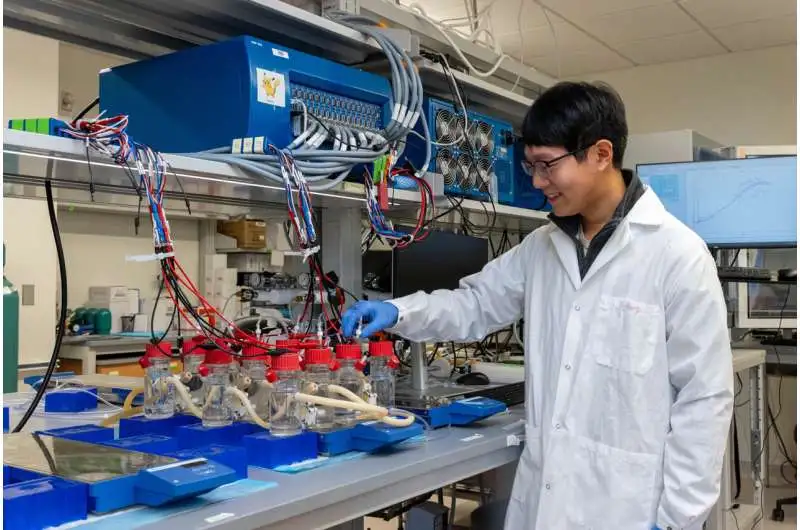
Engineered E. coli Form Biosensors, Detecting Specific Chemical Pairs
Researchers have engineered Escherichia coli bacteria to act as biosensors, capable of generating electrical signals in response to specific chemical combinations. This development offers a pathway towards creating low-cost sensing devices. The work, detailed in a recent publication in Nature Communications, demonstrates how these modified bacteria can differentiate between various chemical mixtures by producing distinct electrical current patterns.
The approach involves genetically altering E. coli to produce a signal only when a particular set of molecules is present together. In one instance, researchers developed sensors that responded to the co-occurrence of specific chemical signals. Another sensor application focused on detecting mercury ions in water, with a noticeable signal emerging approximately two hours after exposure.
This method utilizes E. coli strains as 'containers' for the biosensing mechanism. The capacity for 'multiplexed sensing'—detecting multiple substances simultaneously—was a key area of investigation, though initial trials showed E. coli alone could not reliably achieve this in complex environmental samples. Further research explores combining different bacterial strains or engineering more sophisticated response systems.
Read More: 9 Scientists Dead or Missing: US Investigates Pattern
The concept of using biological agents for sensing is not entirely new, but the ability to translate specific molecular interactions into measurable electrical outputs marks a significant step. The potential applications span environmental monitoring, medical diagnostics, and industrial process control, where the development of sensitive, low-cost, and in-situ detection methods remains a persistent challenge.