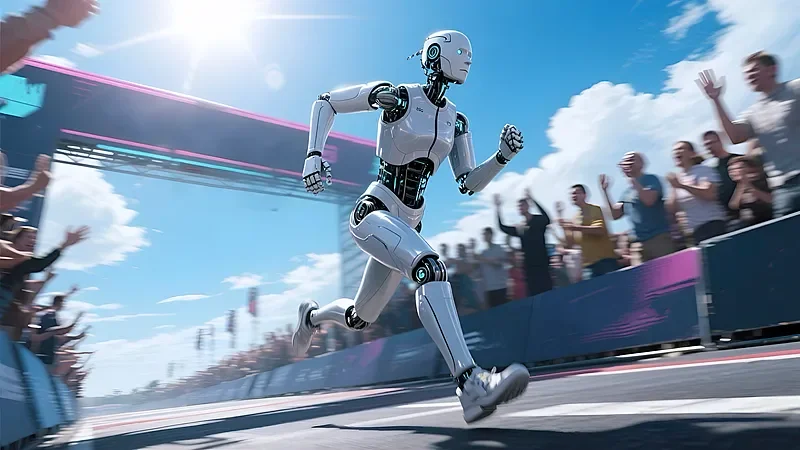
BEIJING – In what organizers are calling a significant step for 'real-world' robotics, the first-ever humanoid robot half-marathon in Beijing concluded Saturday with a stark reality check. Of the 20 teams participating, only six managed to complete the 21-kilometer course, highlighting the significant challenges that remain in deploying sophisticated autonomous machines in unpredictable environments. The event, which ran concurrently with a standard half-marathon featuring 12,000 human athletes, attracted considerable attention, with spectators and human runners alike documenting the unusual spectacle.
The robots, designed to mimic human form and movement, faced a series of critical issues throughout the race. Failures included frequent falls, system overheating, and the need for constant human intervention. Reports indicate that human operators, often numbering two or three per robot, were frequently seen assisting or replacing malfunctioning units. While the ambition was to test these machines in a demanding, real-world scenario, the outcome suggests that current capabilities are still far from seamless integration into such physically complex events.
Read More: Chrome mimeHandler API lets extensions handle file types
This half-marathon was framed by Chinese tech firms and state media as a demonstration of China's growing prowess in artificial intelligence and robotics. The stated aim was to showcase the nation's capacity to build machines capable of gradual societal integration, positioning China as a potential global leader in the field. The juxtaposition of high-tech ambition with the robots' actual performance – stumbling, overheating, and requiring extensive human support – offers a complex narrative of technological advancement.
The event saw 20 teams of humanoid robots join 12,000 human participants on the same course. Despite the robots' struggles, official media outlets reported that audiences offered enthusiastic support, regardless of whether the machines finished the race. Human participants, meanwhile, captured the unusual scene on their mobile devices, underscoring the novelty of robots competing in a human athletic event.
Read More: Humanoid Robot Beats Human Marathon Record in Beijing
The demonstration's emphasis on functional utility, rather than purely aesthetic capabilities like dancing, was noted by observers. The event was designed to assess how well these robots could handle a prolonged, demanding physical task, moving beyond laboratory conditions. However, the significant rate of failure raises questions about the practical readiness of such robots for tasks requiring sustained autonomy and resilience outside of controlled settings.
This initiative aligns with a broader national strategy by Beijing to bolster its position in the global AI and robotics landscape. The integration of robots into everyday human activities, as envisioned by this event, forms a core part of that vision. The challenges encountered at the Beijing half-marathon, however, provide a public, tangible benchmark for the current state of that ambition, suggesting a significant gap between aspirational goals and realized technological capabilities.
Read More: BEREC Asks for Mobile Network API Ideas from Developers