New Species Employes Dorsal Pouch for Egg Development, Diverging From Aquatic Norms
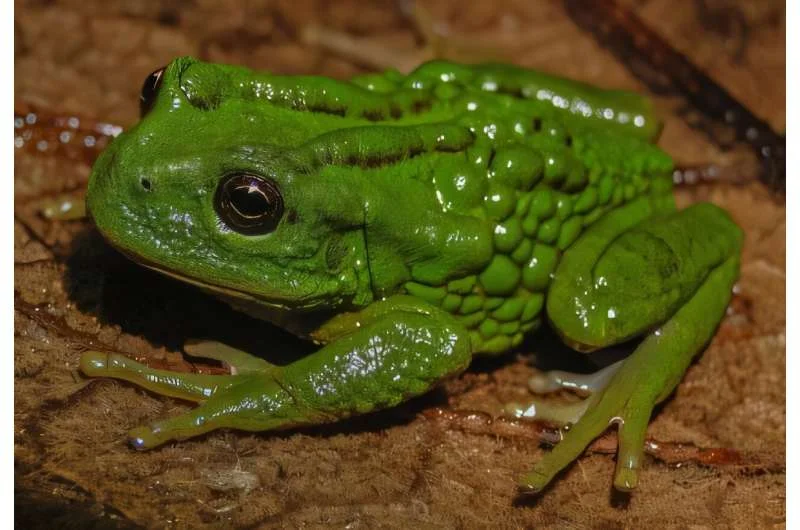
A new species of miniature frog, bearing the scientific designation Gastrotheca mittaliiti, has been cataloged in the Peruvian Amazon. This diminutive amphibian, measuring a mere 2.7 to 3.3 centimeters (1 to 1.3 inches), distinguishes itself by nurturing its offspring within a specialized pouch on its back. This adaptation allows for the direct development of young, bypassing the reliance on water bodies typical for the majority of amphibian reproduction.
The frog's physical characteristics include a striking bright green coloration and small, noticeable protuberances along its dorsal surface, believed to be associated with the egg-carrying pouch. The discovery occurred within a mountainous ecosystem in the Amazonas region of Peru, an area bordering Ecuador.
The identification and classification of Gastrotheca mittaliiti involved contributions from research bodies at Florida International University and the University of Seville in Spain. Findings were formally documented and published in the scientific journal Zootaxa.
Read More: Orangutan Mothers Plan Playdates for Babies in Borneo

Broader Implications and Context for Marsupial Frogs
The reproductive strategy observed in Gastrotheca mittaliiti places it within the Gastrotheca genus, a group known for this particular form of parental care. Members of this genus, spread across Central and South America, are characterized by their females' ability to carry developing eggs in a dorsal pouch. This can range from eggs developing into tadpoles to emerging as fully formed froglets. Some species within this genus even exhibit nutrient transfer through their skin to support embryonic development.
This discovery adds to the known diversity within the Gastrotheca genus, which, prior to this, comprised around 75 recognized species. The find occurred in a region, the Cordillera Colan National Reserve, noted for its biodiversity and a significant number of endemic species.
Concerns have been raised regarding the potential vulnerability of this newly identified species, despite the scientific significance of its unique reproductive method.
Read More: Brazil's Population Over 221 Million in 2025, Largest in South America