Deep within the Earth's mountain belts, vast reserves of naturally occurring hydrogen gas—often dubbed "white hydrogen"—may lie hidden. New international research, employing advanced numerical models, suggests that geological processes, particularly rock erosion, play a critical, albeit ambivalent, role in both generating and potentially limiting the accumulation of these subterranean hydrogen stores. These findings could reshape the landscape of clean energy exploration, offering a natural source of fuel distinct from current, often carbon-intensive, production methods.

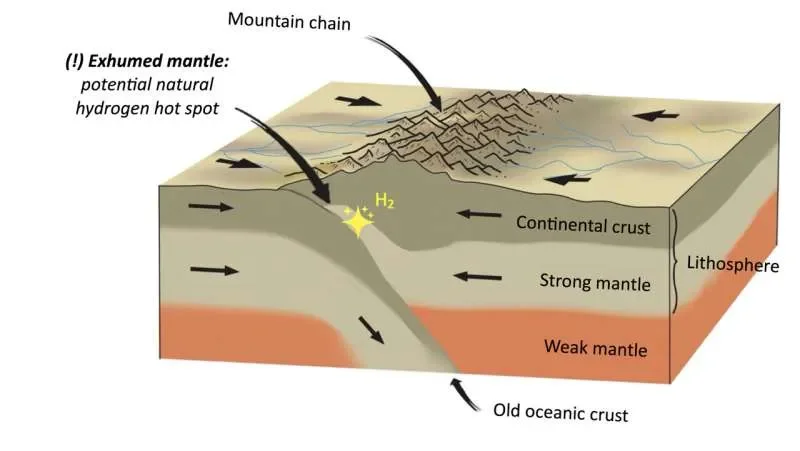
Erosion emerges as a key regulator in the formation and potential reduction of natural hydrogen accumulations. The duration of tectonic extension phases, predating mountain formation, also influences hydrogen generation potential. Researchers focused on regions where tectonic plates diverged millions of years ago, creating rift basins, before converging to build mountain ranges. This process brought rocks from the deep mantle closer to the surface, facilitating reactions with water that release hydrogen. Mountain-forming mechanisms, in particular, appear to produce significantly more hydrogen—approximately 20 times more—than processes associated with continental rifting.
Read More: Solaris Energy SEI Stock Price Forecast Reaches $91.98 by July 2027

The Ambivalent Influence of Erosion
While erosion is highlighted as a crucial factor in natural hydrogen potential, its role is complex. Scientists used numerical plate tectonic models to understand how erosion, acting as a "delicate regulator," influences hydrogen generation. The study, published in the Journal of Geophysical Research: Solid Earth, underscores that this intricate balance makes erosion a critical control factor.
Natural Hydrogen: A Cleaner Alternative
Natural hydrogen, or "white hydrogen," has garnered attention as a potential clean energy source to displace planet-heating fossil fuels. Unlike "grey hydrogen," which is derived from fossil fuels and releases greenhouse gases, or "green hydrogen," produced from renewables, white hydrogen is a naturally occurring substance. Its potential extraction could bypass the environmental drawbacks associated with conventional hydrogen production, revolutionizing clean energy sourcing. Previous discoveries of natural hydrogen have been noted in places like the US, Australia, and France.
Read More: Indigenous Data Rights Now Key in Conservation Genomics
Geological Genesis of Hydrogen
The generation of natural hydrogen in these subsurface reservoirs is primarily linked to a process called 'serpentinization'. This occurs when mantle rocks are brought upwards due to tectonic activity and interact with water. The subsequent chemical reaction yields hydrogen gas. Researchers combined field data with computer modeling to simulate plate tectonic movements, mountain formation, and the subsequent production of hydrogen. This allowed them to assess the hydrogen potential across different mountain belts, revealing significant variations.
Future Prospects and Challenges
The potential economic opportunities linked to natural hydrogen are substantial. However, large-scale exploitation faces hurdles. Further investigation into hydrogen migration pathways and the deep, hydrogen-consuming microbial ecosystems is suggested to better understand where these reservoirs might form. While small-scale extraction of natural hydrogen is already underway in some regions, such as Mali, significant challenges remain in developing the technology for widespread use.
Read More: Summer AC Settings: Save Money by Raising Thermostat