Precision timing and navigation could be revolutionized by placing ultrastable lasers in the Moon's permanently shadowed craters.
Researchers are exploring the deployment of highly stable lasers within the Moon's perpetually dark polar craters. These regions, untouched by direct sunlight, offer extreme cold and darkness, conditions ideal for creating lasers with unprecedented coherence times. This could allow for minute-long laser stability, a significant leap from the few seconds achievable with similar technology on Earth, potentially transforming lunar navigation, timing accuracy, and even fundamental physics experiments.
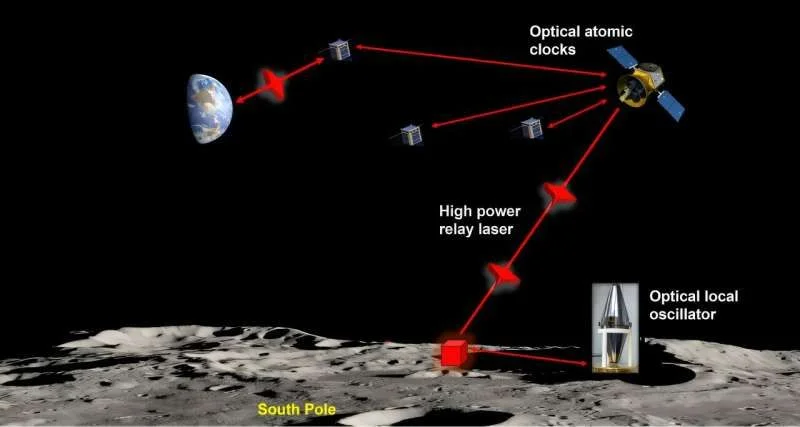
The proposed system hinges on an 'optical silicon cavity', a compact component designed to fit within an Artemis mission spacecraft. Astronauts or robotic rovers would position this cavity within the frigid, shadowed craters. The inherent stability of these lunar environments—characterized by consistent temperatures around 100 mK and minimal vibration—is key to enhancing laser performance.
Navigating the Lunar Depths
The primary envisioned application is enhancing navigation and positioning for lunar landers and rovers. Such a laser system could provide a precise reference point, reducing the risks associated with polar landings and enabling more autonomous operations.
Read More: US Space Force Victus Haze Mission Successfully Tests Orbital Intercepts
"The permanently shadowed regions on the moon remain central to long-term lunar exploration because they contain water-ice and other resources needed to maintain a human presence."
Beyond Navigation: A Cosmic Timekeeper
The potential applications extend beyond local lunar operations. The extreme stability of a lunar-based laser could serve as a 'reference laser' for Earth-based activities. The slight delay in a laser beam's travel time between the Moon and Earth—just over a second—could enable new forms of precision timing and potentially even experiments related to gravitational waves or space-time ripples.
The Science of Stability
An ultrastable laser maintains synchronized light waves for extended periods, a property known as coherence. On Earth, cryogenic silicon cavities have achieved minute-scale stability, but lunar deployment offers advantages:
Temperature Stability: Permanently shadowed craters maintain natural temperatures between 20-50 Kelvin, with projected temperatures within silicon cavities below 100 mK.
Vibration Isolation: The lunar surface inherently offers a quieter, less vibratory environment compared to Earth.
This enhanced stability is crucial for advanced optical clock development and precision metrology.
Background: A Long Shadow of Exploration
The concept emerged from discussions about instruments suitable for NASA's 'Artemis' missions. Lunar south pole craters, known for their perpetual darkness, were identified as prime locations due to their potential resources, such as water ice, crucial for sustained human presence. The development of such technology builds upon decades of research into ultrastable lasers and optical cavities, pushing the boundaries of precision measurement.
Read More: Chrome mimeHandler API lets extensions handle file types