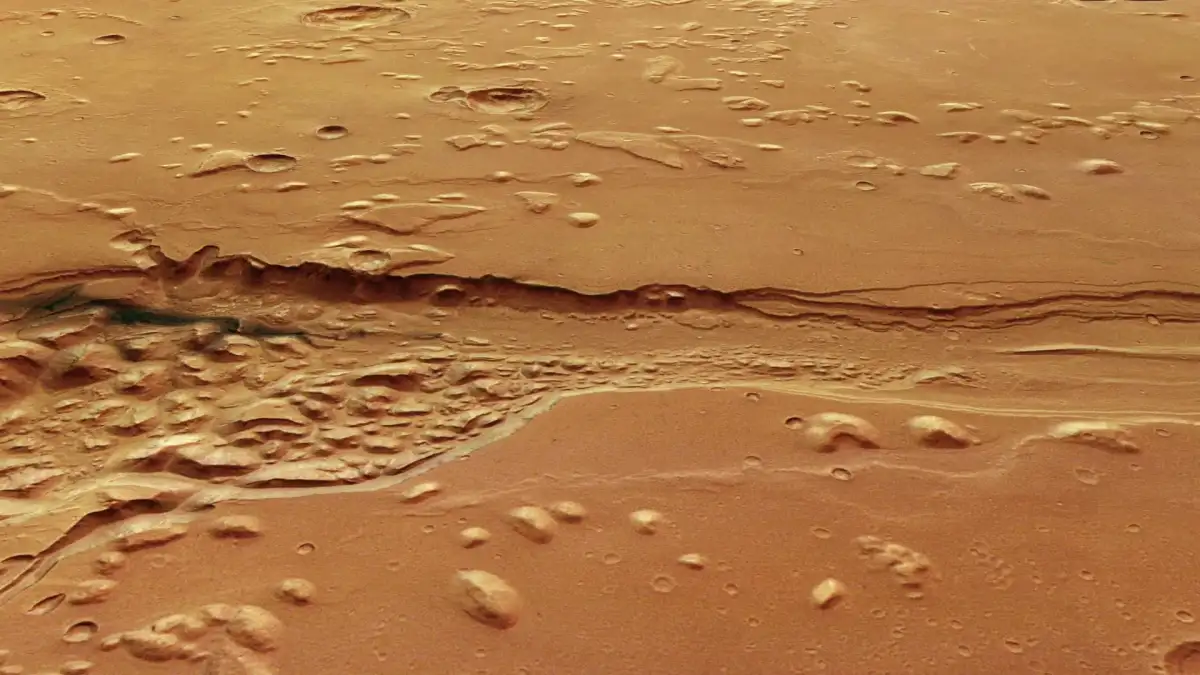
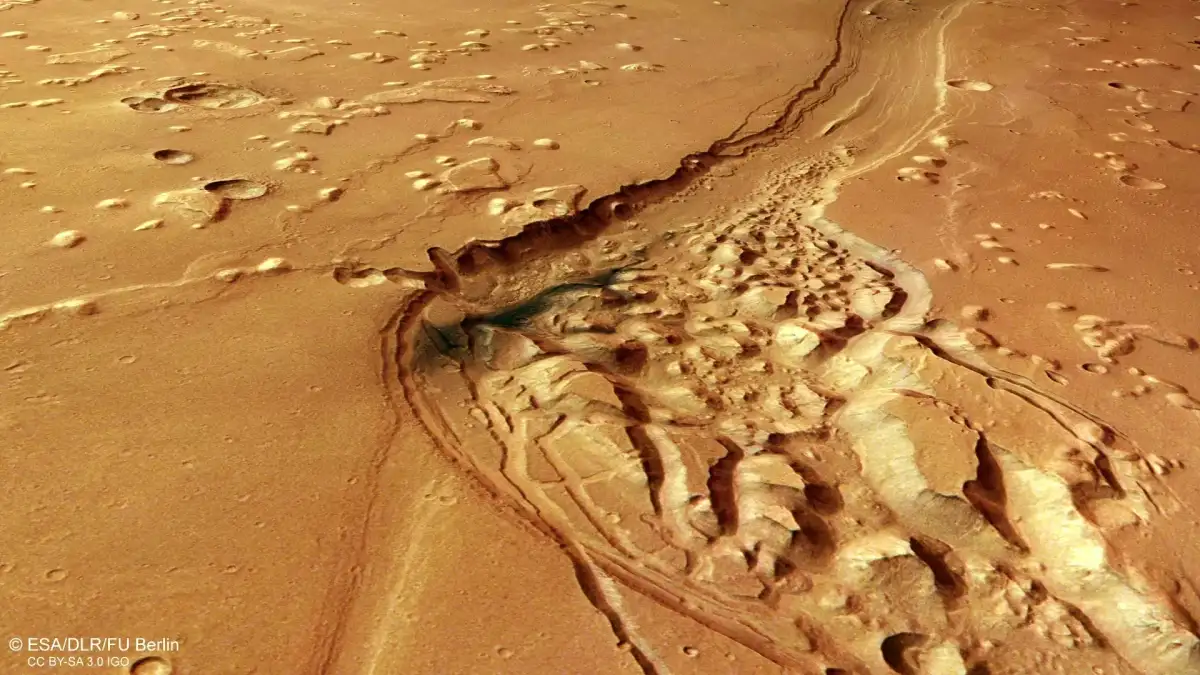
New images beamed back by the European Space Agency's Mars Express orbiter offer striking geological details of Shalbatana Vallis, a colossal valley on Mars, presenting compelling evidence of massive ancient floods. The valley, stretching approximately 1,300 kilometers—roughly the length of Italy—near the planet's equator, was carved billions of years ago when enormous volumes of groundwater burst onto the surface. This dramatic event gouged deep, winding channels across the Martian landscape, creating what is now termed "chaotic terrain" marked by craters.
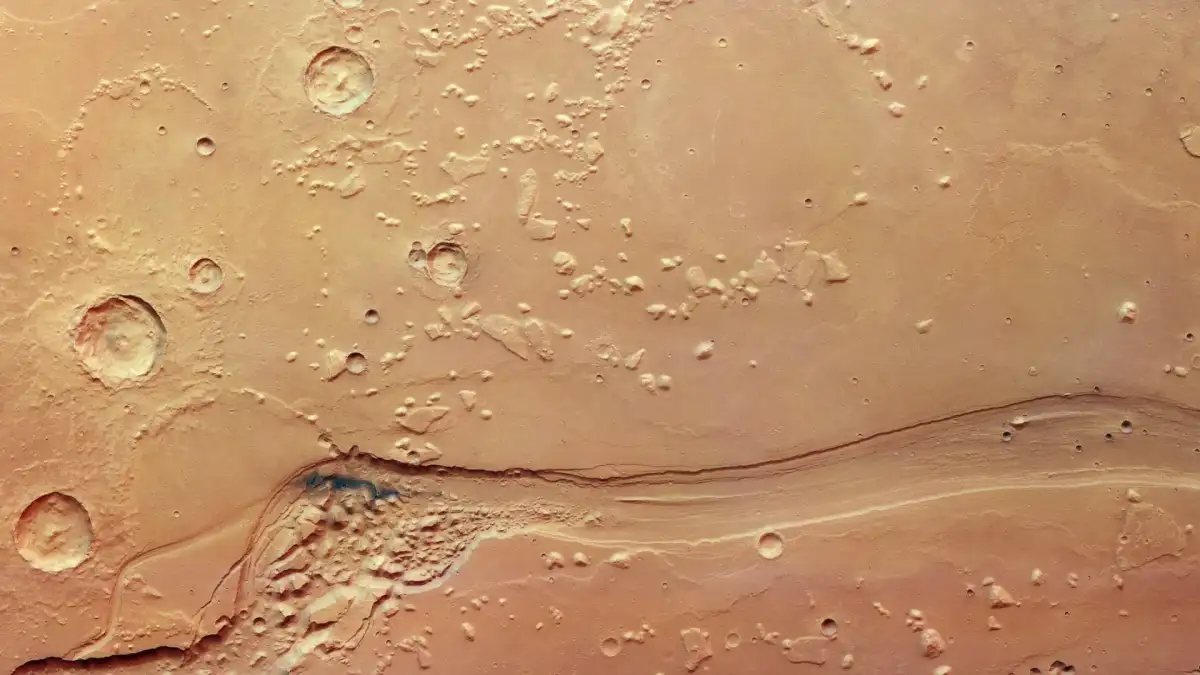
The Shalbatana Vallis region is of particular interest to scientists studying Mars's past. Its geological formations are believed to preserve crucial clues about a period when the Red Planet was significantly warmer and wetter than it is today. This renewed focus on the valley stems from images released on May 13th, which provide fresh visual data supporting theories of a once-water-rich and potentially more habitable Mars. The outflow channel of Shalbatana Vallis directs towards Chryse Planitia, a vast lowland region where some researchers have posited the existence of an ancient ocean.
Read More: NASA Robot Mission Launched to Raise Swift Telescope Orbit, Add 10 Years
A Landscape Sculpted by Water and Lava
The primary channel within Shalbatana Vallis measures about 10 kilometers wide and 500 meters deep. These dimensions are clearly discernible in topographical views of the area. The formation of Shalbatana Vallis is dated to around 3.5 billion years ago. Scientists also suspect that the valley was originally deeper, later partially filled with lava, sediment, and debris from subsequent geological events. Beyond the main channel, the surrounding plains are dotted with numerous impact craters, some of which appear to be largely buried by later deposits.

The source region of Shalbatana Vallis is identified as the approximately 100-kilometer-wide Orson Welles impact crater, situated in the highland area of Xanthe Terra. Here, the largest outflow channels on Mars converge in a pattern radiating outwards. New images from the German HRSC stereo camera aboard Mars Express provide detailed views of the middle section of this impressive geological feature.
Read More: Nevada Desert Earthquakes Near Area 52 Cause Concern

The implications of these findings extend to discussions about Mars's planetary evolution and its potential for past life. The visual evidence from Shalbatana Vallis underscores a violent geological history, shaped by both immense water flows and volcanic activity. Scientists continue to analyze these images, seeking to unravel the complex environmental conditions that once defined the Red Planet.