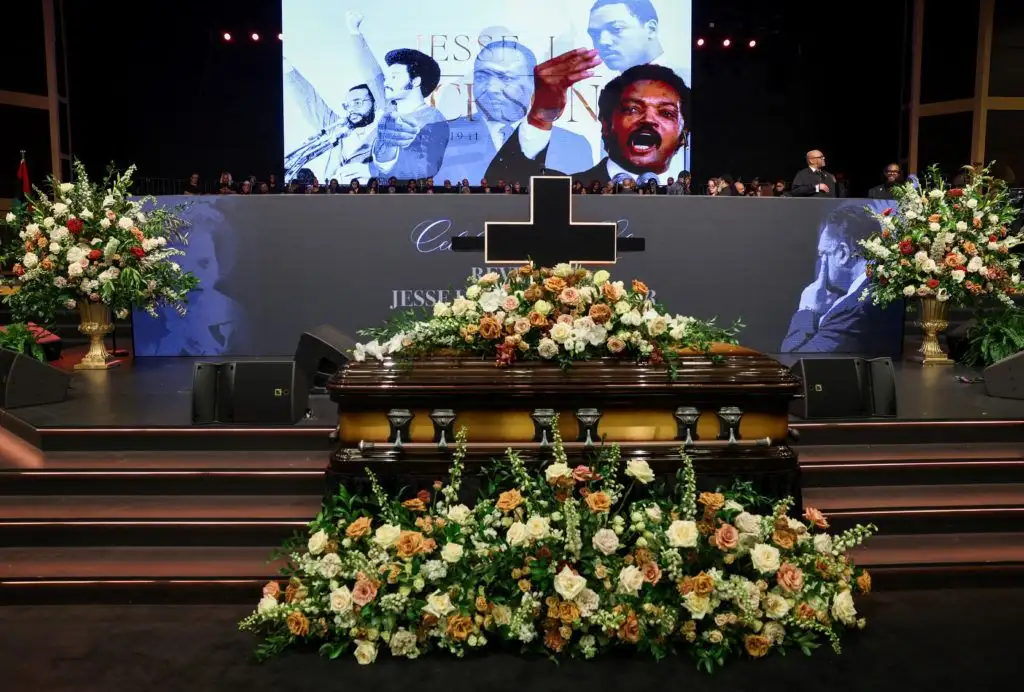
At the House of Hope on Chicago’s South Side, the state and the street converged to frame the narrative of the late Rev. Jesse Jackson. The gathering, attended by three former presidents—Barack Obama, Bill Clinton, and Joe Biden—functioned less as a traditional funeral and more as an anchoring of a specific American mythology: the activist-as-institution.
Jackson died at 84 following a neurological decline, leaving behind a complex legacy that navigates the tension between movement-based agitation and the Democratic establishment he helped expand.
| Attendee Role | Symbolic Utility |
|---|---|
| Former Presidents | Legitimization of the protest lineage within state power. |
| Local Politicians | Territorial ownership of the 'Chicago icon' narrative. |
| Cultural Figures | Transmuting the picket line into a performative moral spectacle. |
The liturgy of the day prioritized the 'Hope' refrain, centering his influence on corporate boardrooms, civil rights advocacy, and the Rainbow PUSH Coalition.
Public testimony focused heavily on interpersonal anecdotes, a common tactic for humanizing figures whose public actions often provoked polarizing discourse.
The exclusion of Donald Trump from the guest list, despite his prior social media acknowledgment of the activist, underscores the performative boundary-drawing inherent in modern political memorialization.
The Architect of ‘Somebody’
The rhetoric utilized by speakers—including Isiah Thomas and Gov. J.B. Pritzker—sought to cement Jackson not merely as a man, but as a vernacular landmark of the city. By framing Jackson as the progenitor of the phrase "I am somebody," the eulogists effectively packaged the chaotic energy of the 1970s and 80s civil rights efforts into a digestible, singular legacy of empowerment.
Read More: Taiwan Holds Nantou County Drills to Prepare for State Collapse
The persistent attempts to address past criticisms—notably by Rabbi Jacobs, who sought to distance Jackson from long-standing allegations of antisemitism—point to a concerted effort to sanitize the historical record. In the theater of the "homegoing," friction is replaced by hagiography, ensuring that the deceased is repurposed to fit current coalition-building requirements.

Contextualizing the Icon
Jesse Jackson emerged from the tradition of the Southern Christian Leadership Conference (SCLC) and eventually pivoted toward national electoral politics with his 1984 and 1988 presidential campaigns. These runs were foundational, providing the tactical blueprint for future Democratic mobilizations. His work, however, was perpetually haunted by the limitations of the electoral machine he sought to reform. By moving from the margins of radical activism into the inner circles of the Democratic Party, Jackson became a mirror for the shifts in American liberalism itself: moving away from confrontational structural critique and toward an ethics of inclusivity and moral exhortation.
Read More: Obama Presidential Center Opens in Chicago on June 3, 2026
The spectacle at the House of Hope serves as the final seal on this transformation—the rebel who eventually became the guest of honor at the very institutions he once pressured.