The night sky, a canvas of seemingly distant and independent celestial bodies, is actually a stage for a grand, ongoing cosmic drama. While we are taught that the universe is a constantly expanding entity, with galaxies drifting further apart like specks of dust in an inflating balloon, a fundamental question arises: How then can some galaxies, like our own Milky Way and its neighbor, Andromeda, be on a collision course? This apparent paradox challenges our understanding of cosmic evolution and gravity's persistent influence.
The universe's expansion, a cornerstone of modern cosmology, suggests a relentless outward movement of galaxies. Yet, the predicted merger of the Milky Way and Andromeda, a cataclysmic event billions of years in the future, points to a more complex reality. Are we witnessing a cosmic tug-of-war between the expansive force of the universe and the immutable pull of gravity? This investigation delves into the intricacies of this celestial phenomenon, questioning the simplistic narrative of universal expansion and exploring the powerful forces that govern galactic interactions.
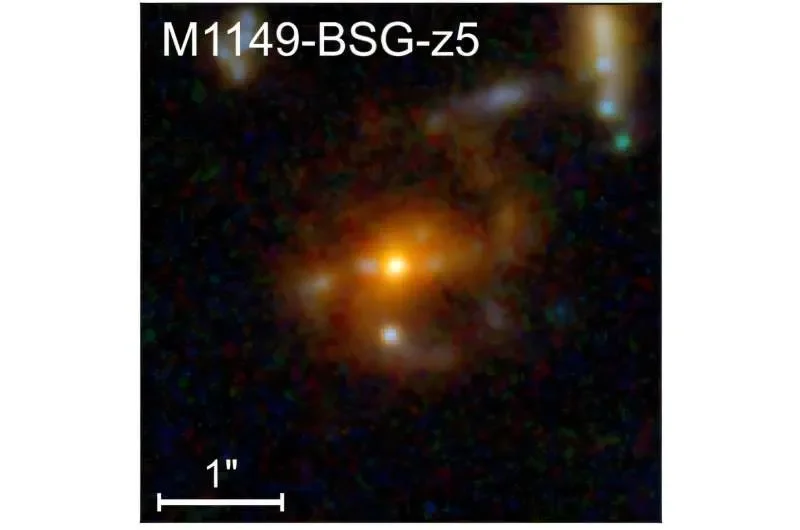
Read More: JWST Finds Oldest Barred Spiral Galaxy M1149-BSG-z5
A Universe in Motion: The Expanding Canvas
Our current understanding of the cosmos is deeply rooted in the observation that the universe is not static but is, in fact, expanding. This expansion isn't like an explosion happening into space; rather, it's the fabric of spacetime itself stretching, carrying galaxies along with it.
The Raisin Bread Analogy: A common way to visualize this is the "raisin bread" model. As dough rises, the raisins (galaxies) embedded within it move further apart from each other. The dough itself represents the expanding space. The further apart two raisins are, the faster they appear to recede from one another.
Hubble's Discovery: This concept was solidified by Edwin Hubble's observations in the early 20th century. He noticed that most galaxies are moving away from us, and the farther away they are, the faster they recede. This relationship is known as Hubble's Law.
Accelerated Expansion: Further observations, particularly those of distant supernovae, revealed an even more startling fact: the universe's expansion is not only ongoing but is actually accelerating. This has led to the hypothesis of dark energy, a mysterious force driving this acceleration.
"The farther away two points are in an expanding scale, the faster they move away from each other." (Article 3)
This fundamental principle of expansion seems to create an inherent outward drift for all celestial bodies. If everything is moving away from everything else, how can any two objects, especially vast structures like galaxies, ever get closer, let alone collide? This is the central paradox that fuels our investigation.
Gravity's Grip: The Counter-Force to Expansion
While the universe's expansion dictates a general outward movement on the largest scales, gravity acts as a localized, powerful counteracting force. Within relatively small cosmic neighborhoods, gravity can easily overcome the tendency for expansion.
The Local Group: Our Milky Way galaxy is part of a collection of galaxies known as the Local Group. This group, containing around 100 galaxies, is gravitationally bound. The two most prominent members are the Milky Way and the Andromeda galaxy.
Gravitational Binding: On scales smaller than a certain "cosmic horizon," gravity is strong enough to keep objects bound together. This means that while galaxies far beyond our Local Group are indeed receding from us due to cosmic expansion, galaxies within our immediate cosmic vicinity are held together by their mutual gravitational attraction.
Andromeda and the Milky Way: The Andromeda galaxy, our closest large galactic neighbor, is approximately 2.5 million light-years away. Despite the vastness of this distance, the gravitational pull between the Milky Way and Andromeda is substantial enough to overcome the general expansion of space between them.
"Galaxies which are very close together attract each other gravitationally, counteracting the repulsive force of the expanding universe." (Article 5)
This gravitational dominance on local scales is crucial. It explains why, despite the universe's expansion, galaxies can form clusters, groups, and ultimately, engage in cosmic collisions. It’s as if individual raisins in the rising bread dough are held together by their own sticky surfaces, preventing them from being pulled apart by the dough's expansion.
Read More: What Was Before the Big Bang? Scientists Explore Ideas
| Cosmic Scale | Dominant Force | Galactic Motion | Example |
|---|---|---|---|
| Very Large Scale | Expansion (Dark Energy) | Galaxies move away from each other (accelerating) | Distant galaxy clusters receding |
| Local Scale | Gravity | Galaxies attract each other | Milky Way and Andromeda approaching each other |
| Within Galaxies | Gravity | Stars orbit galactic centers | Solar system orbiting the Milky Way's core |
The Andromeda-Milky Way Rendezvous: A Billions-Year Journey
The impending collision between the Milky Way and Andromeda is not a sudden event but a long-anticipated cosmic dance. Astronomers predict this merger will occur in approximately 4.5 billion years.
Initial Approach: Currently, Andromeda is approaching the Milky Way at a speed of about 110 kilometers per second (roughly 250,000 miles per hour). This speed is a result of gravitational attraction, not the outward push of cosmic expansion.
The Merger Process: When the two galaxies collide, it will be a slow, drawn-out process spanning hundreds of millions, if not billions, of years. The stars within each galaxy are so far apart that direct stellar collisions will be rare. However, the gravitational interactions will distort both galaxies, trigger intense bursts of star formation, and eventually lead to the formation of a single, larger elliptical galaxy.
Future Sky: Inhabitants of Earth, if they still exist in some form, will witness a spectacular celestial show. Over eons, Andromeda will grow larger in our sky, eventually dominating the view. After the merger, the night sky will look dramatically different, with a single, giant galaxy filling much of it.
"If the accelerating expansion of the universe is driving galaxies away from each other, how is it that the Andromeda and Milky Way galaxies are on a collision course?" (Article 1)
This collision highlights that the universe is not a uniform expanse where expansion dictates all motion. Instead, it's a dynamic arena where local gravitational forces can dominate, leading to profound interactions and transformations of cosmic structures.
Beyond the Local Group: Expansion Dominates
While gravity holds together local collections of galaxies like our Local Group, the universe's expansion exerts its influence on larger scales.
Cosmic Horizon: There's a limit, often referred to as the cosmic horizon or the edge of the gravitationally bound universe, beyond which the expansion of space outpaces gravity's pull. Galaxies beyond this horizon are indeed moving away from us, and the further they are, the faster they recede.
Galaxy Clusters and Superclusters: Even within larger structures like galaxy clusters and superclusters, while gravity plays a role in keeping the cluster bound, the expansion of space can still be observed affecting the distances between these massive structures over cosmological timescales.
Gravitational Growth Limitations: On scales significantly larger than galaxy groups, gravitational growth doesn't occur in the same way. The time it takes for gravitational signals to traverse these vast distances, coupled with the expansion of space, means that large-scale structures are largely determined by initial density fluctuations from the early universe, rather than ongoing gravitational accretion across the entire expanse.
"On scales greater than the cosmic horizon, gravitational growth doesn’t occur until the cosmic horizon overtakes them, meaning that growth doesn’t occur on those larger scales." (Article 6)
Therefore, the apparent contradiction is resolved by understanding that cosmic expansion and gravitational attraction operate at different scales, influencing galactic motion in distinct ways. It’s not a case of one force negating the other, but rather a dynamic interplay.
Implications and Unanswered Questions
The collision course of the Milky Way and Andromeda serves as a tangible example of gravity's enduring power within an expanding universe. It reassures us that the universe is not a featureless void but a structured cosmos where interactions shape its evolution.
Read More: Astronomers' discoveries about comets and cosmic background radiation explained
However, this phenomenon also raises deeper questions:
The Nature of Dark Energy: If dark energy is accelerating the universe's expansion, will it eventually overcome gravity even on local scales, leading to a future where even bound galaxy groups begin to fly apart?
The Role of Galaxy Mergers in Life: Article 9 suggests galaxy collisions and mergers could have made the universe more life-friendly. What are the specific mechanisms through which this occurs, and how significant is this factor in the development of habitable environments?
The Fate of the Universe: The ultimate fate of the universe hinges on the balance between expansion driven by dark energy and the gravitational pull of matter. Understanding local galactic dynamics helps us refine our models for the universe's long-term evolution.
The Andromeda-Milky Way collision is more than just a future astronomical event; it's a living testament to the complex physics governing our cosmos. It reminds us that even in an ever-expanding universe, the intimate dance of gravity continues to sculpt galaxies and shape their destinies.
Sources:
Article 1: Ask Astro: If the universe is expanding, why will the Milky Way and Andromeda galaxies collide? - Astronomy.com (May 18, 2023) - https://www.astronomy.com/science/ask-astro-if-the-universe-is-expanding-why-will-the-milky-way-and-andromeda-galaxies-collide/
Article 2: If the universe is expanding, how are the Milky Way and Andromeda getting closer together? - BBC Science Focus Magazine (July 12, 2023) - https://www.sciencefocus.com/space/if-the-universe-is-expanding-how-are-the-milky-way-and-andromeda-getting-closer-together
Article 3: How can galaxies ever collide in an ever-expanding universe? - Scientific American (Accessed December 1, 2023) - https://www.scientificamerican.com/article/if-the-universe-is-expanding-how-can-galaxies-collide/
Article 4: How can galaxies collide if the universe is expanding? - ABC Science (August 23, 2011) - https://www.abc.net.au/science/articles/2011/08/23/3300155.htm
Article 5: Colliding Galaxies in a Expanding Universe? - Big Think (September 30, 2021) - https://bigthink.com/guest-thinkers/colliding-galaxies-in-a-expanding-universe/
Article 6: Ask Ethan: Why do galaxies still collide in the expanding Universe? - Big Think (March 14, 2025) - https://bigthink.com/starts-with-a-bang/why-galaxies-still-collide-expanding-universe/
Article 7: How can galaxies collide if everything moving outwards - Physics Stack Exchange (Accessed December 1, 2023) - https://physics.stackexchange.com/questions/37907/how-can-galaxies-collide-if-everything-moving-outwards
Article 8: Galaxies, the expanding universe, and the Big Bang - Princeton University Press (Accessed December 1, 2023) - https://press.princeton.edu/ideas/galaxies-the-expanding-universe-and-the-big-bang
Article 9: Galaxy collisions and mergers explained - Sky at Night Magazine (October 2, 2024) - https://www.skyatnightmagazine.com/space-science/galaxy-collisions
Article 10: How is the Milky Way on a collision course with Andromeda when the universe is expanding? - Astronomy Stack Exchange (Accessed December 1, 2023) - https://astronomy.stackexchange.com/questions/23992/how-is-the-milky-way-on-a-collision-course-with-andromeda-when-the-universe-is-e
Article 12: Future of an expanding universe - Wikipedia (December 24, 2025) - https://en.wikipedia.org/wiki/Futureofanexpandinguniverse