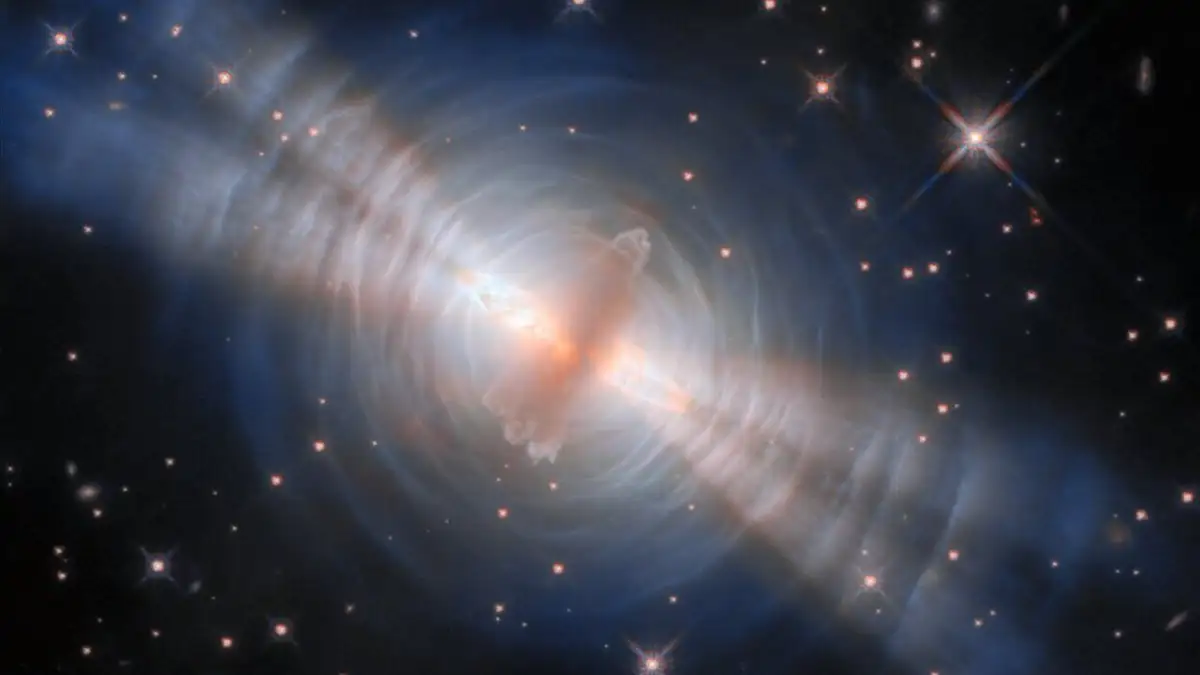
The Hubble Space Telescope has delivered a new, highly detailed image of the Egg Nebula, offering scientists a rare glimpse into the final stages of a Sun-like star's life. This transitional phase, known as a pre-planetary nebula, is brief, lasting only a few thousand years. The Egg Nebula, situated approximately 1,000 light-years away, serves as a critical case study for understanding how stars shed their outer layers and contribute to the cosmic material that forms new solar systems. The latest observations aim to refine theories on stellar evolution by examining the intricate structures of dust and gas ejected by the dying star.
Cosmic Canvas of a Dying Star
The Egg Nebula is a celestial object approximately 1,000 light-years from Earth, located in the constellation Cygnus. It represents a pre-planetary nebula, an early stage in the life cycle of a Sun-like star that is nearing its end.
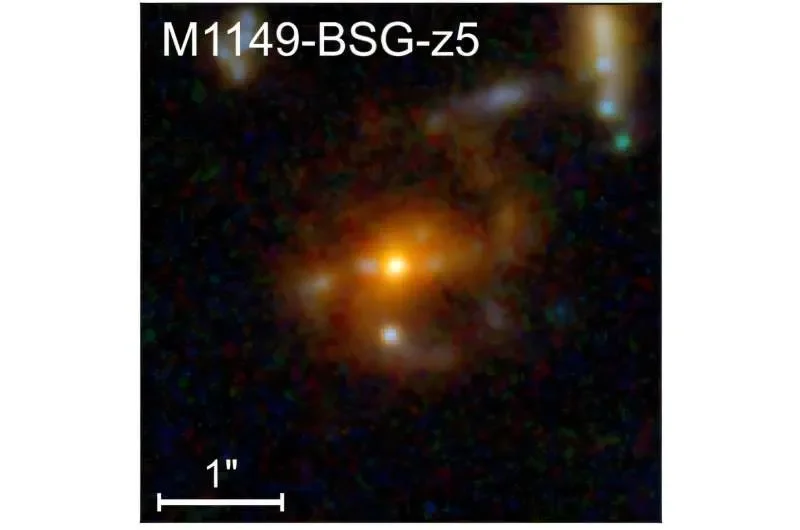
Read More: JWST Finds Oldest Barred Spiral Galaxy M1149-BSG-z5
Stars, much like our own Sun, exhaust their core fuel (hydrogen and helium) over vast timescales.
As this fuel depletes, the star begins to shed its outer layers.
The Egg Nebula is in a fleeting period, the pre-planetary stage, before it fully develops into a planetary nebula.
This transitional phase is understood to last only a few thousand years.
Hubble's Unprecedented View
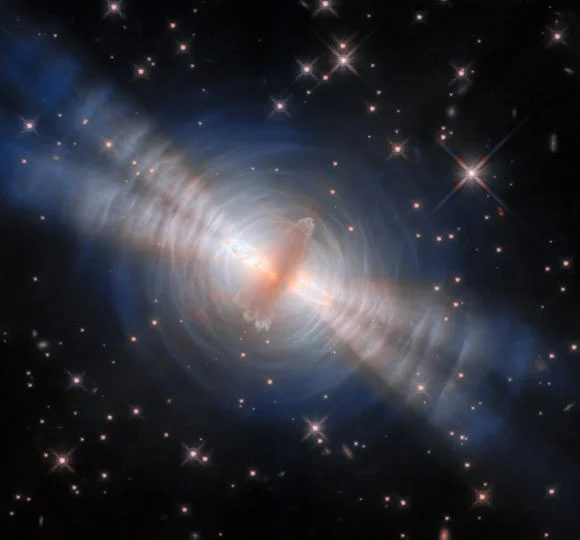
Recent observations by the Hubble Space Telescope have provided the most detailed images of the Egg Nebula to date. These new visuals allow astronomers to study the nebula's features with greater precision.
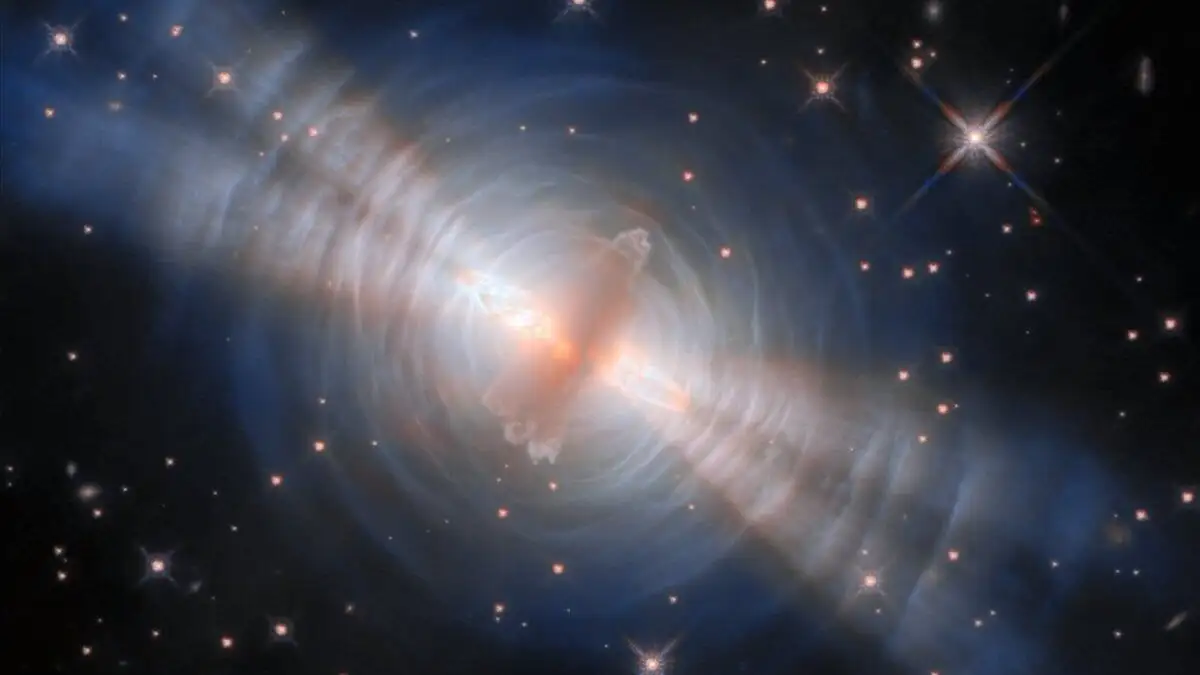
The image captures the dense layer of gas and dust surrounding a central, hidden star.
It reveals twin beams of light emanating from the star, illuminating fast-moving polar lobes.
These lobes are seen piercing through older, concentric arcs of material, indicating a layered structure formed over time.
The bright orange highlights in some images signify the presence and glow of infrared light.
The Egg Nebula's compact nature and its position in the pre-planetary stage make it an ideal subject for observing the mechanics of stellar death while the evidence of this process is still "fresh."
Insights into Stellar Evolution and Origins
The Egg Nebula's structure offers valuable data for astrophysical research, particularly in understanding stellar evolution and the origins of planetary systems.
Dust Ejection: The nebula's intricate dust shells and arcs are believed to be the result of sporadic "sputtering events" from the star's core.
Formation of Solar Systems: Aged stars, like the one in the Egg Nebula, are credited with creating and dispersing the dust that eventually forms new stars and planets, including our own Solar System.
Testing Theories: The nebula provides a unique opportunity to test and refine existing theories about the late stages of stellar evolution.
The Mystery of Companion Stars
Observations suggest that the shape and movement of the nebula's components might be influenced by unseen celestial bodies.

The specific shapes and motions of the polar lobes and arcs suggest potential gravitational interactions.
These interactions may be caused by one or more hidden companion stars.
Such companions would be buried deep within the central, thick disk of stardust.
The potential gravitational influence of hidden companion stars adds a layer of complexity to the understanding of the Egg Nebula's formation and dynamics.
A Legacy of Observation
The Hubble Space Telescope has been observing the Egg Nebula for decades, accumulating a valuable archive of data.
Read More: US Space Force Victus Haze Mission Successfully Tests Orbital Intercepts
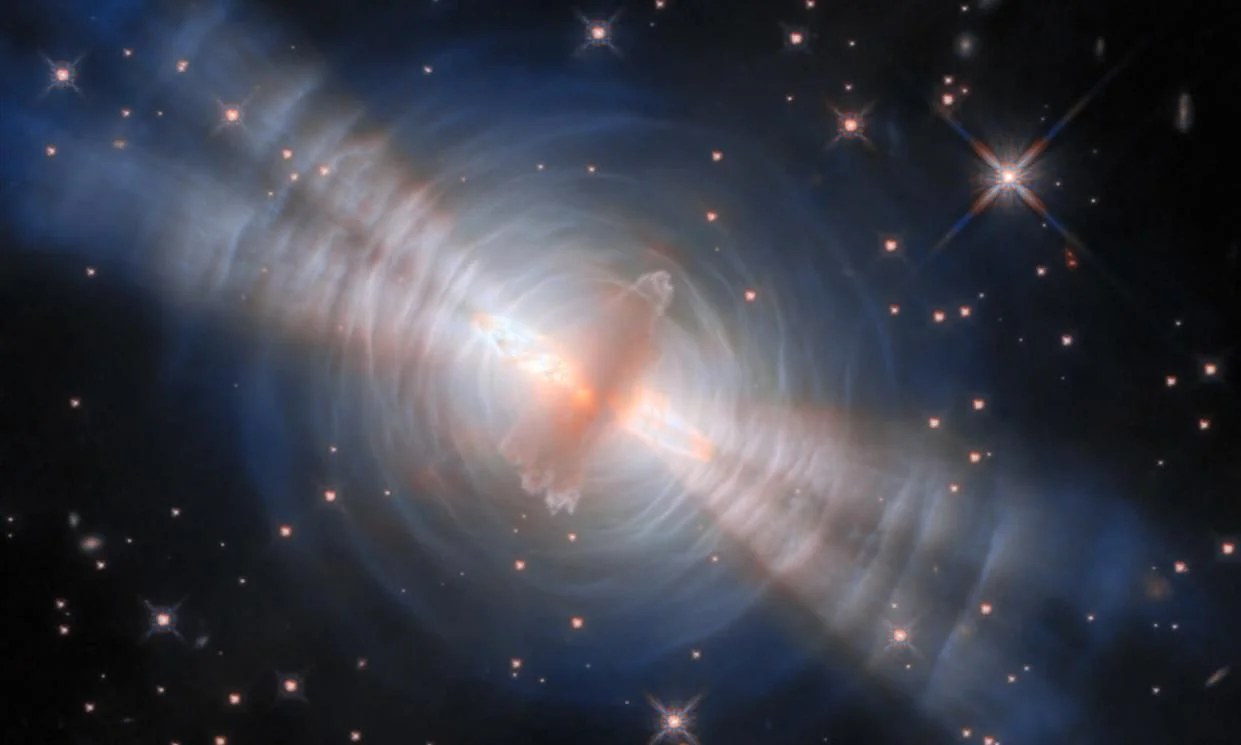
This ongoing observation allows scientists to compare images from different eras.
By analyzing these images, astronomers can track the evolution of tiny features within the nebula's dust shell.
The NASA/ESA Hubble collaboration underscores the international effort in space exploration and astrophysical discovery.
Expert Perspectives
Astronomers emphasize the significance of the Egg Nebula as a window into cosmic processes.
"The nebula offers a rare opportunity to test theories of late-stage stellar evolution." - Hubble astronomers
"This light emerges from a dusty disk expelled from the star’s surface just a few hundred years ago." - Hubble astronomers
"Twin beams from the dying star illuminate fast-moving polar lobes that pierce a slower, older series of concentric arcs." - Hubble astronomers
"Their shapes and motions suggest gravitational interactions with one or more hidden companion stars, all buried deep within the thick disk of stardust." - Hubble astronomers
The consistency in descriptions across multiple reports highlights the established scientific interpretation of the Egg Nebula's features and their implications.
Conclusion and Future Study
The latest Hubble images of the Egg Nebula provide an unprecedentedly detailed view of a crucial, yet brief, stage in stellar life. This cosmic object is vital for understanding:
The process by which stars like our Sun end their lives.
The generation and distribution of elements that form new stars and planets.
The complex dynamics that can occur within stellar systems, potentially involving unseen companions.
Continued analysis of Hubble's extensive data on the Egg Nebula is expected to further refine astrophysical models and deepen our comprehension of the universe's ongoing evolution. The ability to revisit and compare historical observations with new ones is a testament to the enduring value of the Hubble mission.
Sources
NASA Science: https://science.nasa.gov/missions/hubble/nasas-hubble-captures-light-show-around-rapidly-dying-star
Summary: Focuses on the pre-planetary stage and the dual beams illuminating polar lobes.
ESA Hubble: https://esahubble.org/news/heic2604/
Summary: Highlights the Egg Nebula as the first, youngest, and closest pre-planetary nebula and notes the international collaboration.
Summary: Emphasizes the spectacular image, the details of light and dust, and the ability to analyze evolution through comparative images.
Sci.News: https://www.sci.news/astronomy/hubble-egg-nebula-14546.html
Summary: Provides location, details on cosmic dust and stellar winds, quotes about testing theories, and mentions potential companion stars and sputtering events.
Mashable: https://mashable.com/article/hubble-new-image-egg-nebula
Summary: Describes the new image as peeling back dust layers around a dying star, foreshadowing the Sun's end.
Scientificult: https://scientificult.it/en/2026/02/10/hubble-captures-a-light-show-around-a-rapidly-dying-star-a-white-dwarf-in-the-egg-nebula/
Summary: Reinforces the Egg Nebula's status as the first, youngest, and closest pre-planetary nebula and the value of revisiting its data.
Quantum Zeitgeist: https://quantumzeitgeist.com/nasa-hubble-space-telescope-egg-nebula/
Summary: Mentions Hubble's Wide Field Camera 3, the nebula's distance, its role in stellar evolution, and links dying stars to solar system origins.
Summary: Calls the new image the clearest view yet and notes the presence of infrared light indicated by orange highlights.
AZoQuantum: https://www.azoquantum.com/News.aspx?newsID=11047
Status: Low Priority. Summary: Extraction failed or content too short. (Excluded due to insufficient summary).