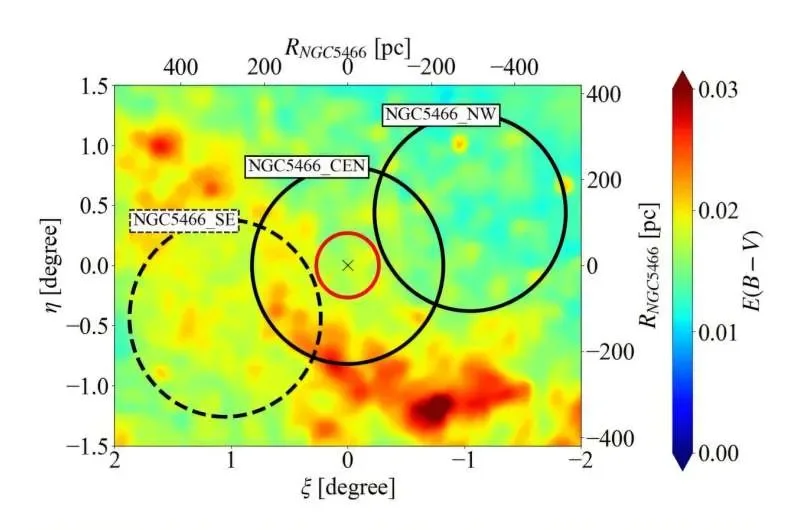
A recent study using the Subaru Telescope has revealed a notable gap within the tidal stream of NGC 5466, a globular cluster. This finding offers new insights into the cluster's structure and how it interacts with its galactic environment. The tidal stream, a trail of stars pulled from the cluster, has been known for two decades, yet its exact shape and properties remain somewhat uncertain. This observation provides finer detail on these characteristics.
Globular clusters are dense groups of stars, often found orbiting larger galaxies. When a smaller object like a globular cluster or a dwarf galaxy comes too close to a massive galaxy, the stronger gravitational pull on the near side and the weaker pull on the far side can stretch and tear the smaller object apart. This process creates a tidal stream – a long, faint ribbon of stars that can extend for thousands of light-years. Studying these streams helps astronomers understand the forces acting on celestial bodies and the history of their interactions. NGC 5466 is described as a large but dim globular cluster, spanning about 238 light-years and possessing a mass equivalent to 179,000 suns.
Read More: JWST Finds Oldest Barred Spiral Galaxy M1149-BSG-z5

Tracing the Tidal Stream of NGC 5466
The existence of a tidal stream around NGC 5466 has been recognized for at least 20 years. These streams are typically formed when a galaxy's gravity pulls stars away from a less massive object, such as a globular cluster or a satellite galaxy. The resulting stream is composed of these stripped stars, often forming a long, diffuse trail in space.
A previous investigation, as detailed in a March 2022 publication, aimed to revisit the NGC 5466 tidal stream. This study utilized data from multiple sources, including the Gaia space observatory, the SDSS/SEGUE survey, and the LAMOST telescope. The goal was to identify and analyze the member stars of the stream, comparing observational data with simulated streams.

Subaru Telescope's Observational Campaign
A recent observational campaign conducted with the Subaru Telescope focused on obtaining a more detailed understanding of NGC 5466's tidal stream. The proposal for this observation (S23A0040) highlighted the unique capabilities of the Subaru/HSC (Hyper Suprime-Cam) instrument. Its wide-field view allowed for coverage extending beyond two times the cluster's tidal radius, while also being sensitive enough to detect dimmer stars, including those on the main sequence.
Read More: US Space Force Victus Haze Mission Successfully Tests Orbital Intercepts
The primary objective was to analyze the physical properties of the tidal stream, specifically its shape (length and width), orientation, and the distribution of stellar masses within it. This level of detail was intended to constrain the dynamical evolution and formation of the tidal stream with high statistical significance.

A previous attempt under program S22A-113 had managed to capture narrow-band NB395 photometry of the cluster's central and north-western regions. However, poor transparency conditions during that observation period prevented the acquisition of corresponding g and i-band data, which were planned to go significantly deeper.
Read More: Astronomers' discoveries about comets and cosmic background radiation explained
Unveiling an Intrinsic Gap
The latest findings, published on February 4th, 2026, on the arXiv preprint server, indicate the discovery of a distinct gap within the tidal stream of NGC 5466. While the tidal stream has been a subject of study for years, its detailed morphology and properties have remained less defined. This newly observed gap provides a significant piece of evidence for understanding the stream's structure.

The observational campaign's results are described as yielding important information about the stream's structure. The presence of this gap suggests that the tidal stream is not a continuous, unbroken entity but rather possesses internal variations.
Interpretation of the Gap
The significance of this gap is open to interpretation. Tidal streams are shaped by complex gravitational interactions. A gap could potentially indicate:
Read More: Magnetic Fields Help Binary Stars Form Faster, New Study Shows
Disruptions in Formation: The initial process of stars being stripped from the globular cluster might not have been uniform, leading to periods where fewer stars were ejected.
Interactions with the Galactic Environment: Could the stream have passed through a region of space containing denser gas or dark matter that disrupted its continuity?
Dynamical Processes within the Stream: Once formed, tidal streams can evolve. Were there internal processes that caused a localized depletion of stars?
The observation of this gap implies that the processes forming and shaping NGC 5466's tidal stream are complex and may involve distinct phases or external influences.
Expert Analysis and Further Research
The discovery of an intrinsic gap in the tidal stream of NGC 5466 presents an opportunity for further investigation into the dynamics of globular clusters and their interactions with host galaxies. Future studies could aim to:
Precisely map the extent and depth of the gap.
Analyze the stellar populations on either side of the gap for differences.
Model the gravitational forces and past encounters that could have created such a feature.
This finding underscores the value of detailed observational campaigns using advanced telescopes like the Subaru Telescope in refining our understanding of galactic structures and their evolution.
Source 1: Subaru observations suggest an intrinsic gap in NGC 5466's tidal stream - Phys.org
Context: News report summarizing recent findings published on arXiv.
Link: https://phys.org/news/2026-02-subaru-intrinsic-gap-ngc-tidal.html
Source 2: Revisit NGC 5466 tidal stream with Gaia, SDSS/SEGUE, and LAMOST - Oxford Academic (MNRAS)
Context: Academic paper detailing previous efforts to study the NGC 5466 tidal stream using multi-source data.
Link: https://academic.oup.com/mnras/article/513/1/853/6556019
Source 3: S23A0040 - Subaru Telescope Past Proposals
Context: Abstract for a successful observation proposal outlining the scientific goals and instrumental capabilities for studying NGC 5466.
Link: https://subarutelescope.org/Proposals/Pastinfo/S23Aabstract/S23A0040.html
Source 4: Subaru/HSC NB395 view of NGC 5466: metallicity, mass function, and the nature of its tidal stream - arXiv
Context: Research paper detailing observations of NGC 5466 using Subaru/HSC. Published on February 4, 2026.