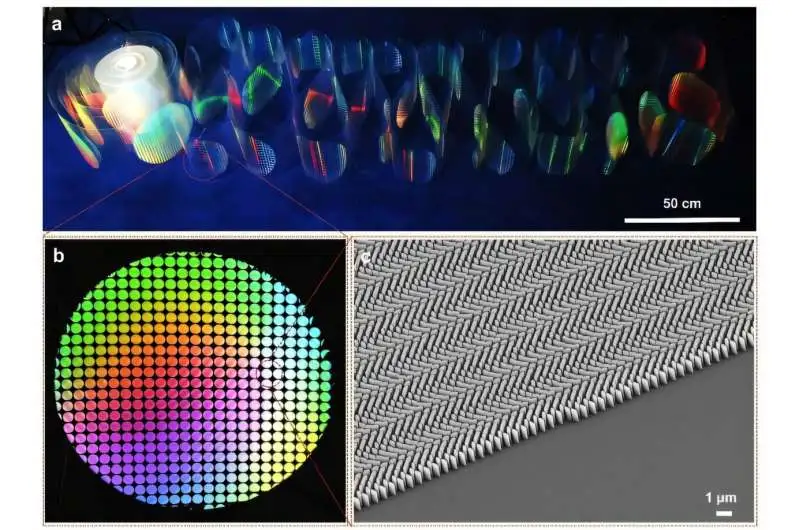
Researchers at Sungkyunkwan University and POSTECH have unveiled a fully automated roll-to-roll manufacturing platform capable of producing large-area visible metalenses at an unprecedented rate. The system churns out 300 metalenses per second, each 1 cm in diameter, using nanoimprint lithography on 12-inch scale molds. This marks a significant stride towards the industrial deployment of flat optics, moving beyond laboratory confines.
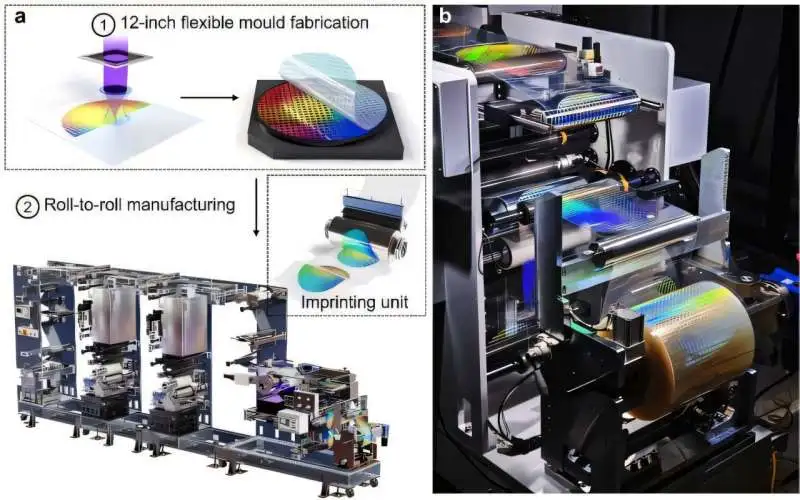
The innovation centers on a custom-built nanoimprint lithography system operating at the 12-inch scale. This automated process achieves feature resolutions down to 80 nm, imprinting a 12-inch mold every 1.5 seconds. This speed directly translates to the high throughput of individual metalenses. For the first time, the team has demonstrated the mass production of 200-meter-long metalens arrays, reporting high yield and consistent functionality across the entire expanse. This successful validation underscores the viability of the roll-to-roll nanoimprint lithography for scalable, high-quality metasurface manufacture.
Read More: Taiwan Landslide: Fiber Optics Show Deep Hidden Movement
The core of this advancement lies in the adaptation of roll-to-roll manufacturing, typically seen in printing, to the precise demands of nanostructure fabrication for optical components. The replicated metalenses are subsequently treated with a titanium dioxide (TiO₂) layer via atomic layer deposition (ALD), a process recognized for its scalability and integration into existing industrial workflows, to further enhance their optical properties.
Production Breakthroughs
The reported advancements address long-standing technical hurdles in metalens commercialization. Key innovations enabling this industrial scale while maintaining optical performance and uniformity include:
Automated Roll-to-Roll Nanoimprint Lithography: This system stamps out 12-inch molds at a rapid pace, crucial for high-volume output.
Streamlined Mold Path: This element is cited as reducing both cost and complexity in the manufacturing workflow.
High-Precision Master Fabrication: The process begins with a 12-inch silicon master created using E-beam writing and DUV lithography.
This research, published in Nature, has been described as a "major step toward commercialization of flat optics." The team anticipates this approach will bolster broader industrial efforts to integrate metasurface optics into future iterations of imaging, display, sensing, and consumer electronic devices.
Metalenses: A New Paradigm in Optics
Metalenses represent a departure from traditional, bulky lenses. They are flat, ultrathin optical components comprised of meticulously arranged two-dimensional arrays of subwavelength nanostructures. These nanostructures enable precise control over light, offering a compact and lightweight alternative to conventional optical systems. Companies like Corlens are already marketing metalens-based optics for various applications, including autonomous systems, defense, thermal imaging, and aerospace, where factors like size, weight, and reliability are paramount.
Read More: New Nanomedicine Targets Cancer Cells With No Side Effects
While this breakthrough promises reduced per-unit manufacturing costs, it's worth noting that considerations such as quality control, metrology requirements, and wafer-scale uniformity issues have historically added substantial overhead and complexity to metalens production. The move towards roll-to-roll manufacturing appears poised to mitigate some of these challenges, as exemplified by Epson's own efforts to incorporate precision positioning and quality control for consistent metalens performance at scale.