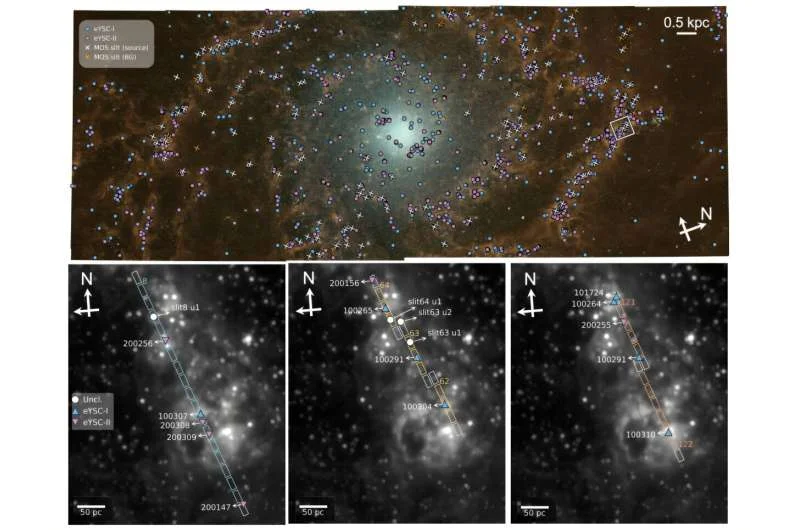
The James Webb Space Telescope (JWST) has peered into the nearby spiral galaxy NGC 628, revealing nascent star clusters still shrouded in their birthplaces. These "emerging young star clusters" are actively influencing their surroundings, a crucial stage in understanding galactic evolution. Observations indicate that as these clusters mature and shed their cocoons, emissions from molecular hydrogen and polycyclic aromatic hydrocarbons (PAHs) diminish. This suggests a direct link between a cluster's emergence and the dissipation of these key interstellar components.

The findings emerge from the 'Feedback in Emerging extrAgalactic Star clusTers' (FEAST) program. Astronomers are using these insights to better grasp the intricate processes of star formation, how stars change over time, and the dynamics of galaxies themselves. Early findings suggest a pattern: younger, more embedded clusters exhibit higher levels of molecular hydrogen and PAH emissions, which decrease as they become more visible.
Read More: JWST Finds Oldest Barred Spiral Galaxy M1149-BSG-z5

Spatial Behavior Varies
Further analysis of the cluster catalogue in NGC 628 indicates that a cluster's movement and distribution across the galaxy are not uniform. These spatial characteristics shift based on a cluster's location within the galaxy, its age, and its mass. Researchers noted a complex relationship between age and mass, cautioning against oversimplified divisions of clusters solely by size, as lower-mass clusters tend to represent younger populations and higher-mass clusters older ones. An age limit of 100 million years was applied to samples when studying mass-restricted groups.

PAH Destruction Observed
The FEAST program specifically highlights the destruction of polycyclic aromatic hydrocarbons (PAHs) within NGC 628 during this emergent phase of star formation. This observation, detailed in The Astrophysical Journal, points to energetic processes at play as stars begin to dominate their local environments. The study is part of a larger effort to catalog and analyze these early stellar nurseries.
Read More: US Space Force Victus Haze Mission Successfully Tests Orbital Intercepts

Background: NGC 628 and JWST
NGC 628, also known as Messier 74, is a well-studied spiral galaxy located approximately 32 million light-years away. Its face-on orientation makes it an ideal target for observing galactic structures. The JWST, with its unparalleled infrared capabilities, is uniquely suited to pierce through the dust and gas that obscure these star-forming regions, providing unprecedented detail of their early, often fleeting, stages. The FEAST program leverages JWST's advanced instrumentation, including NIRSpec/MOS, to survey these extragalactic star clusters.