New research flights, the first of their kind in two decades, are providing detailed insights into how clouds form over Antarctica. Scientists are using this data to better understand the role of tiny particles, called aerosols, in this process. This knowledge is crucial for improving climate models and predicting future weather patterns, as Antarctica plays a significant part in the Earth's overall climate system.
How Clouds Form in Antarctica
Clouds are formed when water vapor in the air turns into tiny liquid water droplets or ice crystals. This usually happens when the vapor collects on small particles floating in the atmosphere.
These particles are called aerosols.
Aerosols can be made of different things, such as sea salt, dust, or soot.
In Antarctica, the exact way these aerosols and clouds interact is still being studied.
Unlocking Atmospheric Secrets: The SANAT Campaign
A major effort, known as the SANAT flight campaign, has been launched by several scientific groups. This campaign involves flying special research planes equipped to measure aerosols and other atmospheric conditions.
The goal is to gather detailed information about where aerosols come from, how they move, and how they affect cloud formation.
This work builds upon previous studies but offers new, more precise measurements.
The data gathered will help make climate models more accurate, leading to better predictions about climate change.
Insights from New Measurements
Recent scientific flights have provided unprecedented data on Antarctic aerosols and their connection to cloud formation.
Read More: Indigenous Data Rights Now Key in Conservation Genomics
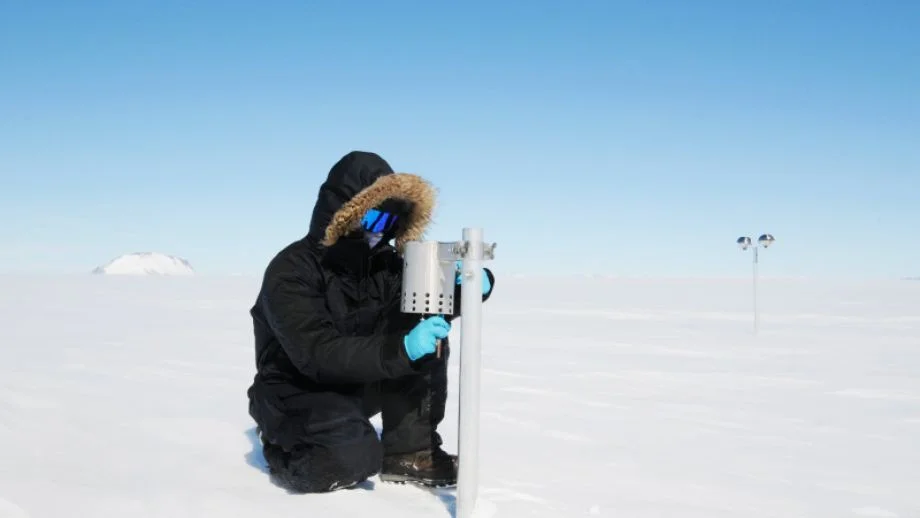
Flight-based measurements: The Polar 6 research aircraft has been instrumental, collecting aerosol data from the air.
Ground-based data: Alongside the flights, measurements were also taken from Neumayer Station III, a permanent research base.
Comprehensive data: This combined approach has yielded detailed information on:
How often aerosols are present.
How they move in small-scale atmospheric processes.
Their chemical makeup.
Weather factors like air pressure, temperature, and water vapor.
Different Types of Antarctic Clouds
While the Antarctic atmosphere is generally very cold, clouds there can contain both water droplets and ice crystals.
Ice crystal formation: For ice crystals to form, a specific type of particle, known as an ice nucleus, must be present for the ice to grow upon.
Water droplets: Even in very cold clouds, many water droplets can exist without ice if the right nuclei are missing.
Noctilucent clouds: At very high altitudes (around 80 km), silvery clouds called noctilucent clouds form during the summer months.
Observing Atmospheric Ripples
Satellite technology is also offering new ways to study clouds in Antarctica.
The EarthCARE satellite mission can now see and measure "gravity waves" within clouds.
These are like ripples in the atmosphere that can affect how clouds form.
By studying these waves, scientists can understand how they influence ice cloud formation.
Challenges and Ongoing Research
Studying Antarctic clouds presents unique challenges due to the harsh environment.
Research teams are working to understand the composition of clouds, especially polar stratospheric clouds.
Data from satellites like ACE, CALIPSO, and MIPAS are used alongside models to study these clouds.
Past studies have highlighted the need for more up-to-date information, with some research being the first of its kind in decades.
Expert Analysis
"Understanding aerosol-cloud interactions in Antarctica transcends mere academic interest." This highlights the global importance of this research for climate prediction.
The SANAT campaign's data is expected to "enhance the parameterization of aerosol-cloud interactions within climate models, thus refining predictions and reducing uncertainties associated with future climate change scenarios." This underscores the practical application of the findings.
Given Antarctica's "integral position in the planetary climate system, modifying aerosol concentrations and cloud properties could have cascading effects on climate feedback mechanisms, influencing not only regional but also global weather patterns and climate trajectories." This points to the far-reaching impacts of changes in Antarctic clouds.
Conclusion
The SANAT flight campaign and other recent research efforts, including satellite observations, are significantly advancing our understanding of cloud formation in Antarctica. By gathering detailed measurements of aerosols and atmospheric conditions, scientists are improving the accuracy of climate models. This work is vital for comprehending how changes in this remote region can influence weather and climate patterns worldwide. Future research will likely focus on further analyzing the collected data and integrating these new findings into global climate simulations.
Sources Used:
phys.org: Details the purpose and methods of the SANAT campaign, including the use of the Polar 6 aircraft and ground-based measurements. https://phys.org/news/2026-02-clouds-antarctica-flight-based-aerosol.html
scienmag.com: Provides context on the importance of Antarctic aerosol-cloud interactions for climate science and names the institutions involved in the SANAT campaign. https://scienmag.com/first-aerosol-measurements-from-flights-in-20-years-reveal-how-clouds-form-in-antarctica/
bas.ac.uk: Offers a general overview of Antarctic clouds, including the conditions for ice crystal formation and mentions noctilucent clouds. https://www.bas.ac.uk/about/antarctica/geography/weather/clouds/
earth.esa.int: Explains how the EarthCARE satellite is providing new observations of gravity waves and their impact on ice cloud formation in Antarctica. https://earth.esa.int/eogateway/success-story/earthcare-reveals-how-atmospheric-ripples-boost-cloud-formation-over-antarctica
sciencedirect.com: Mentions research into the composition of Antarctic polar stratospheric clouds using satellite data (ACE, CALIPSO) and models. https://www.sciencedirect.com/science/article/pii/S0022407324001687
nature.com: Briefly notes that Antarctic clouds have been studied for the first time in decades, referencing the AWARE project. https://www.nature.com/articles/529012a.pdf