Recent discussions and research highlight significant doubts about the feasibility and safety of geoengineering as a solution to the climate crisis. While intended to mitigate the worst effects of global warming, many proposed methods are facing scrutiny due to their substantial risks, high costs, and complex implementation challenges. The core issue revolves around whether these technologies, often considered a last resort, can truly deliver on their promise without introducing new, equally concerning problems.
The Earth's climate has seen a notable rise in average temperatures, with uneven warming across different regions, particularly over landmasses compared to oceans. Human industrial activities are understood to be a primary driver of these atmospheric changes, which in turn impact land, oceans, and cloud formations. In the face of these shifts, geoengineering has emerged as a potential, albeit debated, intervention strategy.
Read More: Assam Forest Guards Not Used for Elections After NGT Order on April 2
Proposed Geoengineering Methods Under Review
Several geoengineering approaches have been put forth, primarily aimed at addressing critical climate impacts such as polar ice loss. These methods include:
Stratospheric Aerosol Injection: This technique involves releasing tiny particles into the upper atmosphere to reflect sunlight.
Solar Geoengineering: This broader category encompasses methods to reflect sunlight away from Earth.
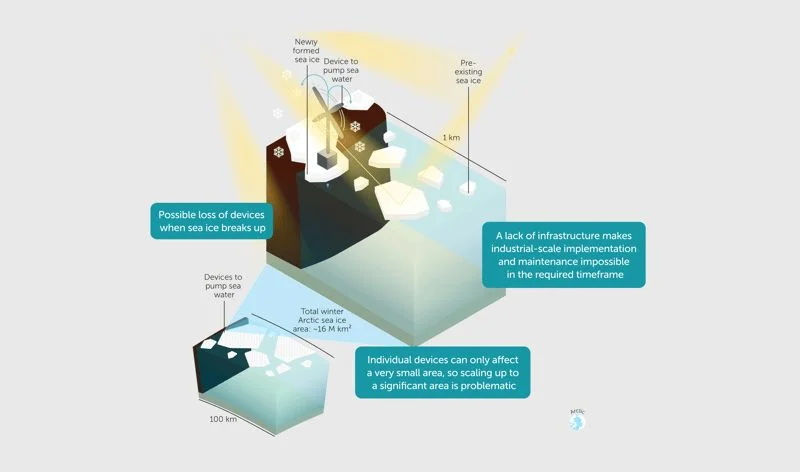
Interventions focused on polar regions: Proposals specifically designed to slow the melting of polar ice caps.
However, these proposals are not without their detractors. A common thread in critiques is the immense environmental and financial burdens associated with their implementation.
Significant Trade-offs and Risks Identified
The analysis of various geoengineering methods reveals substantial challenges that question their viability.
All five examined methods for protecting polar ice caps come with major environmental and financial trade-offs.
Stratospheric aerosol injection, despite garnering considerable attention, carries the risk of damaging the ozone layer and unpredictably altering global climate patterns.
The resources and time required to deploy these technologies appear to conflict with the urgent timelines needed to avert critical temperature thresholds, such as the 2-degree Celsius increase above pre-industrial levels.
Professor Frans Berkhout from King's College London noted that polar geoengineering, initially conceived to simplify global climate governance, is instead mired in technical, logistical, political, and economic complexities that render it highly impractical.
Public Perception and Governance Hurdles
Beyond the technical and environmental concerns, public acceptance and governance frameworks pose additional obstacles to geoengineering.
Public perception of novel technologies like carbon removal can be wary, as demonstrated by initial reactions to trials.
Large-scale projects are more likely to succeed if they align with local culture and social norms.
The complex governance and environmental protection frameworks in polar regions are likely to impede the approval of fieldwork and large-scale projects.
Compared to other controversial technologies, climate engineering can be even more unsettling for the public.
Expert Concerns and Scientific Warnings
A collective voice of concern has emerged from the scientific community. Over 40 polar scientists have issued warnings, deeming proposals to slow polar ice loss as unrealistic, unaffordable, and dangerous. This sentiment underscores a broader skepticism about humanity's ability to engineer its way out of the climate crisis, suggesting that faith in geoengineering might be misplaced given the current understanding of its potential ramifications.
Read More: New Research Explains Paper Stiffness for Better Recycling in 2024
Conclusion and Implications
While geoengineering is sometimes framed as a necessary last defense against severe climate change, current evidence and expert opinions suggest that the proposed technological fixes are fraught with considerable difficulties. The environmental consequences, vast resource demands, lengthy implementation times, and complex social and political hurdles cast doubt on their efficacy and safety. The focus remains on the fundamental need to address the root causes of climate change rather than relying on potentially risky technological interventions.
Sources
No, we can't geoengineer our way out of the climate crisis
Published: Feb 12, 2025
Source: Big Think
Link: https://bigthink.com/starts-with-a-bang/cant-geoengineer-climate-crisis/
Researchers Warn That We Can't Engineer Our Way Out of Climate Change
Published: Sep 11, 2025
Source: Popular Mechanics
Link: https://www.popularmechanics.com/science/green-tech/a66030106/geoengineering-wont-work/
Polar geoengineering: risks and realities
Published: Sep 9, 2025
Source: Frontiers in Science
Link: https://www.frontiersin.org/journals/science/article-hubs/polar-geoengineering-risks-realities
Geoengineering could fight climate change—if scientists can get the public on their side
Published: Apr 3, 2025
Source: Science
Link: https://www.science.org/content/article/geoengineering-fight-climate-change-if-public-can-convinced