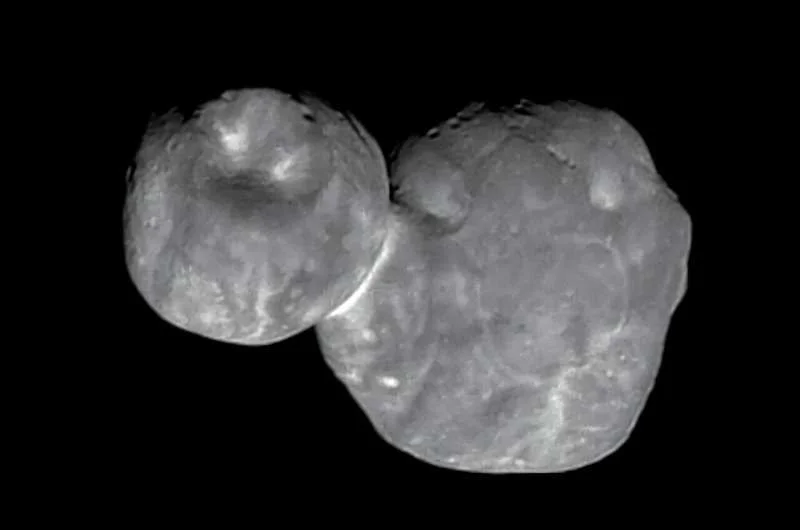
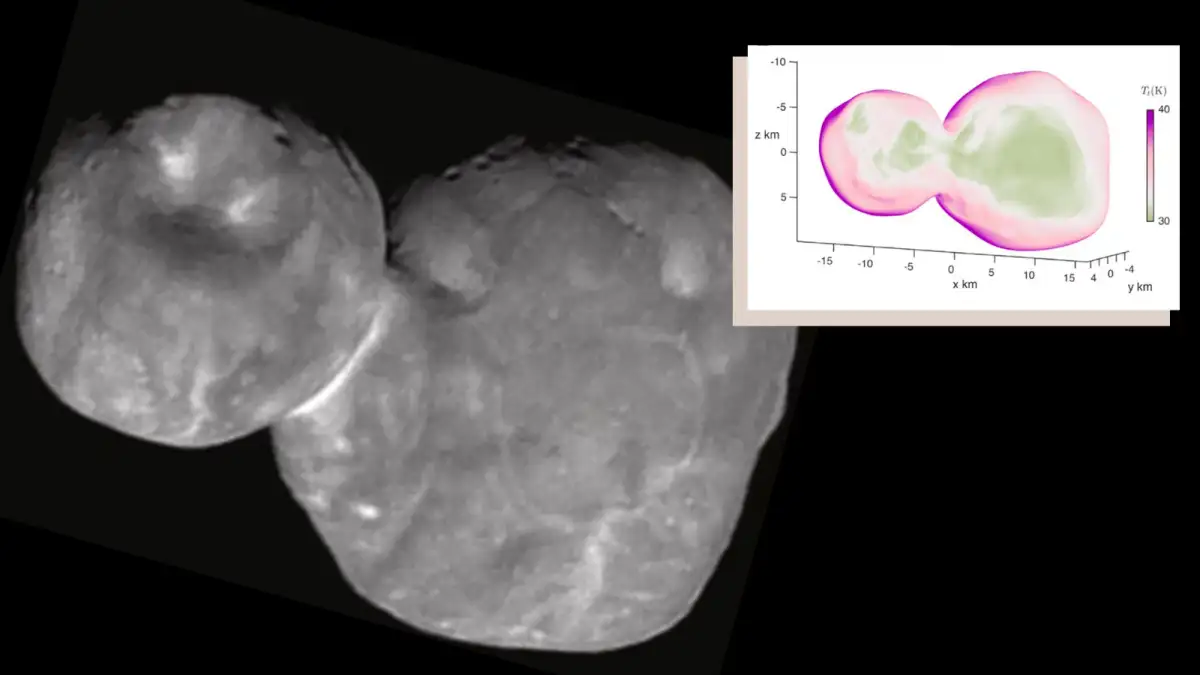
Recent computer models offer a new explanation for the peculiar "snowman" shape of Arrokoth, a large object in the Kuiper Belt, a region of icy bodies beyond Neptune. These simulations suggest that Arrokoth and similar objects may have formed through a process called gravitational collapse, where clouds of dust and gas naturally clumped together.
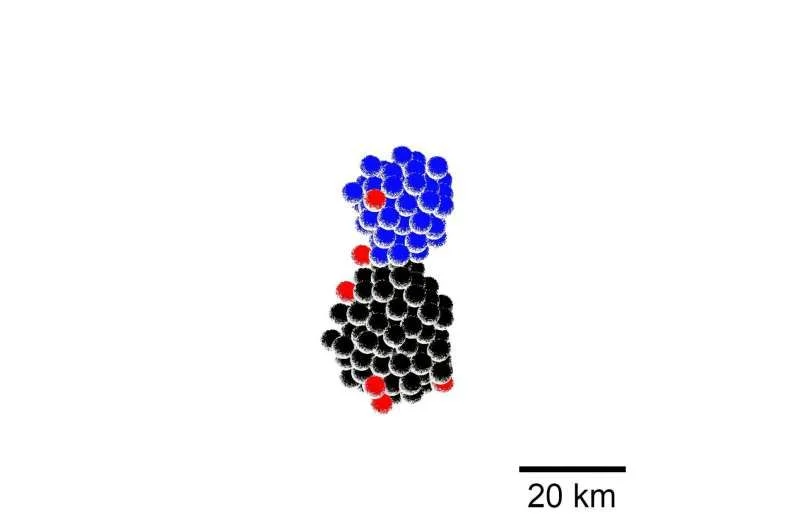
Jackson Barnes, a graduate student at MSU, developed a simulation that for the first time accurately reproduced the two-lobed, or "snowman," shape using this gravitational collapse method. Previously, simulations of collisions between smaller space objects tended to create single, rounder shapes.
Arrokoth, officially known as Kuiper Belt Object 486958 Arrokoth, is not only notable for its shape but also for its potential to hold ancient ice. Research suggests it may contain locked-away carbon monoxide and water ice, preserved from the early days of the solar system billions of years ago. This makes objects like Arrokoth valuable "time capsules" for understanding how our solar system formed.
Read More: Asteroid Dirt Is Fluffier Than Thought, New Study Shows
Arrokoth's Unusual Form
Objects in the Kuiper Belt often have unusual shapes. About one in ten of these bodies are "contact binaries," meaning they look like two spheres stuck together, much like a snowman.

For a long time, astronomers have wondered how these objects ended up with their distinctive shapes.
The unique, double-lobed appearance of Arrokoth has been a particular puzzle.
New computer models developed by Jackson Barnes appear to provide a solution.
Gravitational Collapse: A New Perspective
The simulations by Barnes are significant because they support the idea that many space objects form through gravitational collapse.
In this process, gravity pulls together clouds of small particles.
Over time, these clumps grow into larger bodies, known as planetesimals.
Barnes's simulations differ from earlier ones by including the physics of how particles behave when they touch each other.
"Researchers had simulated gravitational collapse before but, unlike the new approach, they did not take into account the physics of how particles rest upon each other when they make contact."
Previous collision simulations suggested that impacts would likely result in a single, more rounded object, rather than the distinct two-lobed structure seen in Arrokoth.
Ancient Ice as a Time Capsule
Beyond its shape, Arrokoth is believed to be rich in ancient ices, offering clues about the early solar system.
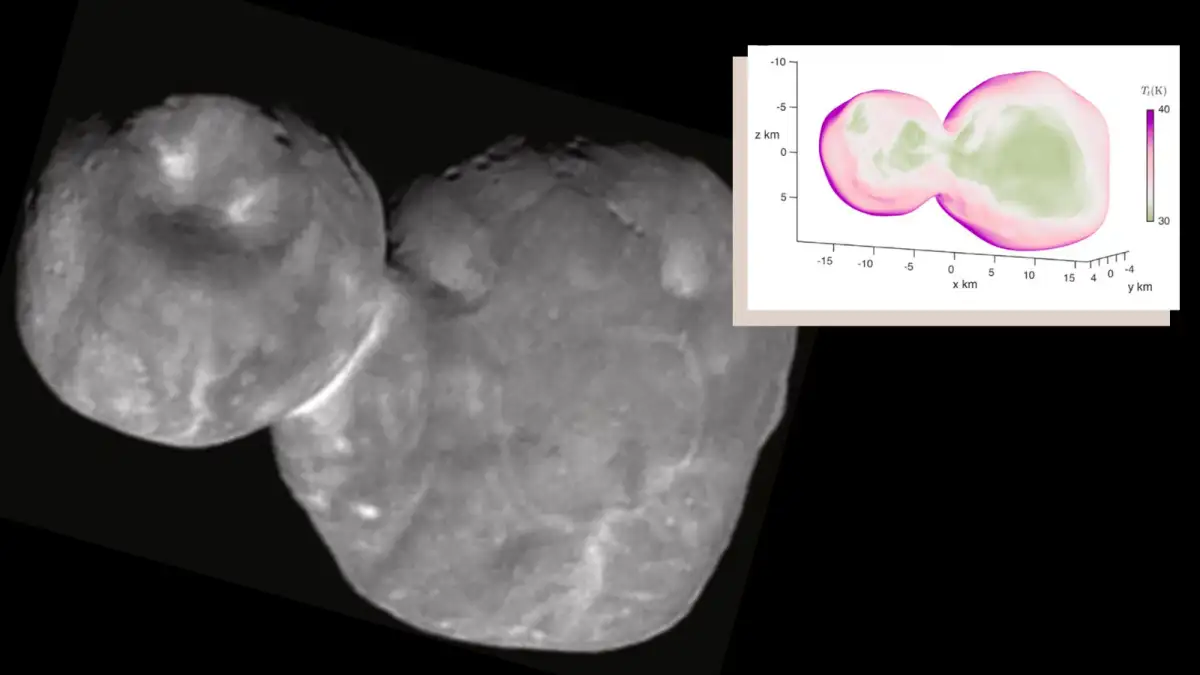
Studies suggest Arrokoth is composed of a mixture of carbon monoxide and water ice.
This ancient ice has been preserved deep within the object since its formation billions of years ago.
The presence of locked ice, like carbon monoxide, may have created an internal atmosphere within Arrokoth, preventing gas from escaping.
"Researchers found that the double-lobed object… may have ancient ices stored deep within it from when the object first formed billions of years ago."
When such objects approach the sun, this trapped ice can warm up, potentially transforming them into comets.
Implications for Solar System Formation
The study of Arrokoth and its formation has broader implications for understanding the history of the solar system.
It helps shed light on how objects in the Kuiper Belt, and planetesimals in general, came into being.
These findings are crucial for understanding the early stages of the solar system's development.
It is thought that many other Kuiper Belt objects might also hold similar ancient "time capsules."
"These studies will provide important input for understanding the formation of the solar system, and in particular the Kuiper Belt."
Expert Analysis
Jackson Barnes's simulations represent a paradigm shift in understanding the formation of contact binaries like Arrokoth. By incorporating the granular physics of particle interaction during gravitational collapse, his models offer a more natural explanation for the observed two-lobed shapes. This approach moves beyond simple impact simulations and provides a more holistic view of early planetary body formation. The confirmation of ancient ices within Arrokoth further enhances its value as a pristine relic from the primordial solar nebula, offering tangible evidence of the composition and conditions present during planetary system assembly.
Read More: JWST Finds Oldest Barred Spiral Galaxy M1149-BSG-z5
Conclusion
New computer simulations by Jackson Barnes provide a compelling explanation for the snowman-like shape of Kuiper Belt Object 486958 Arrokoth. The models suggest that Arrokoth formed through gravitational collapse, a process where particles naturally clumped together, incorporating the physics of particle contact. This new understanding contrasts with previous theories that focused on collisions, which tended to produce more spherical objects.
Read More: New Study: Cosmic Neighborhoods Help Find Alien Life
Furthermore, Arrokoth is understood to contain ancient ices, such as carbon monoxide and water ice, acting as a frozen archive of the early solar system. The potential for these trapped volatiles to behave like "ice bombs" as they approach the sun has implications for understanding comet evolution. These findings are consequential for our broader knowledge of how planetary bodies formed and the fundamental processes that shaped our solar system. Further study of Arrokoth and similar objects is expected to yield additional insights into this ancient cosmic history.
Sources Used:
The Guardian: https://www.theguardian.com/science/2026/feb/19/arrokoth-snowman-shape-simulations-kuiper-belt
Phys.org: https://phys.org/news/2026-02-space-snowmen-gravitational-collapse-contact.html
Space.com: https://www.space.com/arrokoth-space-snowman-kuiper-belt-ice-objects
ScienceDaily: https://www.sciencedaily.com/releases/2024/03/240327124627.htm
Science Times: https://www.sciencetimes.com/articles/49361/20240321/kuiper-belt-object-arrokoth-more-similarities-snowman-aside-shape.htm
SpaceDaily: https://www.spacedaily.com/reports/ThebirthofaSnowmanattheedgeoftheSolarSystem999.html
Space News: https://nasaspacenews.com/2024/04/a-space-snowman-upends-icy-mysteries/