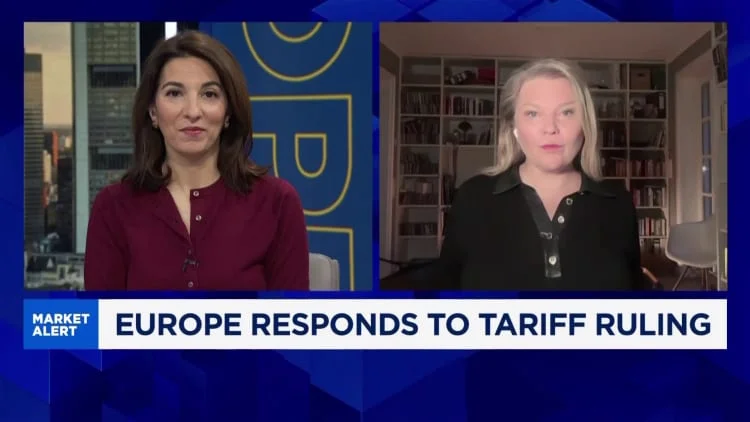
Recent U.S. tariff actions, particularly following a Supreme Court decision that nullified prior measures, have introduced significant global trade disruption. While U.S. officials maintain trade policy continuity, partner nations, including the United Kingdom and the European Union, express alarm. Analysis suggests these new tariffs will increase average import tax rates for these allies, potentially jeopardizing previously agreed-upon trade pacts and creating economic uncertainty for businesses worldwide.

The U.S. Supreme Court recently ruled against President Trump's use of a 1970s emergency law to impose tariffs on goods from most countries. This decision affected about half of the total tariffs in place. Despite this, President Trump has continued to use tariffs as a tool, imposing them under different legal authorities. Some of these tariffs have been in place since the first Trump administration and continued under the Biden administration, particularly on goods from China. The use of tariffs, even those overturned by the courts, appears to be a key strategy, with the potential for reinstatement.
Read More: Trump Tariffs: Supreme Court Ruling Brings Some Relief, But New 10% Tariff Causes Worry

Tariffs Increase Costs for Allies
Analysis from Global Trade Alert, a trade watchdog, indicates that the U.K. will see a 2.1 percentage point increase in its average tariff rate on a trade-weighted basis. The European Union faces a 0.8 percentage point rise. These figures, while seemingly small, represent a notable shift in the cost of imported goods for these major trading partners.

Officials in Europe and London have voiced concern, stating that the latest tariff policy could disrupt trade agreements signed with the U.S. in the previous year.
Jamieson Greer, the U.S. Trade Representative, faces the task of reassuring these partners that existing trade deals remain valid.
Uncertainty Disrupts Business Planning
The ongoing shifts in U.S. tariff policy create a climate of uncertainty that hinders businesses. Companies struggle to plan for spending, hiring, and managing their supply chains when the future cost of imports is unclear.

Economists have raised concerns that the fallout from trade disputes could increase the likelihood of a recession in the U.S.
Even as the U.S. pursues new trade agreements, businesses continue to face substantial risks due to this instability.
U.S. Domestic Manufacturing Lacks Revival
President Trump had stated that imposing high tariffs, the highest since the Great Depression, would revitalize U.S. manufacturing. However, available information suggests these tariffs have not yet led to a noticeable revival of domestic production.
Trade Pacts Face New Pressure
White House statements indicate a commitment to a 10% baseline tariff for trade negotiations, including with the United Kingdom. This rate, while lower than some tariffs imposed on other nations, is still significantly higher than the 3% effective tariff rate seen before the current administration, according to the Centre for Economic Policy Research.
Read More: Top Fed Official: Tariff Ruling Does Not Change Interest Rate Plans
These higher rates create a more challenging environment for trade negotiations.
President Trump has expressed dissatisfaction with what he views as higher tariffs imposed by other countries on U.S. goods, using tariffs as leverage to push for policy changes.
Expert Analysis
"The tariffs already imposed over the last year are the highest since the second world war – though lower than Trump initially threatened. Yet ironically, one of the most significant risks of Trump’s latest tantrum lies at home, with the threat of resurgent prices." - The Guardian analysis on Trump's tariff threats.
"Whatever the ultimate level of tariffs, uncertainty takes its own toll." - The International Monetary Fund (IMF) has repeatedly highlighted the economic impact of trade policy unpredictability.
Conclusion
The recent U.S. tariff actions, compounded by legal challenges and subsequent policy adjustments, have introduced significant volatility into global trade. Allies like the U.K. and the E.U. are facing increased import costs, and the overarching uncertainty poses a risk to international trade deals and business planning. Despite official reassurances, the impact on global economic stability and the promised revival of U.S. manufacturing remain points of close observation. The administration's commitment to a baseline tariff suggests a sustained focus on using trade measures as a negotiating tactic, further embedding these concerns into the international economic landscape.
Read More: Congress Says India-US Trade Deal Hurts India Due to US Tariffs
CNBC: Europe hits back at 'pure tariff chaos' from the U.S., warning trade deals are at risk. Published 3 hours ago. https://www.cnbc.com/2026/02/23/trump-15percent-global-tariff-europe-eu-uk-reaction.html
NPR: 7 key things to know about Trump's tariffs after the Supreme Court decision. Published 2 days ago. https://www.npr.org/2026/02/20/nx-s1-5677609/tariffs-economy-trump-supreme-court
The Atlantic: Get Ready for Zombie Tariffs. Published 2 days ago. https://www.theatlantic.com/economy/2026/02/supreme-court-trump-tariffs/686083/
CBS News: Why the U.S.-U.K. trade deal may not be as good as it sounds. Published May 9, 2025. https://www.cbsnews.com/news/trump-tariffs-uk-deal-economy-10-percent-tariff-rate-risk-inflation/
BBC News: What impact will Trump’s tariffs have on the UK? Published Mar 12, 2025. https://www.bbc.co.uk/news/articles/c99n7ex4vnko
The Guardian: Trump tariff threats are bad, but the uncertainty they instil is much worse. Published Jan 19, 2026. https://www.theguardian.com/business/2026/jan/18/trump-tariff-threats-economic-uncertainty-analysis
:max_bytes(150000):strip_icc()/GettyImages-2235423405-3eedce52b463446285c296e9c3080921.jpg)