The Centers for Disease Control and Prevention (CDC) confirmed on May 18 that one American has tested positive for the Bundibugyo virus following exposure in the Democratic Republic of the Congo (DRC). Federal authorities are currently coordinating the evacuation of the infected individual and six additional high-risk contacts to Germany for specialized care and medical monitoring.
The identified strain, Bundibugyo, currently lacks approved vaccines or standardized treatment, leaving international health bodies to prioritize the development of monoclonal antibody therapies.
| Current Outbreak Status | Key Data Points |
|---|---|
| Confirmed Deaths | 131 (as of May 19, 2026) |
| Suspected Cases | Nearly 250 |
| Primary Virus Strain | Bundibugyo (Ebola) |
| International Status | Public Health Emergency of International Concern |
Escalating Response and Travel Restrictions
To mitigate transmission risks, the Department of Homeland Security and the CDC have implemented rigid entry protocols. Non-U.S. passport holders who have visited the DRC, Uganda, or South Sudan within the preceding 21 days are now subject to strict entry limitations.
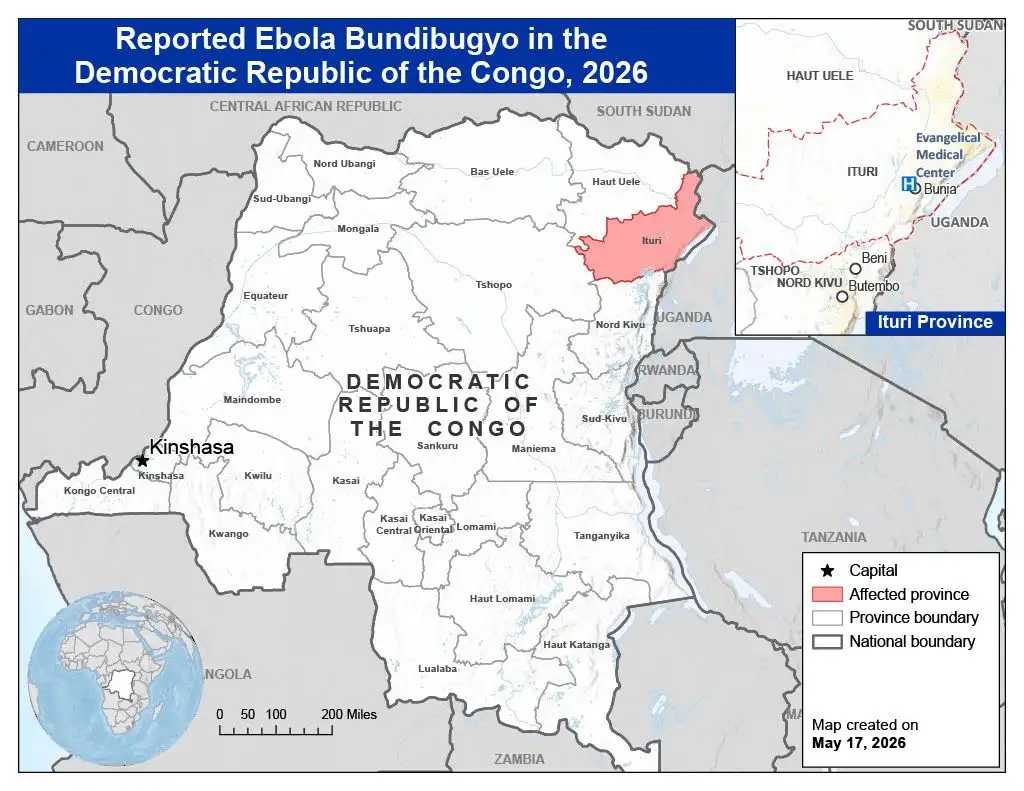
Medical professionals remain concerned about undetected community spread, as death records frequently include individuals who perished at home without clinical confirmation.
The World Health Organization (WHO) has categorized the situation as a 'Public Health Emergency of International Concern,' though it has yet to meet the threshold for a 'pandemic emergency' under current regulations.
Context of the Viral Outbreak
The current crisis originates from remote health zones within the DRC. Unlike previous outbreaks of the Zaire ebolavirus, the Bundibugyo strain presents distinct challenges for containment. Health officials stress that transmission is limited to direct contact with bodily fluids, excluding airborne or casual social interactions.
Read More: India IVF Costs And Social Barriers Limit Access In April 2026
"When people die at home, it means there are many more undetected cases," stated Dr. Manenji Mangudu, Oxfam DRC country director, regarding the statistical gap between official death tolls and actual viral impact.
Despite the clinical severity in central Africa, federal officials maintain that the risk to the general public within the United States remains low. The movement of the infected American to a facility in Germany serves as both a humanitarian necessity and a tactical step to isolate the infection outside of domestic borders while the CDC monitors those with potential exposure.
Further information regarding the outbreak can be tracked through the official CDC Situation Summary.