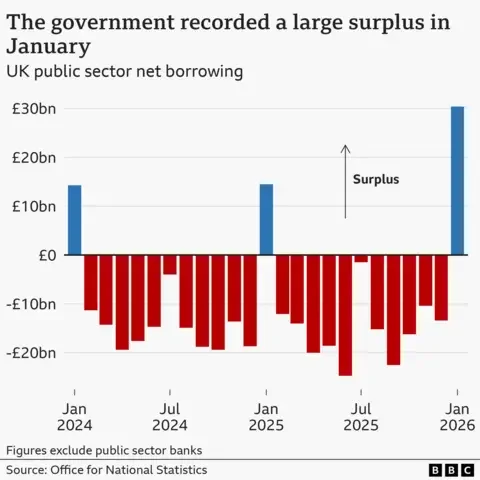
London, UK – Official figures released have shown the United Kingdom government achieved its largest ever budget surplus in January, a development driven by a significant increase in tax revenue. This record outcome offers a temporary boost to public finances, yet analysts suggest underlying challenges persist.

Economic Indicators Point to January Surplus
In January, the UK government's financial accounts registered a notable surplus. This means that the amount of money collected through taxes exceeded the government's spending during that month. This event is particularly significant as January is typically a month when the government collects more tax than it spends, largely due to the payment deadlines for self-assessed taxes. The surplus recorded this year stands as the highest ever for the month of January, marking a key financial event.

"The government usually collects more tax than it spends in January compared with other months due to self-assessed tax payments falling in the month." - BBC News
Factors Contributing to the Record Surplus
Several factors appear to have contributed to this substantial surplus. A major element was the surge in capital gains tax receipts, alongside higher contributions from employer National Insurance and a general increase in income tax collection.

Income Tax Growth: The government's policy of freezing income tax thresholds meant that as people's incomes rose, more of them were brought into paying higher tax rates. This policy, known as fiscal drag, directly contributed to the increase in income tax revenue.
Capital Gains Tax Uptick: A significant rise in capital gains tax receipts was identified as a primary driver for the overall increase in government income.
Self-Assessment Payments: The typical influx of self-assessed tax payments in January played a crucial role, as is common for this time of year.
"A big upswing in capital gains tax receipts was a major factor in the uptick in government revenue." - Jason Hollands, Managing Director at Evelyn Partners
"The Treasury's freeze on income tax thresholds is dragging people in to paying higher tax rates as their incomes rise which aided the increase in income tax receipts." - Paul Dales, Chief Economist at Capital Economics
Mixed Economic Signals and Future Concerns
While the January surplus is a positive headline figure, a broader view of the economy presents a more complex picture. Reports indicate that some of the recent increase in retail spending might not be sustainable. This caution is echoed by data showing a slowdown in wage growth and a rise in unemployment, which has reached a five-year high.

Economic Growth: Concerns remain about anaemic economic growth, which could potentially stall future tax income.
Unemployment: A rising unemployment rate poses a risk to the consistent collection of tax revenue.
National Debt: Despite the recent surplus, the UK's national debt remains substantial, standing at £2.9 trillion, equivalent to 92.9% of the GDP.
"Economists cautioned that the broader fiscal picture remains challenging, with national debt standing at £2.9 trillion – equivalent to 92.9 per cent of GDP – despite the recent improvement." - The London Economic
"However, the road ahead is not without risks for the public finances." - Sky News
Contrasting Views on Public Finances
Experts offer differing perspectives on the implications of this record surplus. Some highlight the positive aspect of increased headroom and reduced inflation, while others emphasize the ongoing difficulties within public finances.
Positive Outlook: This surplus provides a positive point for the Chancellor to highlight in upcoming fiscal statements. It suggests the economy started the year in a stronger position, with efforts to bring down inflation and spend taxpayer money wisely. Lower interest rates have also reduced the cost of government borrowing.
Lingering Challenges: Despite the record surplus, the overall position of public finances is still considered difficult. This is partly due to the structure of some government debt, where interest payments are linked to inflation measures. Furthermore, the January figures might represent a one-off event rather than a sustained trend.
"We have doubled our headroom, we are bringing inflation down, we are making sure that taxpayers’ money is spent wisely, and borrowing this year is forecast to be the lowest since before the pandemic." - Henning Diederichs, Public Sector Senior Technical Manager at the Institute of Chartered Accountants in England and Wales
"The January tax revenue figures could be a one-off." - Sky News
Conclusion and Implications
The United Kingdom government's achievement of a record budget surplus in January is a significant financial event, primarily fueled by increased tax receipts, particularly from capital gains and income tax. This outcome provides a temporary improvement in the government's financial position and a positive talking point for policymakers.
Read More: Pressure Washer Mistakes Cost UK Owners More Money
However, the broader economic context remains a point of concern. Challenges such as slowing wage growth, rising unemployment, and persistent high national debt suggest that the fiscal situation requires continued attention. The sustainability of the revenue increase and the potential impact of future economic fluctuations will be critical factors to monitor. The upcoming Spring statement will likely address how the government plans to navigate these mixed signals and manage public finances moving forward.
Public Sector Net Borrowing (January 2025): £15.4 billion surplus.
Financial Year to January 2025 Borrowing: £118.2 billion.
National Debt: £2.9 trillion (92.9% of GDP).
Sources
BBC News: Higher tax helped government finance reach record January surplus - https://www.bbc.com/news/articles/c93w4egd3gzo
The Guardian: UK reports record-breaking budget surplus of £30.4bn in surprise boost for Rachel Reeves - https://www.theguardian.com/politics/2026/feb/19/uk-reports-record-breaking-surplus-rachel-reeves
Sky News: Record-breaking budget surplus as government's tax income rises - https://news.sky.com/story/record-breaking-budget-surplus-as-governments-tax-income-rises-13509835
The London Economic: The UK has just recorded the biggest January budget surplus since records began - https://www.thelondoneconomic.com/business-economics/economics/the-uk-has-just-recorded-the-biggest-january-budget-surplus-since-records-began-403426/
The Argus: Government posts record borrowing surplus in January amid rise in tax receipts - https://www.theargus.co.uk/news/national/24952407.government-posts-record-borrowing-surplus-january-amid-rise-tax-receipts/
Trading Economics: UK Public Surplus Widens in January - https://tradingeconomics.com/united-kingdom/government-budget-value/news/448755