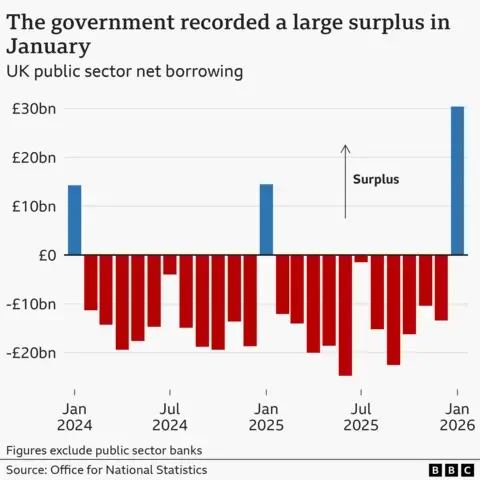
The United Kingdom's government has achieved a record-breaking budget surplus for January, a development largely attributed to a significant increase in tax revenue. This outcome, while providing a positive fiscal signal, occurs against a backdrop of broader economic challenges and differing interpretations of its long-term implications.
The period in question is January 2025. Official figures indicate that the government collected more in taxes than it spent, a common occurrence in January due to the timing of self-assessed tax payments. However, this year's surplus stands out as the largest recorded for the month since records began in 1993.

Key actors involved include the UK Treasury, responsible for government finances, and various economic analysts and institutions. The data emerged just before the Spring Statement, a significant fiscal review.
Economic Landscape and Tax Surges
The UK government's financial performance in January 2025 showed a notable surplus. This outcome was heavily influenced by several factors related to tax collection:
Read More: AI Boom Makes Kingston Founders David Sun and John Tu $14 Billion Richer in 2025

A substantial rise in capital gains tax receipts.
Increased contributions from employer National Insurance.
Higher income tax collections, partly due to the freeze on income tax thresholds which has moved more individuals into higher tax brackets as their incomes grew.
This surge in revenue contrasted with government spending, which remained largely stable, with lower interest payments on national debt offsetting some increased costs for public services and benefits.
Evidence of the Surplus and its Drivers
Official figures released confirm the record surplus.

"The UK government has posted the biggest ever budget surplus, official figures show, after a large increase in self-assessment and capital gains tax receipts." (The Guardian)
"Britain notched up a record Government borrowing surplus in January, according to official figures…" (The Independent)
The Office for National Statistics (ONS) reported that revenues were "strongly up on the same time last year." (The London Economic)
Self-assessed income and capital gains tax receipts reached a record high for January. (Trading Economics)
The £15.4 billion surplus in January 2025 was larger than the previous year. (The Independent, Trading Economics)
Conflicting Views on Underlying Economic Health
While the surplus offers a positive headline figure, analysts present a more nuanced picture of the UK's economic standing.
Viewpoint 1: A Healthier Economy to Start the Year
Some economic indicators suggest a positive start to the year for the economy, contributing to the higher tax take.

The surplus provides the Chancellor with a positive point to reference in fiscal statements. (The London Economic)
The overall situation indicates that the government is managing its finances effectively, bringing down inflation and spending taxpayer money wisely. (The Guardian)
Viewpoint 2: Persistent Risks and Challenges
Others highlight that the surplus, while significant, does not erase underlying economic fragilities.
"The public finances continue to be in a difficult position before the spring statement despite the record surplus." (The Guardian)
Recent economic data has been mixed, with wage growth slowing and unemployment reaching its highest in five years. (BBC News)
The national debt stands at £2.9 trillion, equivalent to 92.9% of GDP, despite the recent improvement. (The London Economic)
Lower interest rates have reduced the cost of borrowing, but this benefit may be temporary. (Sky News)
There is a possibility that the January tax figures are a "one-off" event, and anaemic economic growth coupled with rising unemployment could lead to a stall in tax revenues. (Sky News)
Expert Analysis
Economists and financial analysts have provided commentary on the January surplus:
Paul Dales, Chief UK Economist at Capital Economics, noted that the freeze on income tax thresholds has significantly contributed to higher income tax receipts as incomes rise. He also suggested the figures imply "the economy started the year looking a lot healthier and will give the chancellor something positive to point to." (BBC News, The London Economic)
Jason Hollands, Managing Director at wealth management firm Evelyn Partners, identified a "big upswing in capital gains tax receipts" as a major factor in the increased government revenue. He also raised concerns that some of the boost in retail spending might not be sustainable. (BBC News)
Henning Diederichs, a public sector senior technical manager at the Institute of Chartered Accountants in England and Wales, cautioned that despite the record surplus, the overall public finances remain in a challenging state. He pointed to interest rates on some government debt being tied to inflation measures. (The Guardian)
Implications and Future Outlook
The record January surplus carries several implications for government policy and the broader economic outlook.
The surplus provides greater flexibility for policymakers in decisions regarding spending, tax policy, and debt management. (Meyka)
It suggests that government borrowing may be lower than previously expected, offering a potential buffer. (Meyka)
However, the long-term sustainability of debt levels, economic growth, and the potential for these figures to be a one-off event remain key considerations for future tax decisions. (Sky News, Meyka)
The surplus's timing places pressure on the Chancellor ahead of the March Spring Statement, potentially influencing choices about further tax increases or spending cuts. (The Independent)
The evidence indicates a strong January performance for UK government finances, primarily driven by increased tax revenues. Nevertheless, a significant portion of economic analysis suggests that this positive development occurs within a context of ongoing economic risks and considerable national debt. The extent to which this January surplus represents a sustained improvement versus a temporary uplift remains a subject of continued economic assessment.
Read More: Iconic UK Jewellery Maker Since 1886 Enters Administration, 100 Jobs at Risk
Sources Used:
BBC News: "Higher tax helped government finance reach record January surplus"
Context: Provides an overview of the record surplus, highlighting key tax drivers like capital gains tax and National Insurance, and quoting economists on the impact of income tax thresholds and broader economic conditions.
The Guardian: "UK reports record-breaking budget surplus of £30.4bn in surprise boost for Rachel Reeves"
Link: https://www.theguardian.com/politics/2026/feb/19/uk-reports-record-breaking-surplus-rachel-reeves
Context: Reports the record surplus, emphasizes the role of self-assessment and capital gains tax, and includes expert commentary on the persistent challenges facing public finances despite the surplus.
Sky News: "Record-breaking budget surplus as government's tax income rises"
Link: https://news.sky.com/story/record-breaking-budget-surplus-as-governments-tax-income-rises-13509835
Context: Discusses the record surplus and rising tax income, but also raises concerns about risks to public finances, the potential for the January figures to be a one-off, and the impact of anaemic economic growth and rising unemployment.
The London Economic: "The UK has just recorded the biggest January budget surplus since records began"
Context: Details the record January surplus, quotes an economist on the positive fiscal outlook it provides, and mentions the high national debt despite the recent improvement.
The Independent: "Government posts record borrowing surplus in January amid rise in tax receipts"
Context: Reports on the record surplus and rising tax receipts, noting that January typically sees a surplus due to self-assessment payments, and discusses the pressure this puts on the Chancellor ahead of the Spring Statement.
Trading Economics: "UK Public Surplus Widens in January"
Link: https://tradingeconomics.com/united-kingdom/government-budget-value/news/448755
Context: Provides specific figures for the January surplus and year-to-date borrowing, highlighting record highs for self-assessed income and capital gains tax receipts.
Meyka: "UK Budget Surplus Hits All-Time High in Pre-Forecast Boost"
Link: https://meyka.com/blog/uk-budget-surplus-hits-all-time-high-in-pre-forecast-boost/
Context: Analyzes the policy implications of the surplus, suggesting it may influence spending and tax decisions, and that it indicates potential for lower borrowing.