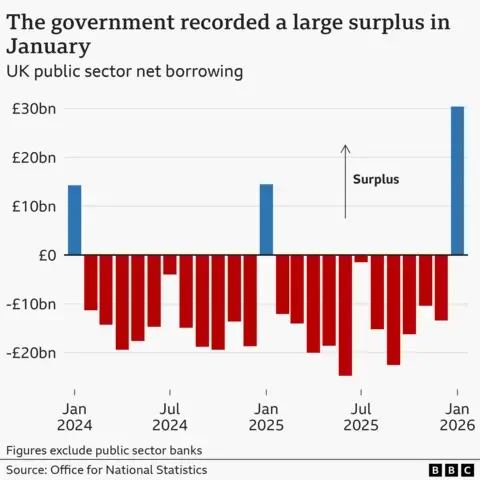
In January 2025, the United Kingdom government achieved a record-breaking budget surplus, a development largely attributed to a significant increase in tax revenue. This notable financial outcome, while offering a positive indicator for government finances, comes amidst ongoing economic complexities and forecasts of persistent public debt. The figures provide the current government with a point of reference ahead of upcoming fiscal statements, but also highlight underlying challenges.

Financial Performance in January 2025
Official figures for January 2025 reveal a substantial surplus for the UK government, the largest recorded for the month since records began in 1993. This means that the tax money collected by the government exceeded its spending during that period.

Record Surplus: The government posted a surplus of £15.4 billion in January 2025, a figure that surpassed previous years' January collections.
Traditional Trend: January is typically a strong month for government revenue due to the influx of self-assessed tax payments.
Factors Contributing to the Surplus
The increase in the government's financial surplus in January was primarily driven by higher tax receipts across several key areas.

Income Tax: A surge in income tax was noted, partly due to the freeze on income tax thresholds. As incomes rose, more individuals were pulled into higher tax brackets, increasing the total income tax collected.
Capital Gains Tax (CGT): A significant upswing in capital gains tax receipts was identified as a major contributor to the overall revenue increase.
National Insurance Contributions (NICs): Employer National Insurance contributions also saw a boost, adding to the government's revenue.
Economic Context and Expert Views
While the January surplus presents a positive snapshot, economists offer a more nuanced perspective on the broader economic landscape and the sustainability of these figures.
Read More: AI Boom Makes Kingston Founders David Sun and John Tu $14 Billion Richer in 2025

Positive Outlook for Chancellor: Economists like Paul Dales, chief UK economist at Capital Economics, suggested that the figures indicate a healthier start to the year and offer the Chancellor positive points for fiscal statements.
Challenging Public Finances: Despite the record surplus, some experts, such as Henning Diederichs, a senior technical manager at the Institute of Chartered Accountants in England and Wales, point out that public finances remain in a difficult position.
Debt Interest Costs: Lower interest rates have, in part, reduced the cost of government borrowing, which helped offset higher public service and benefit costs. However, interest rates on some government debt are linked to inflation measures, making them susceptible to changes.
Potential Risks and Future Outlook
The record surplus, while welcome, is accompanied by considerations regarding future economic performance and public debt levels.
Economic Growth and Unemployment: Concerns remain about anaemic economic growth and a rising unemployment rate, which could potentially slow down future tax collection. Recent data showed wage growth had slowed and unemployment reached its highest in five years.
Sustainability of Gains: Some analysts suggest that the boost in certain areas, like retail spending, may not be sustainable. The January tax revenue figures could be a one-off event.
National Debt: The UK's national debt stands at £2.9 trillion, equivalent to 92.9% of its Gross Domestic Product (GDP), indicating that long-term borrowing and debt levels remain significant challenges.
Policy Implications: The surplus may influence future decisions on government spending, tax policy, and debt management. It provides the government with more flexibility but does not eliminate long-term financial considerations.
Sources
The Guardian: https://www.theguardian.com/politics/2026/feb/19/uk-reports-record-breaking-surplus-rachel-reeves
Sky News: https://news.sky.com/story/record-breaking-budget-surplus-as-governments-tax-income-rises-13509835
The London Economic: https://www.thelondoneconomic.com/business-economics/economics/the-uk-has-just-recorded-the-biggest-january-budget-surplus-since-records-began-403426/
Independent: https://www.independent.co.uk/news/business/government-posts-record-borrowing-surplus-in-january-amid-rise-in-tax-receipts-b2702120.html
Trading Economics: https://tradingeconomics.com/united-kingdom/government-budget-value/news/448755
Meyka: https://meyka.com/blog/uk-budget-surplus-hits-all-time-high-in-pre-forecast-boost/