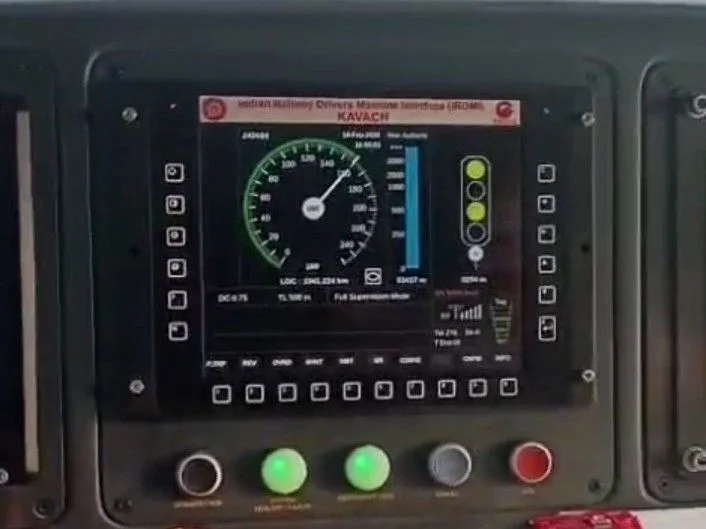
The North Central Railway has successfully completed trials of its indigenous 'Kavach' automatic train protection system. These tests were conducted at a speed of 160 kmph on the Dadari-Tundla section, using a Vande Bharat Express train. The primary goal was to assess the system's effectiveness in enhancing operational safety and preventing accidents, particularly at high speeds. This marks a significant step in the nationwide rollout of the 'Kavach' system.
Key Developments and Timeline
February 14, 2024: Trials of the 'Kavach' system were conducted at 160 kmph on the Dadri-Tundla section of the Prayagraj Division. A 20-coach Vande Bharat Express rake was utilized for a significant phase of these trials.
February 16, 17, and 18, 2024: Further detailed trials are scheduled using WAP-5 and WAP-7 electric locomotives with conventional coach compositions.
Ongoing: The 'Kavach' system is being rolled out across railway sections nationwide in a phased manner.
Actors Involved
North Central Railway (NCR): The zonal railway responsible for conducting the trials.
Prayagraj Division: The specific division within NCR where the trials took place.
Vande Bharat Express: A modern train rake used for testing the 'Kavach' system.
WAP-5 and WAP-7 Electric Locomotives: Scheduled to be used in subsequent trials with conventional coaches.
General Manager Naresh Pal Singh: Mentioned as guiding the trials.
Agra Railway Division: Conducted separate trials on an eight-car Vande Bharat train between Mathura and Palwal.
ITALCERTIFER: An Italian safety assessment body, overseeing the trials as part of an Independent Safety Audit (ISA).
Testing Parameters and Observations
The trials focused on several critical operational and safety aspects of the 'Kavach' system:
Speed Supervision: Evaluating the system's ability to monitor and maintain train speeds.
Automatic Braking Intervention: Assessing the system's effectiveness in applying brakes automatically when necessary, even at 160 kmph. One report noted the system stopping an engine approximately 30 meters before a red signal.
Kulwa Loop Line Speed Control Test: Verifying the system's capability to automatically reduce train speed to safe limits when entering a station's loop line.
SPAD Prevention: Testing the system's effectiveness in preventing 'Signal Passing at Danger' incidents.
Failure Scenarios: Analyzing the system's response during various failure situations.
Auto-Whistling: Checking an automatic whistling feature at level crossing gates.
Communication Failure Response: Evaluating how the system reacts when communication is lost.
The core finding from these trials is the successful demonstration of the 'Kavach' system's ability to accurately supervise speed and intervene with automatic braking at 160 kmph, while also performing well in other critical safety functions.
System Rollout and Future Steps
Following the successful trials with the Vande Bharat rake, the 'Kavach' system will now be tested with conventional coach compositions. Detailed trials are scheduled with WAP-5 and WAP-7 electric locomotives.
Upon the successful completion of all required tests and obtaining regulatory approvals, regular operations of 'Kavach'-equipped trains on the Dadri-Tundla section are expected to commence. This advanced safety technology is intended to reduce accidents caused by human error and ensure the safe and timely operation of trains, even in adverse weather conditions like fog.
Read More: New Bengaluru Green Line Metro Trains Arriving by August 2026

The integration of 'Kavach' is presented as a move to significantly bolster rail safety across the nation.
Expert Analysis and External Oversight
The trials are being conducted under the supervision of ITALCERTIFER, an independent safety audit body. This external oversight suggests a rigorous validation process for the 'Kavach' system.

Conclusion and Implications
The trials conducted by North Central Railway represent a substantial advancement in implementing sophisticated safety technology on Indian Railways. The successful performance of the 'Kavach' system at high speeds, demonstrated with the Vande Bharat rake, indicates its potential to significantly enhance train safety. The planned further testing with conventional locomotives and the ongoing nationwide rollout suggest a clear trajectory towards widespread adoption.
The next steps involve completing scheduled trials with conventional trains, securing final regulatory approvals, and then commencing regular 'Kavach'-equipped operations on the Dadri-Tundla section and other routes.
Read More: India IVF Costs And Social Barriers Limit Access In April 2026
Sources Used:
Indian Express: https://indianexpress.com/article/india/railways-conducts-160-kmph-kavach-trial-dadri-tundla-section-using-vande-bharat-rake-10532703/
Context: A recent news report detailing the successful high-speed trial of the 'Kavach' system.
The Times of India: https://timesofindia.indiatimes.com/city/allahabad/ncrs-kavach-trials-at-160-kmph-on-dadri-tundla-section/articleshow/128358994.cms
Context: A local news report from Allahabad (Prayagraj) covering the high-speed 'Kavach' trials.
Rail Whispers: https://railwhispers.com/?p=12755
Context: A report focusing on the successful high-speed trial of the 'Kavach' system under the guidance of General Manager Naresh Pal Singh.
Dainik Bhaskar: https://www.bhaskar.com/local/uttar-pradesh/prayagraj/news/vande-bharat-160-kmph-speed-trial-successful-dadri-tundla-section-137206104.html
Context: A report from Prayagraj in Hindi, detailing the successful speed trial of 'Kavach' with Vande Bharat at 160 kmph, mentioning supervision by ITALCERTIFER.
Jagran: https://www.jagran.com/uttar-pradesh/aligarh-city-vande-bharat-160-kmph-trial-tundla-to-dadri-speed-test-40140245.html
Context: A report on the 160 kmph speed trial conducted between Tundla and Dadri using a Vande Bharat train, as part of efforts to increase train speeds.
Deccan Herald: https://www.deccanherald.com/india/railways-kavach-braking-efficiency-trial-successful-at-160-kmph-engine-stops-30-metres-before-red-signal-2863880
Context: A report highlighting the braking efficiency of the 'Kavach' system at 160 kmph, noting an engine stopping precisely before a red signal.
The Financial Express: https://www.financialexpress.com/business/railways-kavach-trial-vande-bharat-train-running-at-160-kmph-stops-automatically-before-a-red-signal-3396964/
Context: A report on a successful 'Kavach' trial with a Vande Bharat train at 160 kmph, where the train stopped automatically before a red signal.
UP Plus: https://upplus.in/North-Central-Railway-1133#::text=The%20indigenous%20Automatic%20Train%20Protection%20%28ATP%29%20system%2C%20%E2%80%98Kavach%E2%80%99%2C,completed%20using%20a%2020-coach%20Vande%20Bharat%20Express%20rake.
Context: A brief report confirming the successful testing of the indigenous 'Kavach' system at 160 kmph on the Dadri-Tundla section using a Vande Bharat Express.
Worldnews.com: https://article.wn.com/view/2026/02/14/NCRsKavachtrialsat160kmphonDadriTundlasection/
Context: A report mirroring information from The Times of India, confirming successful trials of 'Kavach' at 160 kmph on the Dadri-Tundla section with a Vande Bharat rake.
/newsfirstprime/media/media_files/2026/02/18/green-line-metro-2026-02-18-14-46-47.jpg)