The Vande Bharat Express, India's indigenously developed semi-high-speed train, has completed seven years of service. Since its inception, the train has undergone significant expansion, with numerous routes now operational across the country. This expansion signifies a move towards modernizing India's rail infrastructure, aiming to provide faster and more comfortable travel. The service's growth, however, raises questions about its operational efficiency and the underlying infrastructure that supports its advanced capabilities.
Evolution and Expansion of Vande Bharat Services
The Vande Bharat Express, initially known as Train 18, was conceptualized as part of India's push for self-reliance in manufacturing advanced rail technology. The first Vande Bharat Express service was launched between New Delhi and Varanasi. Since then, the network has expanded substantially, introducing new routes and increasing the total number of train services.
The Vande Bharat Express is presented as a symbol of India's manufacturing prowess and technological advancement in the railway sector.
Reports indicate that there are now 83 Vande Bharat Express services, accounting for 166 train numbers covering both up and down routes.
New iterations, such as Vande Bharat 2.0 and 3.0, have been introduced, along with the upcoming Vande Bharat Sleeper version.
Projections suggest a plan to operationalize 4,500 Vande Bharat trainsets in the future.
Operational Network and Route Development
The expansion of the Vande Bharat Express network has connected a multitude of cities across India, enhancing regional connectivity and offering faster travel options.
Read More: New Train Connects Udaipur and Asarva
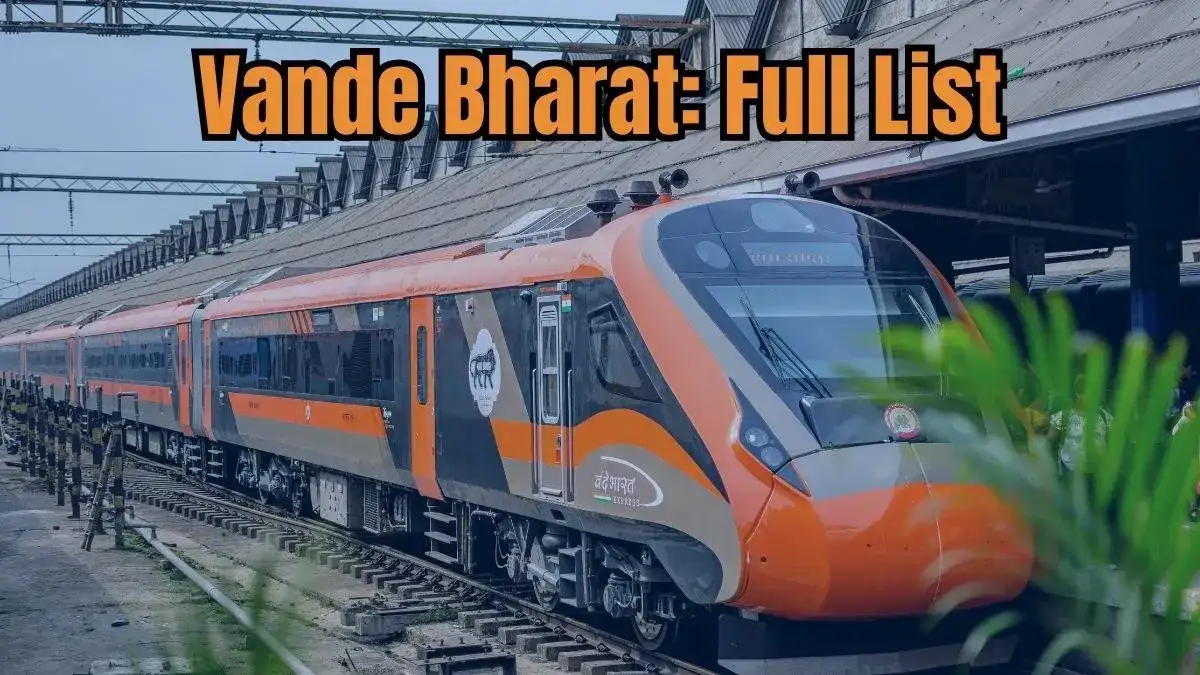
The train service has been extended to various regions, with new routes frequently being flagged off.
Examples of routes include Chennai Egmore - Nagercoil, Bengaluru Cantt - Madurai, Deoghar - Varanasi, and Amritsar - Delhi.
The development includes trains connecting major spiritual and heritage cities, such as the Banaras–Khajuraho Vande Bharat Express.
This expansion is presented as a catalyst for improving trade, tourism, and regional development.
Design and Technological Features
The Vande Bharat Express is characterized by its modern design and technological integration, aimed at enhancing passenger experience and operational efficiency.
The train features a sleek and aerodynamic design, including a tapered nose cone.
It is designed for speeds of up to 180 kmph, positioning it as India's fastest semi-high-speed train.
The coaches are equipped with modern amenities to ensure passenger comfort.
Challenges and Infrastructure Considerations
Despite the advancements, the operational effectiveness of the Vande Bharat Express appears to be constrained by existing railway infrastructure.
Reports suggest that while the trains are designed for high speeds, they often operate at barely half their designed speed due to limitations in tracks and signaling systems.
The coaches may be modern, but they are running on "same old railway tracks, signals and systems."
This disparity raises questions about the full utilization of the train's capabilities and the necessary upgrades required to support its intended performance.
Expert Perspectives and Future Outlook
The Vande Bharat Express is viewed as a significant step in the modernization of Indian Railways, although challenges remain.
The project is seen as stimulating various sectors of the economy, contributing to economic growth.
It marks a "significant milestone in the evolution of Indian Railways."
The introduction of a sleeper version is noted as a new era for long-distance travel.
Conclusion and Implications
Seven years into its operation, the Vande Bharat Express has demonstrably expanded its reach across India. The initiative represents a clear ambition to upgrade the nation's rail travel experience through indigenous technology. However, the success of this ambitious project appears contingent on parallel upgrades to the fundamental railway infrastructure. The juxtaposition of advanced train technology with older track and signaling systems presents a persistent challenge. Future development must address these infrastructural limitations to fully leverage the potential of the Vande Bharat Express and solidify its role in modernizing Indian transportation.
Read More: India IVF Costs And Social Barriers Limit Access In April 2026
Key Sources
indianexpress.com: Provides a timeline and lists operational routes, emphasizing the expansion of the Vande Bharat Express network.https://indianexpress.com/article/india/vande-bharat-express-a-timeline-of-the-train-service-as-it-turns-7-today-10533332/
indiatoday.in: Highlights the discrepancy between the train's designed speed and its actual operational speed due to infrastructure constraints.https://www.indiatoday.in/magazine/the-big-story/story/20251103-vande-bharat-express-fast-train-on-slow-track-2807679-2025-10-24
jagranjosh.com: Offers a comprehensive list of Vande Bharat trains, their timings, routes, and stops, detailing the operational network.https://www.jagranjosh.com/general-knowledge/vande-bharat-trains-full-list-with-timings-routes-and-stops-1820002126-1
kknlive.com: Discusses the Vande Bharat Express as a revolution in Indian high-speed rail travel and its role in shaping the future of rail travel.https://kknlive.com/en/national-news/vande-bharat-express-the-revolution-in-indias/