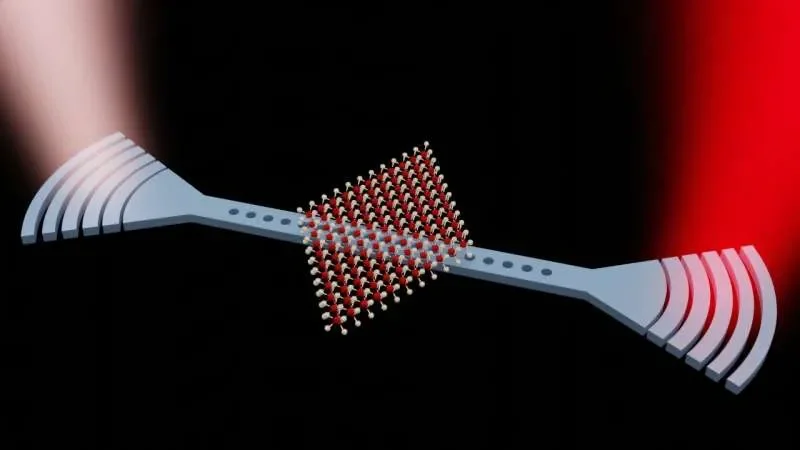
Material Deformations Redirect Thermal Energy
Researchers have identified a novel way heat moves through extremely thin semiconductor materials, deviating from typical understanding. The process involves heat-induced deformations within the material itself, which can actively change the path of thermal energy. This finding suggests a previously unobserved interaction where mechanical stress generated by heat can "redirect—and even obstruct—the flow of heat."
The core of the discovery lies in how heat, when applied to these ultrathin structures, tends to pool around the heated spot longer than anticipated. This contrasts with the usual gradual spread of heat from warmer to cooler areas.
Technology's Thermal Quandary
Controlling the movement of heat is a persistent snag in numerous technological applications. In electronic and photonic devices, the build-up of heat can cap performance, slash efficiency, and restrict efforts to shrink device sizes further.
Read More: New Way to See Cell Sugars Helps Understand Health and Disease
This new insight into heat transport at the nanoscale could offer a fresh avenue for developing devices—be they electronic, photonic, or thermal—with distinct new capabilities. It also presents a method to control heat flow intrinsically, without altering the fundamental makeup of the material.
Fundamental Insight
The experimental work, which led to the identification of this "honey-like" flow, was the result of combining a variety of unexpected observations. The research provides a fundamental glimpse into nanoscale thermal transport. This new understanding opens doors for designing materials and devices with advanced thermal management properties.