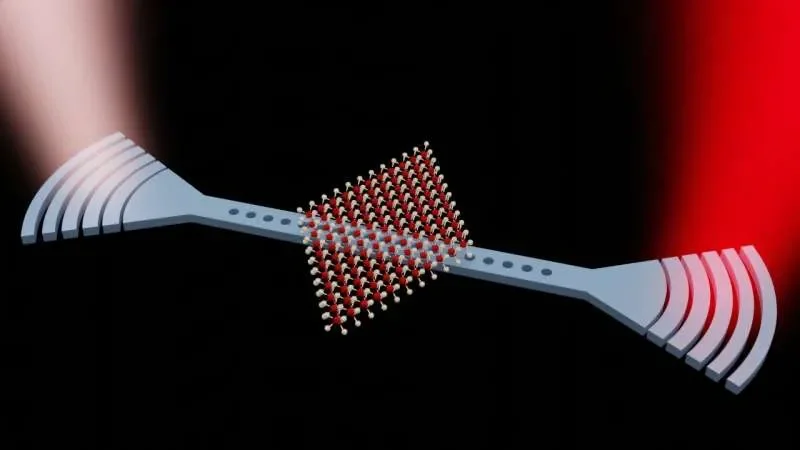
Key Advances in Hybrid Particle Interaction
Physicists have engineered hybrid particles, formed from light and matter, that exhibit strong interactions capable of performing computational tasks. This development addresses a long-standing challenge where photons, while swift and efficient for communication, generally interact weakly, hindering their use in complex computing logic.
The breakthrough centers on what are termed 'exciton-polaritons'. These particles effectively combine the properties of photons with excitons, which are excited states in semiconductor materials. The critical innovation allows these hybrid entities to exhibit the necessary "signal-switching logic" essential for computing.
Implications for Artificial Intelligence and Beyond
The ability of these hybrid particles to interact strongly opens up significant possibilities for artificial intelligence (AI) systems. Current photonic AI chips can handle basic calculations with light, but they still rely on slower, more energy-intensive electronic conversions for crucial non-linear steps, like applying decision rules. This new platform, if successfully scaled, could allow photonic chips to process information directly from sources like cameras.
Read More: Google AI Smart Glasses 2026: New Features and Privacy Focus
Furthermore, the reduced energy demands of such a system could significantly lessen the power requirements for large-scale AI operations. Beyond AI, these advancements also lay groundwork for achieving basic quantum computing capabilities directly on chips.

Bridging the Gap in Photonic Computing
Photons are ideal for transmitting information due to their speed and minimal loss, making them dominant in communication technologies. However, their "charge-neutral" nature and lack of mass mean they typically interact poorly with their environment. This is precisely where the new hybrid particles offer a solution, imbuing light-based systems with the necessary interactive properties for computing.
The research involves entities like exciton-polaritons, which arise from the strong coupling of photons within specialized nanocavities and monolayer semiconductors. The capacity for these particles to interact strongly suggests a potential path to overcoming the limitations of current electronic computing, where electron movement generates heat and resistance, becoming problematic as chips grow more complex.
Read More: Warmer Climate Makes Storms Shallower, Affecting Flood Risk
The work, detailed in publications such as Physical Review Letters, represents a significant step in manipulating the fundamental interaction between light and matter. Previous efforts have explored ways to make photons interact more like matter, a pursuit dating back at least to 2019. More recent work, as of April 2025, has also highlighted the potential of hybrid light states for transforming quantum circuits, particularly through intense light-matter interaction.
The researchers involved, including Li He and work originating from the Zhen Lab, point to a future where computing may leverage light's inherent speed and efficiency without sacrificing the interactive capabilities previously exclusive to electronics. This could revolutionize not only AI and computing but also pave the way for secure quantum communication methods and novel quantum circuit designs.