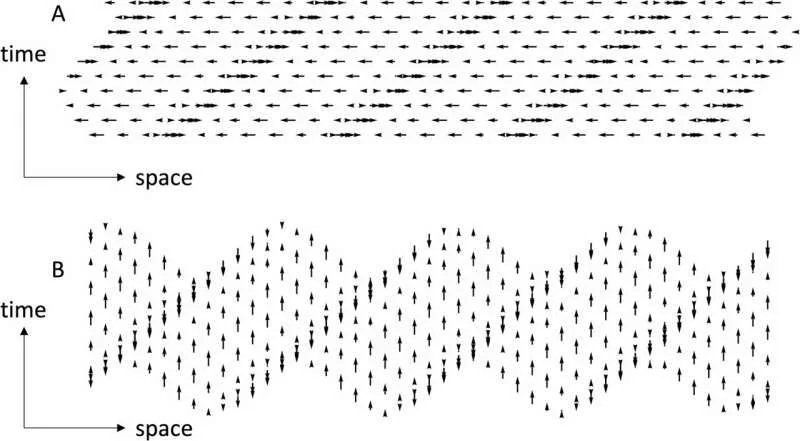
New theoretical analysis published today, May 20, 2026, indicates that the classical model of sound propagation is incomplete. While moderate sound behaves according to established longitudinal patterns—vibrating air molecules back and forth—high-intensity sound undergoes a structural metamorphosis.

Fact 1: At intensities exceeding 160 dB (the acoustic equivalent of a jet engine), sound waves lose their linear consistency.
Fact 2: Instead of maintaining a smooth wave profile, the oscillation becomes progressively distorted as volume increases.
Fact 3: Current brain-processing models struggle to map this distortion, suggesting a mismatch between physical wave behavior and neural perception.
The following table summarizes the shift in understanding regarding sound wave interaction:

| Condition | Observed Wave Behavior | Scientific Framework |
|---|---|---|
| Low/Moderate Intensity | Linear, predictable, longitudinal | Classical Acoustic Theory |
| High Intensity (>160dB) | Non-linear, geometric distortion | New Theoretical Analysis |
| Surface Interaction | Variable propagation/magnetic control | Material Science (SAWs) |
The Mechanics of Perception and Projection
The investigation into wave motion is part of a broader re-evaluation of acoustic mechanics across different media. These developments coincide with distinct findings in how physical structures—both biological and stellar—handle sound propagation.

"The brain processes wave motion very differently from ordinary movement," researchers note, challenging the prior assumption that our sensory systems perceive sound as a direct, unmodified replica of physical vibration.
This discrepancy mirrors recent discoveries in other fields:

Biological Refinement: Research from Yale University identified 'hidden modes' in the cochlea, showing the human ear employs an active reflex to cancel noise and tune surface vibrations, moving beyond simple passive reception.
Solar Helioseismology: Scientists are currently using internal sound waves to map the hidden hemisphere of the Sun, detecting magnetic polarities that were previously inaccessible to earthbound observers.
Material Manipulation: Previous studies have demonstrated that Surface Acoustic Waves (SAWs) can be steered via magnetic fields, a development central to the future of quantum communication.
Background: From Theory to Visuals
Historically, sound has been defined by simple longitudinal models. Efforts to bridge the gap between abstract physics and visual reality have relied on Cymatics—the study of visible vibrations—and spectrograms to render the invisible.
The latest findings shift the focus from merely documenting sound to understanding its intrinsic instability. By moving past the limitations of low-decibel modeling, scientists are forced to reconcile the rigid geometry of earlier theories with the chaotic, non-linear realities of high-energy acoustics. This work implies that what we perceive as "sound" is a highly curated output of both external physical distortion and internal biological filtration.
Read More: New Charge Method Changes How Chemists Work With Molecules