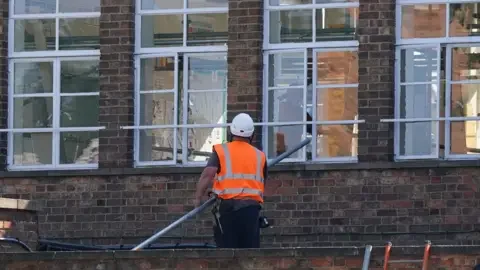
A recent wave of concern over the safety of school buildings, particularly those containing Reinforced Autoclaved Aerated Concrete (RAAC), has prompted significant government action. The material, known for its fragility, led to school closures and disruption at the start of the academic year, forcing some pupils into temporary learning spaces. In response, the Department for Education (DfE) has announced a comprehensive plan to eliminate RAAC from all schools and colleges in England by 2029, before the next general election. This initiative aims to ensure safer learning environments and is part of a broader strategy to improve the nation's school estate.
Context of RAAC in Schools
The presence of RAAC in educational facilities became a prominent issue following a period of widespread concern and subsequent inspections. RAAC is a lightweight concrete composed of cement, lime, water, and an aeration agent, commonly used in roof slabs, floors, and walls between the 1950s and 1990s. Its structural integrity has since been called into question, with reports indicating it can become brittle and prone to failure over time, especially when exposed to moisture.
Read More: Schools Watch Student Devices, Raising Privacy Worries

Triggering Events: Just before the start of the recent school year, dozens of schools were compelled to close partially or entirely due to RAAC in their structures. This sudden action necessitated immediate, often temporary, solutions for affected students.
Disruption: The closures resulted in pupils being relocated to marquees or modular buildings for lessons and break times. Some schools also faced delays in term starts or resorted to remote learning arrangements.
Government Response: The Department for Education (DfE) has been actively working on a strategy to address the RAAC issue. This includes setting clear timelines for removal and integrating the remediation efforts into wider school building improvement programs.
Government's RAAC Removal Plan
The DfE has established a definitive timetable for the complete removal of RAAC from all schools and colleges across England. This commitment is tied to the timeframe of the next general election, aiming for a RAAC-free school estate by 2029.
Read More: Thomas Partey Denies Rape and Sexual Assault Charges
Timeline: The target is to have all classrooms free of RAAC by the end of the current parliamentary term.
Scope: The plan covers all 22,000+ schools and colleges in England.
Progress to Date: As of recent reports, RAAC has been permanently removed from 62 schools and colleges. An additional 123 schools are slated for rebuilding or major refurbishment through the DfE's School Rebuilding Programme.
Funding and Grants: While schools within the School Rebuilding Programme will have RAAC addressed as part of their larger projects, 108 schools and colleges are receiving specific government grants for RAAC removal, with works managed by their respective responsible bodies.
Pupil Impact: The government asserts that over 42,000 pupils are already learning in classrooms confirmed to be RAAC-free. The DfE states that, even with RAAC present at some sites, all 237 affected locations are currently providing full-time, in-person education.
Inclusion and Broader Building Improvements
The initiative to address RAAC is being framed within a larger context of improving school infrastructure and ensuring equitable access to education.
Read More: Education Helps People and Countries Get Richer

Special Educational Needs and Disabilities (SEND): A report from a parliamentary committee highlights that efforts to fix school buildings should actively incorporate measures to make them more inclusive for children with SEND.
Mainstream School Support: The government intends to enhance SEND support within mainstream schools, aligning with anticipated reforms detailed in forthcoming white papers.
Information Gaps: While progress has been acknowledged, MPs have pointed out that gaps remain in the available data concerning the wider condition of school buildings across England.
Parliamentary Oversight and Scrutiny
A committee of Members of Parliament (MPs) has been reviewing the government's approach to managing RAAC in schools. Their findings suggest that while the government has made headway, a more complete picture of the school estate's condition is still needed.
Acknowledged Progress: The committee's report recognizes the important progress made by the government in addressing the RAAC issue.
Information Deficiencies: However, the report also signals that gaps persist in the information held by the government regarding the overall condition of schools in England, particularly concerning RAAC.
Expert Analysis and Public Reaction
The RAAC crisis has brought to light the broader challenges associated with aging school infrastructure. The government's commitment to a 2029 deadline signifies a serious effort to rectify these issues.
Read More: New Files Show Sarah Ferguson and Prince Andrew Stayed Friends with Epstein
Broader Policy Context: The RAAC removal program is presented as an integral part of the government's wider strategy for school building policy, building on previous investments aimed at tackling aging and poorly conditioned estates.
Public Concern: The initial closures and disruptions led to public concern and highlighted the critical need for robust building safety standards in educational institutions.
Conclusion and Implications
The government's pledge to remove RAAC from all schools and colleges by 2029 represents a significant undertaking aimed at enhancing the safety and quality of the educational environment in England. The plan involves a multi-pronged approach, including direct removal, integration into rebuilding programs, and specific grant allocations.
Clear Commitment: The establishment of a firm deadline before the next general election provides accountability for the DfE.
Ongoing Challenges: Despite stated progress, the need for comprehensive data on the entire school estate suggests that continuous monitoring and adaptation of the plan may be necessary.
Focus on Inclusivity: The integration of SEND considerations into building improvement plans reflects a growing understanding of the multifaceted needs of the student population.
Future Steps: The government will need to maintain momentum with the removal program, ensure timely delivery of projects within the School Rebuilding Programme, and address any remaining information gaps to fully secure the school estate against the risks posed by RAAC.
Sources
BBC News: "New plan to fix 'ageing and fragile' schools exposed by Raac crisis"
Published: 9 hours ago
Context: This article provides an overview of a parliamentary committee's report on school building safety, focusing on RAAC and the need for inclusive designs for SEND students.
New Civil Engineer: "DfE promises to remove all RAAC from classrooms by next General Election in 2029"
Published: October 28, 2025
Context: This report details the Department for Education's timeline for RAAC removal, confirming the 2029 deadline and its place within the government's broader school building strategy.
GOV.UK: "Education Secretary sets timeline for RAAC removal in schools"
Published: October 28, 2025
Link: https://www.gov.uk/government/news/education-secretary-sets-timeline-for-raac-removal-in-schools
Context: This is an official government press release announcing the timeline and commitment to removing RAAC from all schools and colleges by the next general election, also noting progress made.
Open Access Government: "Education Secretary sets timeline to remove RAAC from all schools"
Published: October 28, 2025
Context: This article reiterates the government's plan and timeline for RAAC removal, emphasizing the commitment to safer classrooms and detailing figures on progress and affected schools.
LBC: "All schools with 'crumbly concrete' to have RAAC removed before end of Parliament, ministers announced"
Published: October 28, 2025
Context: This news report covers the ministerial announcement regarding the removal of RAAC from schools by the end of the parliamentary term, referencing the disruption caused by the material and the progress in its removal.
Read More: New School Opens in City Center