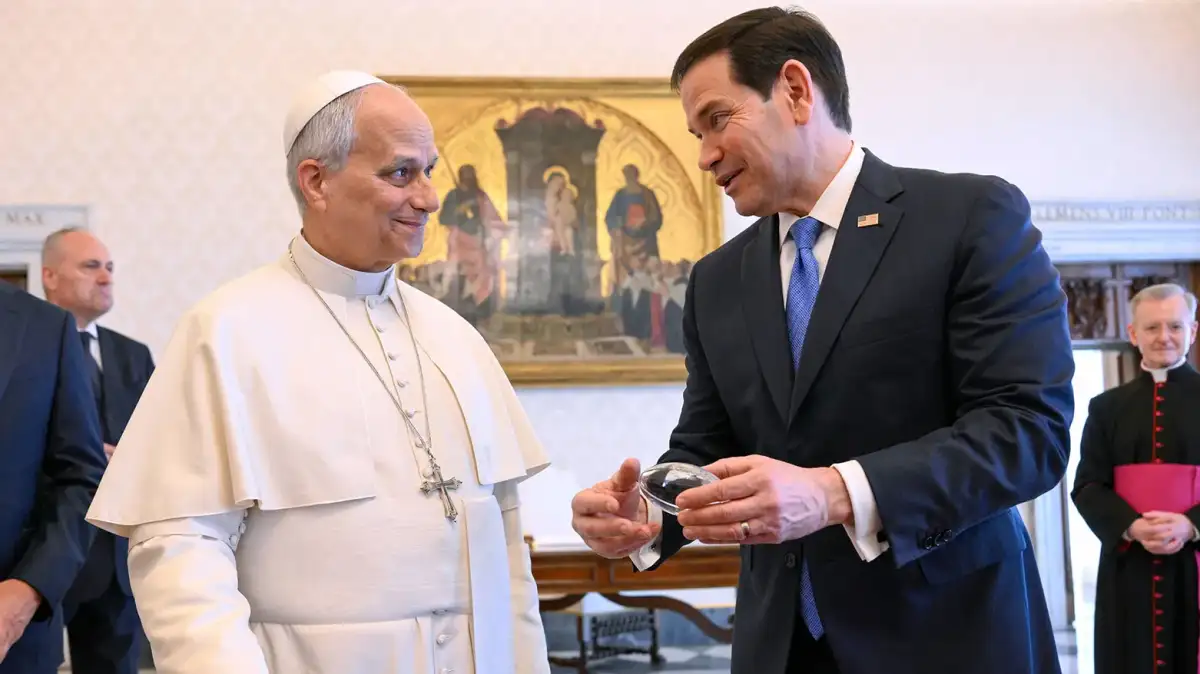
U.S. Secretary of State Marco Rubio concluded a two-day visit to Rome, aiming to smooth over significant rifts between the United States and Italy. The core of the discord revolves around the protracted US-Israeli war against Iran, Italy's refusal to actively participate, and the resulting fallout from President Donald Trump's pointed criticisms directed at both Italian Prime Minister Giorgia Meloni and Pope Leo XIV.
Rubio's meetings with Meloni and Foreign Minister Antonio Tajani were framed as efforts to "ease tensions" and "mend fences," with Italy articulating a clear stance on its strategic partnership with the U.S. while resisting Washington's pressure regarding the Iran conflict.
During his visit, Rubio engaged in approximately 90 minutes of "frank" talks with Meloni at her Palazzo Chigi office. He also conferred with Tajani, who stressed the fundamental importance of "Western unity" and conveyed Italy's view that Europe requires America, and vice versa. Tajani reportedly reiterated Italy's support for the presence of U.S. troops in Europe to bolster NATO, a veiled reference to Trump's past threats of troop withdrawals.
Read More: Virginia Supreme Court voids redistricting map on August 5 2026
Diplomatic Maneuvers and Underlying Strains
Rubio's agenda in Rome also included discussions on global conflicts, with reports indicating that he met with Pope Leo XIV at the Vatican. This meeting, occurring roughly a year after the Pope's election, touched upon international conflicts and contrasted Trump's assertive stance on Iran's nuclear ambitions with the Pope's persistent advocacy for peace and nuclear disarmament.
The timing of Rubio's visit and the nature of the discussions underscore a period of strain in transatlantic relations. Trump's vocal opposition to the Pope's anti-war stance, coupled with his criticisms of Meloni for defending the pontiff, have fueled weeks of sharp disagreements over trade, defense cooperation, and the escalating conflict in the Middle East.
While official statements from the U.S. Department of State regarding Rubio's meeting with Meloni were technically coded as "statistical purposes," the broader context reveals a diplomatic effort to manage these burgeoning frictions. Italy, navigating U.S. pressure and domestic concerns, has maintained a position of non-involvement in the direct military action against Iran, a move that has clearly generated friction with the current U.S. administration.
Read More: Rubio: NATO needs allies' bases for US operations
Historical Context and Shifting Alliances
Historically, Meloni has been perceived as a close ideological ally of Donald Trump among major European leaders during his second term. However, the current political climate, marked by Trump's confrontational rhetoric and the escalating Middle East war, has tested this alignment. The seizure of the Strait of Hormuz by Tehran following U.S. and Israeli military actions on February 28th has further intensified the geopolitical landscape, impacting global energy and trade routes and exacerbating existing tensions between the allies.
Rubio's outreach to Italy also comes against a backdrop of broader transatlantic concerns, including NATO spending and trade tariffs, issues that have consistently marked the Trump administration's foreign policy approach. Italy's engagement with Rubio signals an attempt to preserve its strategic partnership with the U.S. amidst these multifaceted challenges.